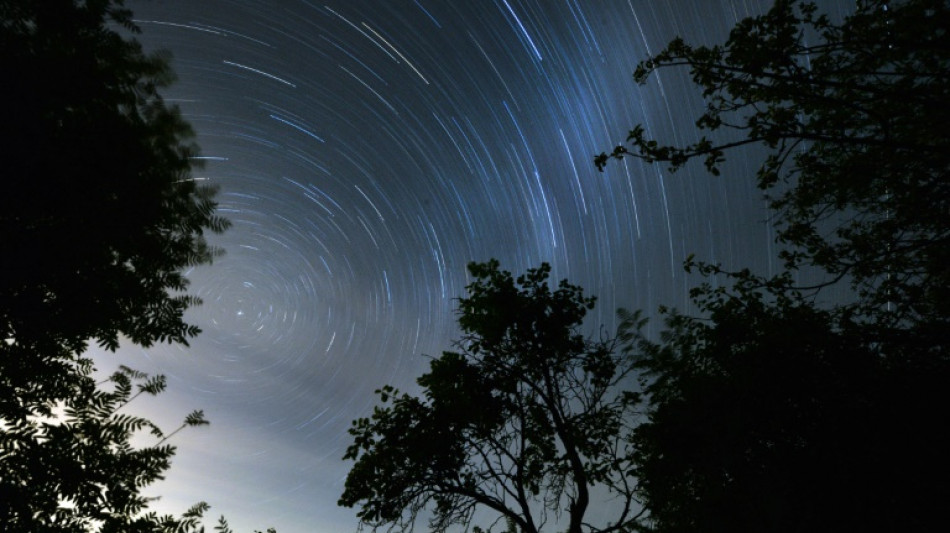
Huge star explosion to appear in sky in once-in-a-lifetime event / Photo: VYACHESLAV OSELEDKO - AFP/File

 Rubio launches Latin America tour to cement US influence

 France tries 14 over deadliest Channel migrant crossing disaster

 Australia threatens hefty fines if big tech fails 'duty of care'

 Zverev romps into quarter-finals as Darderi downed

 Kauai on tornado watch as Hurricane Lowell nears Hawaiian islands

 Pakistan roll the dice in search of consolation win over England

 Yen extends gains as traders eye rate hike, tech rallies again

 'The ber months': Christmas arrives early in the Philippines

 N. Korea calls Russia bridge a sign of tighter ties

 US sanctions threaten to crush Iranian students' dreams

 Former champ Gauff holds off Jovic to reach US Open quarter-finals

 Guardian Metal Resources PLC Announces Admission to FTSE AIM 50 Index

 InterContinental Hotels Group PLC Announces Transaction in Own Shares - September 08

 Osaka seeks answers to nagging achilles injury after US Open exit

 Flight data recorders recovered from Amazon cargo plane crash

 Super Bowl rematch kicks off NFL season as league expands global reach

 Alcaraz faces Shelton in blockbuster US Open quarter-final

 Trump threatens sales in US of Canadian aircraft maker Bombardier

 Eiffel Tower closed in row over women removed for Hindu group

 Willemse replaces Kolbe for Springboks' All Blacks series decider

 Zheng shocks Swiatek in another incredible US Open comeback

 Andreeva survives in three sets against Potapova

 Alleged killers of Australian, US surfers go on trial in Mexico

 King Charles classes Harry and Meghan as 'private citizens'

 Bowling coach Noffke says Pakistan's off-field issues are nothing new

Sometime between now and September, a massive explosion 3,000 light years from Earth will flare up in the night sky, giving amateur astronomers a once-in-a-lifetime chance to witness this space oddity.
The binary star system in the constellation Corona Borealis -- "northern crown" -- is normally too dim to see with the naked eye.
But every 80 years or so, exchanges between its two stars, which are locked in a deadly embrace, spark a runaway nuclear explosion.
The light from the blast travels through the cosmos and makes it appear as if a new star -- as bright as the North Star, according to NASA -- has suddenly just popped up in our night sky for a few days.
It will be at least the third time that humans have witnessed this event, which was first discovered by Irish polymath John Birmingham in 1866, then reappeared in 1946.
The appropriately named Sumner Starrfield, an astronomer at Arizona State University, told AFP he was very excited to see the nova's "outburst".
After all, he has worked on T Coronae Borealis -- also known as the "Blaze Star" -- on and off since the 1960s.
Starrfield is currently rushing to finish a scientific paper predicting what astronomers will find out about the recurring nova whenever it shows up in the next five months.
"I could be today... but I hope it's not," he said with a laugh.
- The white dwarf and red giant -
There are only around 10 recurring novas in the Milky Way and surrounding galaxies, Starrfield explained.
Normal novas explode "maybe every 100,000 years," he said. But recurrent novas repeat their outbursts on a human timeline because of a peculiar relationship between their two stars.
One is a cool dying star called a red giant, which has burnt through its hydrogen and has hugely expanded -- a fate that is awaiting our own Sun in around five billion years.
The other is a white dwarf, a later stage in the death of a star, after all the atmosphere has blown away and only the incredibly dense core remains.
Their size disparity is so huge that it takes T Coronae Borealis's white dwarf 227 days to orbit its red giant, Starrfield said.
The two are so close that matter being ejected by the red giant collects near the surface of the white dwarf.
Once the mass roughly of Earth has built up on the white dwarf -- which takes around 80 years -- it heats up enough to kickstart a runaway thermonuclear reaction, Starrfield said.
This ends up in a "big explosion and within a few seconds the temperature goes up 100-200 million degrees" Celsius, said Joachim Krautter, a retired German astronomer who has studied the nova.
The James Webb space telescope will be just one of the many eyes that turn towards the outburst of T Coronae Borealis once it begins, Krautter told AFP.
But you do not need such advanced technology to witness this rare event -- whenever it may happen.
"You simply have to go out and look in the direction of the Corona Borealis," Krautter said.
Some lucky sky gazers are already preparing for the year's biggest astronomic event on Monday, when a rare total solar eclipse will occur across a strip of the United States.
O.Ortiz--AT