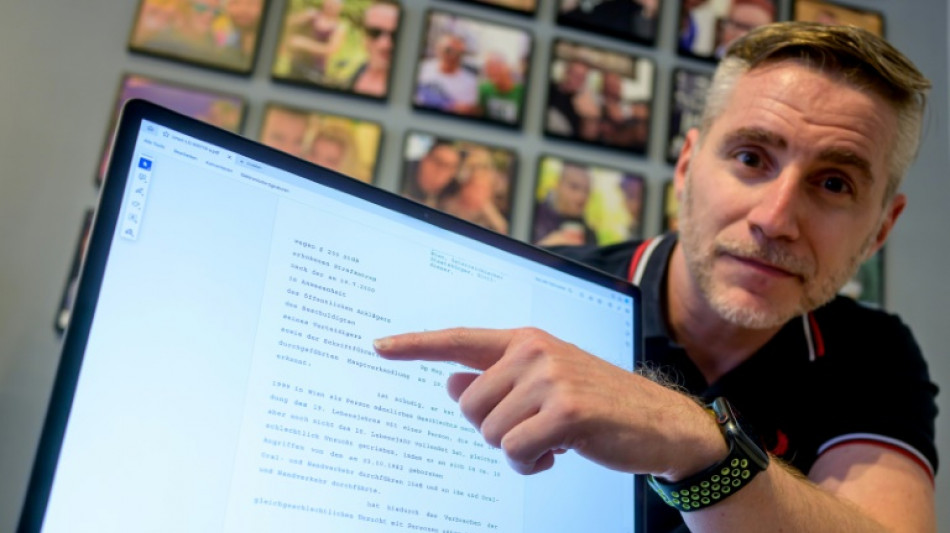
'Reopening wounds': Austria compensates victims of anti-gay laws / Photo: Joe Klamar - AFP

 Forex Expo Dubai to Take Place as Scheduled on 22–23 September 2026

 Russia pounds Kyiv, ending three-day halt for US talks

 Flights resume gradually in Indonesia after volcanic eruption
 French AI firm Mistral valued at 21 bn euros after latest funding
 Sweden heads to the polls in close election race
 Australia's Big Bash T20 teams face sale to private investors

 Russia resumes strikes on Kyiv after three-day halt

 Canada's counter-tariffs take effect on various US goods

 China's trade booms as focus turns to expected Trump-Xi summit

 Is Champions League three-peat really possible for PSG?
 Russia pummels Kyiv after three-day halt
 Mongolians wait hours for fuel as reliance on Russia bites

 Blockx first Belgian man to reach US Open quarter-finals
 Praying for rain as fires, haze plague Indonesian Borneo

 Rybakina tops Osaka, sets US Open quarter-final clash with Zheng

 Apex Expands Trinity Zone with Step-out Hole Returning 197.5 m Interval of 2.12% REO at the Rift Rare Earth Project in SE Nebraska
 BioNxt Advances Sublingual Everolimus ODF for Organ Transplant Rejection with Initiation of Large-Animal Pharmacokinetic Study
 Genflow Biosciences PLC Announces Primary Endpoint in SLAB Clinical Trial Met

 Gaming Realms PLC Announces Interim Results

 Panama Canal considering more cuts in transits due to El Nino

 Maresca agrees with Haaland that players started season jaded

 Hurricane warning issued for westernmost Hawaiian islands

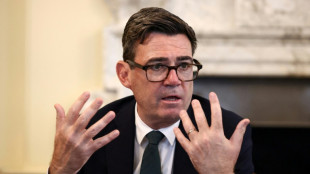 UK PM denounces 'politics of poison' after anti-migrant protests

 Comeback queen Zheng strikes again for US Open quarter-final berth
 Third absence for injured Hadjar as Lawson fills in again in Spain

Austrian consultant Michael Woditschka well remembers the fateful day when he was summoned by police over his relationship with a teenage boy and subsequently convicted in court.
The 44-year-old is one of about 11,000 gay people who until two decades ago faced prosecution in Austria but are, since February, now eligible for financial compensation.
Even though Austria decriminalised homosexuality in 1971, certain discriminatory provisions remained in force until the early 2000s.
Woditschka says he will accept the money offered as compensation to him by the Austrian state, which has officially apologised for convicting him of homosexuality in 1999.
But the compensation "won't erase what happened", he told AFP, recalling the humiliation he endured as a 19-year-old.
"I was searching for my own identity and all of a sudden I found myself being treated like a sex offender at the police station, forced to describe my sex life in full detail," said Woditschka.
Woditschka was on a list of acquaintances his former partner, then 16, had to provide to authorities after being arrested for having sex in a car with another man.
After a humiliating court hearing, which forced him to disclose every detail of their relationship and was closely watched by the press, Woditschka was fined for "same-sex fornication with a minor".
"The whole of Austria suddenly knew that I was gay -- when, with whom and how," he said.
- 'Social death' -
Under Adolf Hitler's Nazi rule, Austria as part of the German Third Reich had persecuted homosexuals to death.
Despite the decriminalisation of homosexuality in the early 1970s, thousands of gays and bisexuals continued to be convicted under newly-introduced sections of Austria's penal code.
A ban on male homosexual prostitution remained in place until 1989 although heterosexual prostitution was legal.
Until 2002, the age of consent for sexual contact between men was 18 -- compared to 14 for heterosexuals.
"Even if you were handed a suspended sentence, you were usually remanded in custody and then everyone knew," explained Andreas Brunner, 62, an expert on LGBTQ history and co-director of the QWIEN archive centre.
"For many it was a social death," Brunner said.
Convictions were registered on people's criminal records, in turn triggering a ban on certain professions.
The ruling conservative party did not amend the legislation, even though it was contrary to European law, Brunner said.
Instead, the party argued, with the support of the Catholic Church, that it was necessary to "protect young men from homosexuals", he explained.
A decision by the European Court of Human Rights in 2002 obliged the Austrian government to end the years of discrimination.
Since then, Austria's highest court has ruled on several cases of discrimination against sexual and gender minorities.
In 2019 it allowed same-sex couples to marry and adopt children.
- 'Reopening wounds' -
When she outlined the compensation programme set up last year, Justice Minister Alma Zadic said it was of "immense importance that we... finally take responsibility for this part of our history".
In 2017, the German parliament voted to quash the convictions of 50,000 gay men sentenced for homosexuality under a Nazi-era law which remained in force after the war, and to offer compensation.
Earlier this month, French lawmakers approved a bill to compensate LGBTQ people convicted under discriminatory laws between 1942 and 1982.
Austria has now set up a compensation fund of 33 million euros ($35 million).
Since February, LGBTQ people who were investigated under the now-repealed laws are eligible to receive 500 euros.
Those who were convicted will have their convictions quashed.
They will be compensated to the tune of 3,000 euros -- or more if they suffered health, economic or professional woes as a result.
Woditschka said he welcomes the initiative but it was "insufficient".
"Some people have lost everything," he said.
He said he would have appreciated it more if the authorities had "written to us directly" instead of asking those affected "to provide evidence ourselves" first.
"Many people will say that it's not worth reopening the wounds" for what is considered to be just a tiny amount of money, he said.
K.Hill--AT