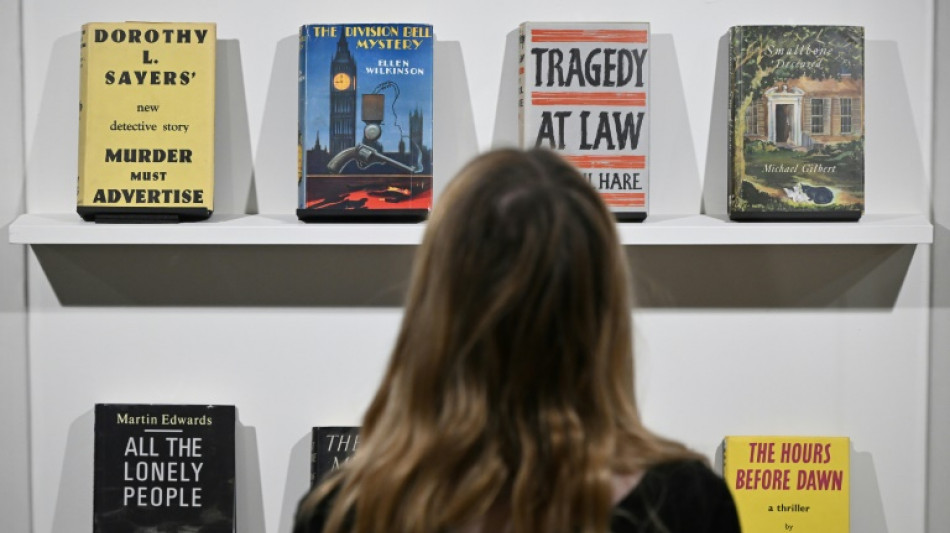
Christie's Poirot farewell unveiled at 'dark' crime exhibition / Photo: Justin TALLIS - AFP

 Forex Expo Dubai to Take Place as Scheduled on 22–23 September 2026

 Russia pounds Kyiv, ending three-day halt for US talks

 Flights resume gradually in Indonesia after volcanic eruption

 French AI firm Mistral valued at 21 bn euros after latest funding

 Sweden heads to the polls in close election race

 Australia's Big Bash T20 teams face sale to private investors

 Russia resumes strikes on Kyiv after three-day halt

 Canada's counter-tariffs take effect on various US goods

 China's trade booms as focus turns to expected Trump-Xi summit

 Is Champions League three-peat really possible for PSG?

 Russia pummels Kyiv after three-day halt

 Mongolians wait hours for fuel as reliance on Russia bites

 Blockx first Belgian man to reach US Open quarter-finals

 Praying for rain as fires, haze plague Indonesian Borneo

 Rybakina tops Osaka, sets US Open quarter-final clash with Zheng

 Apex Expands Trinity Zone with Step-out Hole Returning 197.5 m Interval of 2.12% REO at the Rift Rare Earth Project in SE Nebraska
 BioNxt Advances Sublingual Everolimus ODF for Organ Transplant Rejection with Initiation of Large-Animal Pharmacokinetic Study
 Genflow Biosciences PLC Announces Primary Endpoint in SLAB Clinical Trial Met

 Gaming Realms PLC Announces Interim Results

 Panama Canal considering more cuts in transits due to El Nino

 Maresca agrees with Haaland that players started season jaded

 Hurricane warning issued for westernmost Hawaiian islands

 UK PM denounces 'politics of poison' after anti-migrant protests

 Comeback queen Zheng strikes again for US Open quarter-final berth

 Third absence for injured Hadjar as Lawson fills in again in Spain

Agatha Christie's 1930s typewriter and the manuscript of her final Hercule Poirot novel, which was kept for decades in a bank vault, go on display Saturday in a new exhibition delving into the "dark stuff" at the heart of crime fiction.
The cover of the faded and fragile manuscript has the book's title "Curtain" written in capital letters in Christie's own hand along with her name and address -- Greenway House in Devon, southwest England -- in spidery longhand.
"She wrote it as a nest egg for her daughter Rosalind, 'something to cheer you up when you come back from the funeral'," said crime novelist Nicola Upson, curator of the "Murder by the Book" exhibition at Cambridge University Library in central England.
The last Poirot mystery, in which Christie's fabled Belgian detective dies, was written in the early 1940s during World War II in case she did not survive.
At the time "nothing was guaranteed", Upson told AFP. In fact Christie went on to write many more Poirot novels before she died in 1976.
But with the final instalment already written, fears Poirot's demise might be leaked dictated that the manuscript be kept under lock and key.
- 'Murder by the Book' -
"It's Poirot's last case and she wanted that to come out after her own death and for the royalties from it to benefit her daughter," said Upson.
Poirot's fate, when it was finally revealed in 1975, was seen as so culturally significant it was marked by a front page obituary in the New York Times.
"It ended up being published four months before her own death in January 1976 so when you read Poirot's final words in that book they do read a bit like Christie's farewell to her readers, there's a poignancy to it," Upson added.
Christie, who also wrote the Miss Marple series, is the best-selling fiction author of all time. She sold an astonishing 300 million books during her lifetime.
Nearly half a century after her death, objects such as her clunky 1950s dictaphone and portable 1937 Remington typewriter -- on which she would have written one of her most famous works "And Then There Were None" -- still have the power to fascinate.
"There is something so evocative about the first to witness all those thoughts and stories," said Upson, author of the Josephine Tey series of mysteries.
- Dark stuff -
The exhibition draws on the library's one million-strong fiction collection of first editions -- still in their original dust jackets -- by highlighting nearly 100 of the most famous, influential and best-selling crime novels in UK history.
Upson said she wanted to look not just at the "so-called cosy mysteries" but also "the dark stuff, the kind of nuts and bolts of crime fiction which is after all violence and death".
Forgotten classics also feature such as "A Pin to See the Peepshow" by F. Tennyson Jesse which was inspired by the conviction and 1923 execution of Edith Thompson and Frederick Bywaters.
In Jesse's 1934 novel, protagonist Julia Almond meets a similar fate in an ordeal described as amongst the "most horrific in all crime fiction".
The book was influential in the UK's abolition of the death penalty for murder three decades later in 1969.
As well as early fictional characters such as Miss Marple, Poirot and Arthur Conan Doyle's Sherlock Holmes, the exhibition also features more recent creations such as Lynda La Plante's Jane Tennison and Colin Dexter's Inspector Morse.
And despite changes in style over the decades Upson said the essentials of good crime writing remained the same: "Strong characters... a really realistic, atmospheric world... and a strong story with a beginning middle and end, not necessarily in that order."
"Murder by the Book" at Cambridge University Library runs until August 24.
R.Chavez--AT