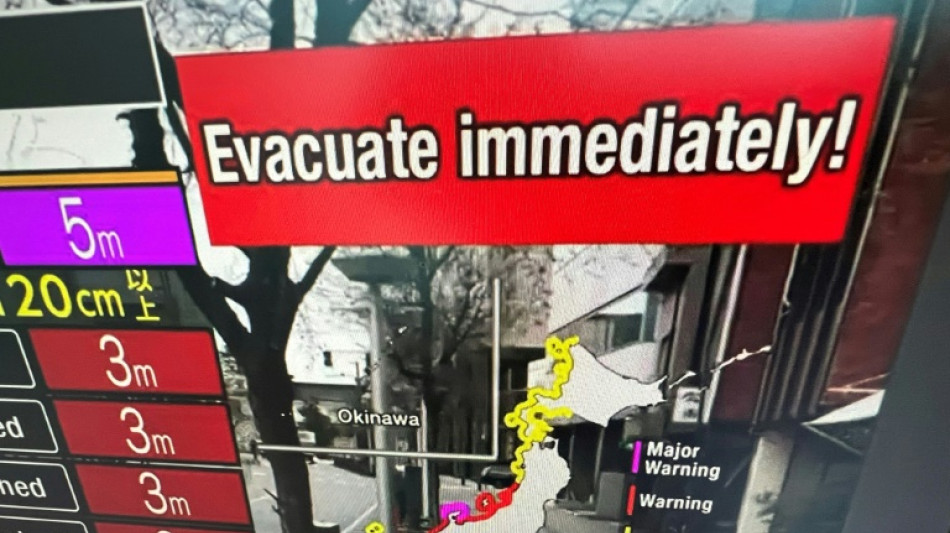
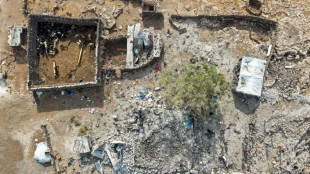
Major Japan quake triggers tsunami waves, residents told to run / Photo: Mladen ANTONOV - AFP

 Syria reopens Jordan border crossing after mending ties

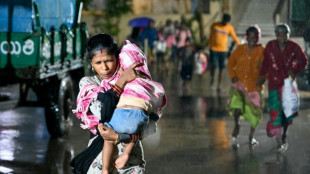 Cyclone Arnab lashes India coast, no deaths reported

 Trump tamed after US midterms? Europe doubts it

 Tech stocks soar as SK hynix adds to rising AI confidence

 Sri Lanka's Tamil farmers fight to reclaim land after civil war

 Afghans compete for jobs, homes as millions return

 'They don't care about us': Trump food aid cuts leave Americans struggling and angry

 Meta, Snap head to trial in another case about social media's harms

 French Senate passes bill to make protesters pay for unrest damage
 India evacuates tens of thousands as Cyclone Arnab makes landfall

 In tight Israel vote, both camps hold out cautious hope
 AI chip giant SK hynix says quarterly operating profit soars 630%

 Youths testify about 'despair' in unprecedented Canadian climate trial

 'A very sad day': Arteta despair as Arsenal stunned by Fleetwood
 Charles tackles thorny legacy of slavery on Caribbean trip

 Former Grand Slam winner Wawrinka ends tennis career

 Brazil's Flavio Bolsonaro flees to US after election loss

 'Faerie' nights: 'ACOTAR' fans finally get their book

 American woman convicted of getting military training from Islamic State

 Israel opposition holds narrow edge over Netanyahu in first projections

 Floriani hits maiden goal as Lazio go top
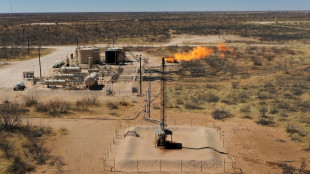 Trump set to drastically loosen oil and gas sector's methane rules

 Storied Paris department store seeks bankruptcy protection

 Xhaka, Embolo can return to Swiss squad after fake Covid docs affair

 Allegri suspended for two Serie A games after red card

Tsunami waves over a metre high hit central Japan on Monday after a series of powerful earthquakes that damaged homes, closed highways and prompted authorities to urge people to run to higher ground.
A major 7.5 magnitude earthquake struck the Noto region in Ishikawa prefecture around 4:10 pm (0710 GMT), the US Geological Survey (USGS) said. Japan's weather agency reported a succession of 21 quakes of 4.0 magnitude or stronger hitting the nation's central region in just over 90 minutes.
Tsunami waves as high as 1.2 meters (four feet) hit Wajima port in Ishikawa prefecture at 4:21 pm (0721 GMT), about 10 minutes after the strongest jolt, the Japan Meteorological Agency (JMA) said.
"All residents must evacuate immediately to higher ground," national broadcaster NHK said after the quakes.
Hazardous tsunami waves were possible within 300 kilometres (190 miles) of the quake's epicentre along the coast, on the Sea of Japan side of Japan's main island of Honshu, the Hawaii-based Pacific Tsunami Warning Center said.
But a much higher tsunami of five metres was expected to arrive in Noto in the same region, the JMA said.
The Japanese government said it was still assessing what damage had been caused and whether there had been any casualties.
Around 33,500 households around the epicentre, in Toyama, Ishikawa and Niigata prefectures, were without power, local utilities said.
Television reports showed a building on fire in Wajima city in Ishikawa and AFP journalists said houses shook in central Tokyo.
A video clip posted on social media platform X showed lines of wooden houses toppled by the quakes, with walls and roofs caved in.
"This is the Matsunami district of Noto. We are in a horrible situation. Please come and help us. My town is in a horrible situation," said a person heard in the video.
Sakhalin island and Vladivostok in Russia's far east were on "alert" due to a possible tsunami risk after the quakes in Japan, officials said.
- 'Lives above everything else' -
The JMA said the Noto region experienced a rapid succession of quakes, with another 6.2 tremor hitting soon after the initial swarm, the USGS said.
The largest of the quakes prompted broadcasters to switch to special programming and make urgent calls for affected residents to leave for higher ground.
"We realise your home, your belongings are all precious to you, but your lives are important above everything else. Run to the highest ground possible," a presenter on broadcaster NHK told viewers.
Several major highways were closed around the epicentre, Japan's road operator said, and Shinkansen bullet train services were also suspended between Tokyo and the epicentre in Noto.
Government spokesman Yoshimasa Hayashi said there were no abnormalities reported at the Shika nuclear power plant in Ishikawa or at other plants.
Japan has strict construction regulations intended to ensure buildings can withstand strong earthquakes and routinely holds emergency drills to prepare for a major jolt.
But the country is haunted by the memory of a massive 9.0-magnitude undersea quake off northeastern Japan in March 2011, which triggered a tsunami that left around 18,500 people dead or missing.
The 2011 tsunami also sent three reactors into meltdown at the Fukushima nuclear plant, causing Japan's worst post-war disaster and the most serious nuclear accident since Chernobyl.
In March 2022, a 7.4-magnitude quake off the coast of Fukushima shook large areas of eastern Japan, killing three people.
The capital Tokyo was devastated by a huge earthquake a century ago in 1923.
hih-tmo-nf-stu/sco/pbt
E.Hall--AT