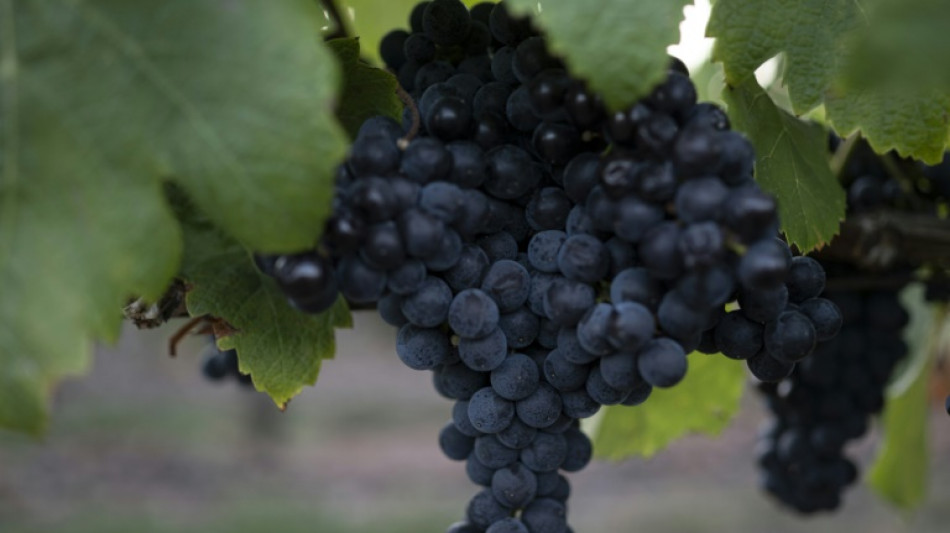
Tannat: Uruguay's 'unlikely' wine hit / Photo: Pablo PORCIUNCULA - AFP

 Myanmar says UN envoy illegitimate ahead of credentials decision

 Philippine rescuers pull more victims from charred ferry

 الأرصاد السعودية تتوقع سيولاً وأمطاراً رعدية في خمس مناطق

 Crash and burn: Pakistan cricket at a new low after England humiliation

 'Second life': Nepal tunnel survivor recalls ordeal

 Hong Kong homes flattened for US$28 bn high-tech hub

 'Be careful what you wish for': 'Obsession' director and star reflect on success

 Messi scores but Miami held by Nashville

 US Open champ Rybakina on top of world after injury scare

 Rybakina reigns serene as new world number one

 Defiant Sabalenka motivated by US Open defeat

 Houthis say hit Saudi base after renewed fighting with Yemeni govt forces

 Christa Pike seeks clemency before September 30 execution in Tennessee

 Japanese floating parking platform is designed to lift cars above floodwater

 Anthropic details Claude misuse as US targets major illicit online marketplace

 Fifth Circuit upholds dismissal of Jackson residents' constitutional water claims

 Winston County trash-debt prosecutions face challenge from civil-rights lawyers

 Marmot research gains over $140,000 from meme-coin fees alongside wildlife contest

 Queens residents seek renewed enforcement along Roosevelt Avenue

 Louisiana's developing roster faces USC as Trojans enter as heavy favorites

 Akron fan's honorary play-calling stint ends with opening-drive fumble

 Maryland groups seek statewide data center pause after local moratoriums spread

 Attissogbe double inspires Pau to Top 14 summit

 Guimaraes strike lights up Arsenal win over Sunderland

 Israeli-made Gaza documentary wins Venice special jury prize

More than 10,000 kilometres (6,000 miles) from its origins in France, a red grape with a reputation for harshness has produced an unlikely hit that thrust the small South American country of Uruguay onto the global wine map.
In a land of gauchos and open-flame grilling, Tannat found a perfect host in Uruguay's mild, humid climate and carnivorous inhabitants.
With more seeds than other grapes, blue-black Tannat is high in astringent tannins -- a dominant characteristic that gave it its name and was long considered undesirable.
But it turned out to be the perfect tipple to cut through a fatty steak -- of which Uruguayans eat more per capita than almost any other nation.
Tannat "marries very well with meat," enologist Eduardo Boido of the Bouza winery in Montevideo told AFP.
"You eat the meat and you take a sip of Tannat to cleanse the palate, you eat again..." he explained among the recently-harvested vines.
Now Uruguay's national grape, Tannat is originally from the southwest of France, where it has grown for centuries.
- From rustic to renowned -
In the 1870s, it was brought to Uruguay, then still a relatively new wine country, by the French Basque Pascual Harriague.
"For a long time, Tannat was known as Harriague (after its Basque father) and generally those were somewhat rustic wines," Nicolas Cappellini, owner of the Montevideo Wine Experience, a wine bar, told AFP.
"Our grandparents and our parents drank those types of Tannat."
It was only in about the 1980s that the focus shifted to fine wine.
Today, the country makes a wide variety of styles, in different price ranges, and its Tannats frequently rank among the best in the world.
"Over 150 years of making Tannat, producers in Uruguay have learnt how to manage the naturally high tannin level of the grape," states the Uruguay Wine website.
"Uruguay... made a champion of the unlikely variety of Tannat."
Almost a third of the world's Tannat wine is produced in Uruguay -- a country of 3.5 million people that is smaller than the state of Washington.
This placed it "second only to France" with 45 percent, said Kym Anderson of the Wine Economics Research Centre at the University of Adelaide.
Argentina follows with 15 percent and the United States with four percent, according to a global database compiled by the university.
- 'Punches above its weight' -
Uruguay's 1,200-odd vineyards -- mostly small and family-owned -- lie between the 30th and 35th parallels south -- the same as major wine producers Chile, Argentina, South Africa, New Zealand and Australia.
They are located within a few kilometers of the River Plate or the Atlantic Ocean, cooled by a maritime breeze year round.
It is the humidity, said Boido, that makes the tannins in Uruguay's Tannat "much more delicate than in other regions."
"What marks out Uruguayan Tannat in particular is its freshness, which is down to the climate," added London-based Master of Wine Julia Harding.
Uruguay's wine exports are dwarfed by beef, milk and soy beans, "but it still punches above its weight," Master of Wine Tim Atkin wrote in his 2021 Uruguay Special Report.
The country exported some 4.8 million bottles of wine, mainly red, worth $18.5 million in 2022, data from the INAVI viticultural institute shows.
Tannat, said INAVI spokeswoman Karina Spremolla, was the "most exported varietal."
- 'A bit strong' -
Uruguay had 1,575 hectares of Tannat vines in 2022, less than France's 2,733 hectares in 2019, according to that country's South West Vineyards website.
The big difference lies in the share: in France, Tannat accounts for less than one percent of total plantation, in Uruguay it is by far the biggest at 27 percent.
Another distinction: "In Uruguay, the Tannat grape is mostly used for the production of monovarietal wines," INAVI technical advisor Eduardo Felix told AFP.
Although this is changing, "in other regions of the world it is used to design high-end blends."
Cappellini said most of the Tannat sold at the bar is "without a doubt" to foreigners keen to try the flagship varietal.
Uruguayans, ironically, have a perception of Tannat as a wine "that is a bit strong, rustic," he told AFP.
Retired American Bob Mayes, 72, finds Tannat, a relatively new varietal for him, to be "very tasty. I drink quite a bit of it," he told AFP -- though not with fish.
A good thing then that traditionally-made Tannat is the "healthiest of wines", according to Roger Corder, a researcher who co-authored a 2006 study in the journal Nature.
Tannat contains high levels of polyphenols -- compounds with antioxidant properties believed to boost brain health and protect against heart disease.
Uruguay marks Tannat Day on April 14, the day Harriague passed away in 1894.
K.Hill--AT