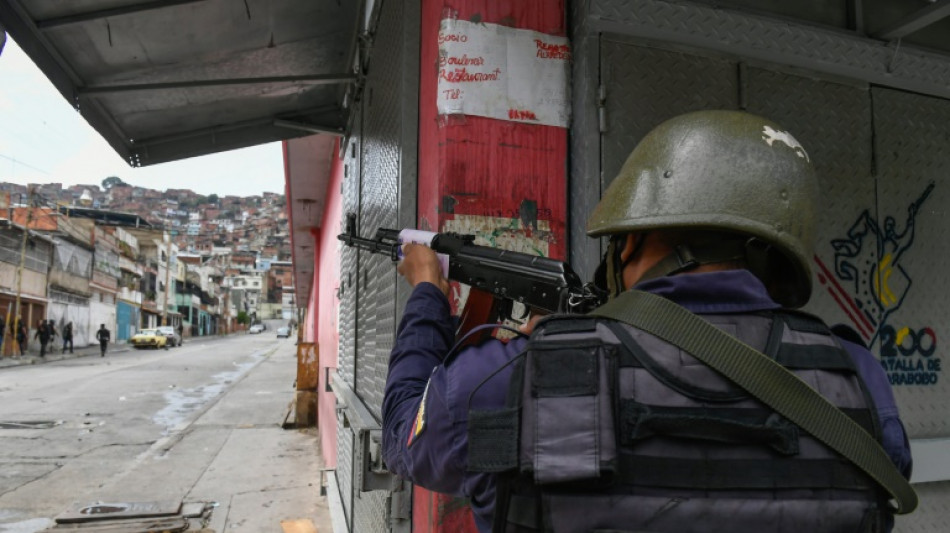
'Aragua train': Venezuela's fearsome crime syndicate exposed in book / Photo: Federico PARRA - AFP

 Myanmar says UN envoy illegitimate ahead of credentials decision

 Philippine rescuers pull more victims from charred ferry

 الأرصاد السعودية تتوقع سيولاً وأمطاراً رعدية في خمس مناطق

 Crash and burn: Pakistan cricket at a new low after England humiliation
 'Second life': Nepal tunnel survivor recalls ordeal

 Hong Kong homes flattened for US$28 bn high-tech hub
 'Be careful what you wish for': 'Obsession' director and star reflect on success

 Messi scores but Miami held by Nashville
 US Open champ Rybakina on top of world after injury scare

 Rybakina reigns serene as new world number one

 Defiant Sabalenka motivated by US Open defeat

 Houthis say hit Saudi base after renewed fighting with Yemeni govt forces

 Christa Pike seeks clemency before September 30 execution in Tennessee

 Japanese floating parking platform is designed to lift cars above floodwater

 Anthropic details Claude misuse as US targets major illicit online marketplace

 Fifth Circuit upholds dismissal of Jackson residents' constitutional water claims

 Winston County trash-debt prosecutions face challenge from civil-rights lawyers

 Marmot research gains over $140,000 from meme-coin fees alongside wildlife contest

 Queens residents seek renewed enforcement along Roosevelt Avenue

 Louisiana's developing roster faces USC as Trojans enter as heavy favorites

 Akron fan's honorary play-calling stint ends with opening-drive fumble

 Maryland groups seek statewide data center pause after local moratoriums spread

 Attissogbe double inspires Pau to Top 14 summit

 Guimaraes strike lights up Arsenal win over Sunderland

 Israeli-made Gaza documentary wins Venice special jury prize

Extortion, prostitution, murder, drug trafficking, people smuggling: Venezuela's "Tren de Aragua" went from gang to multinational syndicate in a matter of years -- a rise that journalist Ronna Risquez documented in a new book endangering her life.
The gang, which emerged in Tocoron prison in the northern state of Aragua in 2014, today boasts a force of some 5,000 men, according to the reporter who spent three years investigating the subject.
The prison today is in the hands of the gang; police relegated to the outside, she says.
"On the inside, the men I saw with firearms were prisoners who belong to the organization," Risquez told AFP in Caracas. "The National Guard is outside, at the entrance."
The prison might as well be a resort hotel for gang leaders. It boasts not just a pool but also a zoo, a betting room, a bank, a baseball field and even a nightclub called "Tokio", where artists perform and invited celebrities visit.
The gang cover the overheads, Risquez said, by extorting millions.
Each prisoner pays a fee of about 15 dollars a week -- that is 3.5 million dollars a year, she explained.
Anyone who fails to pay are forced to sleep outdoors and given little or nothing to eat.
Finances are managed by gang leader Hector Guerrero Flores, known as "Nino Guerrero" (Kid Warrior), according to the author.
Serving a 17-year sentence for murder and drug trafficking, among other crimes, Guerrero appears to come and go as he pleases -- sometimes enjoying Venezuelan beaches on a yacht, Risquez's investigation found.
The prison serves as his base, where he is protected by an army of inmates on his payroll.
- Now beyond borders -
The "Aragua Train" gang at first engaged in "classic" mafia activities: kidnappings, robberies, drugs, prostitution and extortion before graduating to illegal gold mining in a country with some of the largest deposits in the world, Risquez said.
Its tentacles, which also extend to legal businesses, stretch to the remote town of Las Claritas, in the mining state of Bolivar in Venezuela's southeast, where it controls everything from shops to health services.
The gang has also taken advantage of Venezuela's unprecedented economic and emigration crisis to put down roots in at least eight other Latin American countries, the author says.
"Among the seven million Venezuelans who left the country, there are members of criminal groups who no longer had anyone left to kidnap, rob... The gang identified a criminal business opportunity in this emigration," she explained.
The "Aragua Train" gang jumped right in with Latin America's human traffickers known as coyotes and manages prostitution networks with Venezuelans in Peru, Ecuador and Chile.
On emigration routes, it attracts new members in precarious situations and with few alternatives, said Risquez.
In Brazil, the gang entered into an "alliance with the main armed group, the PCC" -- the First Command of the Capital, a group originally from Sao Paulo also born in a prison -- around arms sales and prostitution, she added.
"It is impossible to read the book without wondering how the development of such a criminal organization is possible without the complicity of the Venezuelan State," publisher Sergio Dabhar states on the cover of the book he was forced to print in secret.
Dabhar is in negotiations for the translation of the work into other languages.
"The book presents different risks for the author," said Luis Moreno Ocampo, former prosecutor of the International Criminal Court in the Hague -- urging that her sacrifice not be ignored.
"Our challenge is to turn this book into a lever for change," he stressed.
Risquez has received several death threats since the work's release last week.
S.Jackson--AT