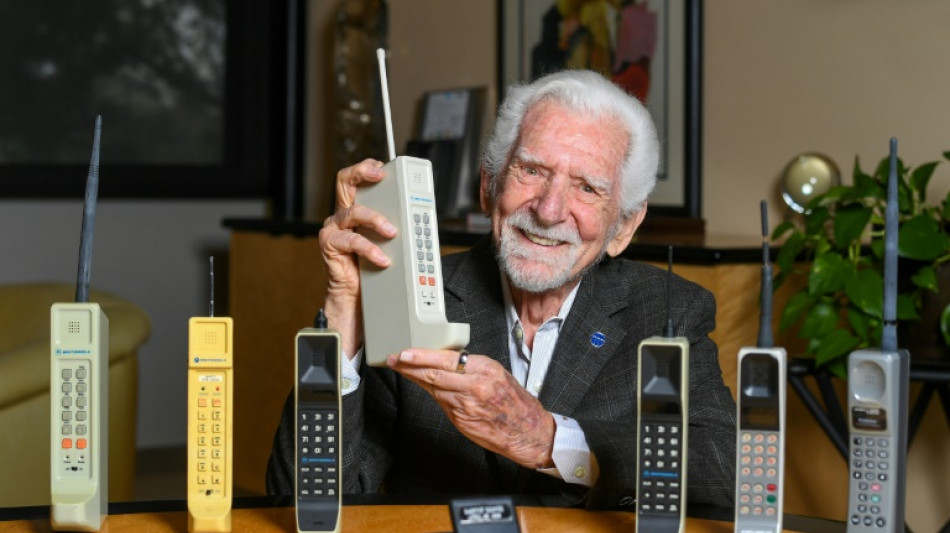
Take your eyes off your mobile phone, says inventor, 50 years on / Photo: VALERIE MACON - AFP

 Myanmar says UN envoy illegitimate ahead of credentials decision

 Philippine rescuers pull more victims from charred ferry

 الأرصاد السعودية تتوقع سيولاً وأمطاراً رعدية في خمس مناطق

 Crash and burn: Pakistan cricket at a new low after England humiliation
 'Second life': Nepal tunnel survivor recalls ordeal

 Hong Kong homes flattened for US$28 bn high-tech hub
 'Be careful what you wish for': 'Obsession' director and star reflect on success
 Messi scores but Miami held by Nashville

 US Open champ Rybakina on top of world after injury scare

 Rybakina reigns serene as new world number one

 Defiant Sabalenka motivated by US Open defeat

 Houthis say hit Saudi base after renewed fighting with Yemeni govt forces

 Christa Pike seeks clemency before September 30 execution in Tennessee

 Japanese floating parking platform is designed to lift cars above floodwater
 Anthropic details Claude misuse as US targets major illicit online marketplace
 Fifth Circuit upholds dismissal of Jackson residents' constitutional water claims
 Winston County trash-debt prosecutions face challenge from civil-rights lawyers

 Marmot research gains over $140,000 from meme-coin fees alongside wildlife contest

 Queens residents seek renewed enforcement along Roosevelt Avenue

 Louisiana's developing roster faces USC as Trojans enter as heavy favorites

 Akron fan's honorary play-calling stint ends with opening-drive fumble
 Maryland groups seek statewide data center pause after local moratoriums spread

 Attissogbe double inspires Pau to Top 14 summit

 Guimaraes strike lights up Arsenal win over Sunderland

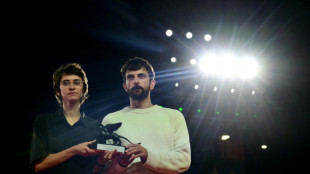 Israeli-made Gaza documentary wins Venice special jury prize

The problem with mobile phones is that people look at them too much. At least, that's according to the man who invented them 50 years ago.
Martin Cooper, an American engineer dubbed the "Father of the cell phone," says the neat little device we all have in our pockets has almost boundless potential and could one day even help conquer disease.
But right now, we can be a little obsessed.
"I am devastated when I see somebody crossing the street and looking at their cell phone. They are out of their minds," the 94-year-old told AFP from his office in Del Mar, California.
"But after a few people get run over by cars, they'll figure it out," he joked.
Cooper wears an Apple Watch and uses a top-end iPhone, flicking intuitively between his email, photos, YouTube and the controls for his hearing aid.
He gets his hands on the latest model every time it is updated, and gives it a thorough road test.
But, he confesses, with several million apps available, it can all feel a bit much.
"I will never, ever understand how to use the cell phone the way my grandchildren and great grandchildren do," he says.
- Real mobility -
Cooper's iPhone -- which he says he likes to use mostly to speak to people -- is certainly a very long way from the weighty block of wires and circuits that he used to make the very first mobile phone call on April 3, 1973.
At the time he was working for Motorola, leading a team of designers and engineers who were engaged in a sprint to come up with the first properly mobile technology and avoid being squeezed out of an up-and-coming market.
The company had invested millions of dollars in the project, hoping to beat out Bell System, a behemoth that dominated US telecoms for more than a century from its inception in 1877.
Bell's engineers had floated the idea of a cellular phone system just after World War II, and by the late 1960s had taken it as far as putting phones in cars -- partially because of the huge battery they needed.
But for Cooper, that didn't represent real mobility.
At the tail end of 1972, he decided he wanted a device that you could use anywhere.
So with the entire resources of Motorola at his disposal, he pulled together experts on semiconductors, transistors, filters and antennae who worked around the clock for three months.
By the end of March, they had cracked it, unveiling the DynaTAC -- Dynamic Adaptive Total Area Coverage -- phone.
"This phone weighed over a kilo -- about two and a half pounds -- and had a battery life of roughly 25 minutes of talking," he said.
"That was not a problem. This phone was so heavy, you couldn't hold it up for 25 minutes."
That very first phone call didn't have to be long. It just had to work.
And who better for Cooper to call than his rival?
"So here I am standing on Sixth Avenue (in New York) And it occurred to me I had to call my counterpart at the The Bell System... Dr Joel Engel
"And I said, 'Joel, this is Martin Cooper... I'm talking to you on a handheld cell phone. But a real cell phone, personal, portable, handheld.'
"There was silence on the other end of the line. I think he was gritting his teeth."
- 'Conquer disease' -
Those first mobile phones were not cheap at around $5,000 per handset, but they granted early adopters -- who Cooper says included people trying to sell property -- an edge.
"It turns out that what real estate people do is they show people houses, or they answer the phone for new clients.
"Now they could do both at the same time; it doubled their productivity."
And mobile phones continue to improve people's lives.
"The cell phone has now become an extension of the person, it can do so many more things," he said.
"And in that regard, we are just at the very beginning. We're just starting to understand what that could do.
"In the future, we can expect the cell phone to revolutionize education, it will revolutionize healthcare.
"I know that sounds like an exaggeration, but I want you to know within a generation or two, we are going to conquer disease."
Just like his watch monitors his heartrate while he swims, and his phone monitors his hearing aids, phones will one day be connected to an array of bodily sensors that will catch illness before it develops, he says.
It's all a long way from where it started with that monster handset, but while he didn't envisage every development, Cooper always knew the device he and his team came up with would change the world.
"We really knew that everybody someday would have a cell phone. We're almost there.
"There are more mobile phone subscriptions in the world today than there are people. So that part of our dream has come true."
As for the problem of people gawping at their phones too much -- even as they cross the road -- he's not worried.
New technology often throws up challenges.
"When television first came out, people were just hypnotized.
"But we somehow... managed to understand that there is a quality associated with looking at a television."
Right now, we're at the mindless staring phase with our phones, he says, but that won't last.
"Each generation is going to be smarter... They will learn how to use the cell phone more effectively.
"Humans sooner or later figure it out."
A.Williams--AT