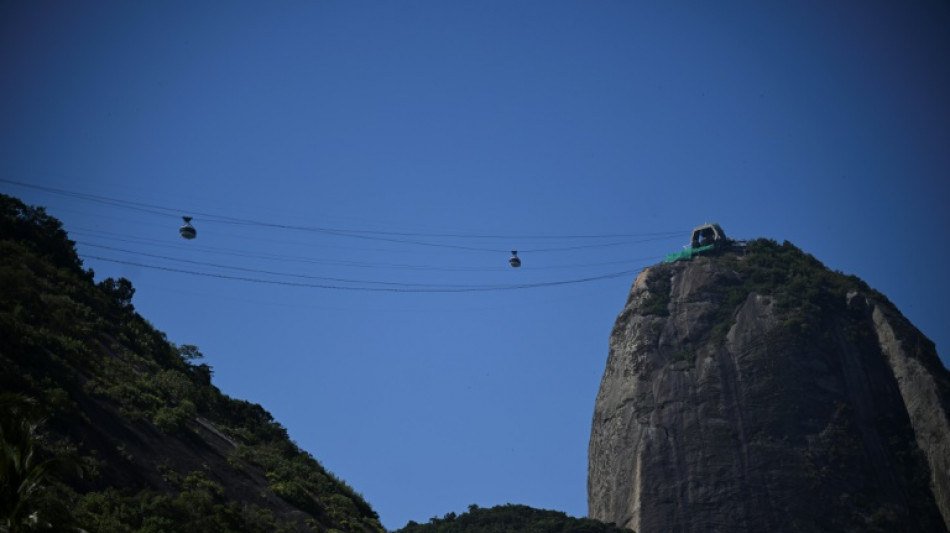
Zip line row erupts at Rio's iconic Sugarloaf Mountain / Photo: CARL DE SOUZA - AFP

 Gauteng Health Department Warns of Rising Antibiotic Resistance Threat

 Bishop Museum Races to Save Rare Megamouth Shark Specimen

 Impauer Technologies Inc. Announces Third Quarter 2026 Financial Results and Equity Compensation Grants

 NiobiumX Mining Explains How it Will Hunt for Niobium at Shipshaw: Magnetic Lows, Thorium Highs, and Machine Learning Built for a District With One Producing Mine

 InterContinental Hotels Group PLC Announces Transaction in Own Shares - November 26

 Black Friday Discounts Cut Prices on Two Top-Rated Wiper Blades

 Luxembourg Pay Rise Delayed as Regional and World Headlines Develop

 Audience to Choose the Set List at Luxembourg's First FAMIL Jukebox Night

 Raheem Sterling Receives Suspended Sentence After Lamborghini Crash

 Luxembourg Housing Petition Passes Threshold for Parliamentary Consideration

The chance to speed down a zip line from the top of Rio de Janeiro's breathtaking Sugarloaf Mountain should easily draw huge crowds of thrill-seekers to the iconic tourist destination.
But not if Gricel Osorio Hor-Meyll has anything to say about it.
Hor-Meyll, a psychologist, was one of dozens of people who protested Sunday against the construction of a 755-meter (2,477-foot) zip line that promises to let tourists whizz down from the top of Sugarloaf, the dramatic mountain at the mouth of the Brazilian beach city's Guanabara Bay.
"It's not right. It's going to disfigure a UNESCO World Heritage Site," said Hor-Meyll, a member of the environmental group Ecological Action and an activist in the "Movement for a Sugarloaf with no Zip Line."
"It's bad for the city, and bad for conservation," she told AFP.
The company that manages the Sugarloaf visitors' area, Parque Bondinho, launched work on the zip line project last year, and plans to finish it by mid-2023.
It says the attraction will be a "unique and environmentally sustainable experience": four zip lines connecting Sugarloaf -- elevation 396 meters (1,299 feet) above sea level -- to the neighbouring peak, Urca -- elevation 220 meters (722 feet) -- and transporting visitors at speeds of up to 100 kilometers (62 miles) an hour.
Critics warn the project could harm the local environment and wildlife, already suffering from the impact of helicopter flights for tourists and night-time parties on the mountain.
They also detest the idea of drilling holes to plant the zip line cables in the mountains, which are protected national monuments in Brazil and an iconic part of Rio's cityscape, which UNESCO declared a World Heritage site in 2012.
"They're not just rocks. They're living things," said Hor-Meyll.
- 'Tip of the iceberg' -
Sugarloaf's tropical-green peaks offer stunning panoramas of Rio's famed beaches, Christ the Redeemer statue and other postcard-perfect landmarks.
The park comprising Sugarloaf and Urca receives around 1.6 million visitors a year, most of whom make the trip up on a cable car known as the "bondinho," completed in 1913.
Parque Bondinho, which manages the cable car, argues the zip line will have limited impact on the landscape, saying the cables are thinner and vibrate less than the ones already linking Sugarloaf and Urca for the cable car system.
The company said in a statement it has fulfilled all regulatory requirements, conducted consultations with civil society groups and obtained all necessary permits for the project.
That did not assuage protesters at the base of the mountain, who brandished signs reading "SOS UNESCO" and "Down with zip lines."
An online petition against the project has collected more than 11,000 signatures.
Activists say there should have been a broader public discussion on the zip line, which the group warned in a statement is "just the tip of a gigantic iceberg."
That is a reference to an even bigger development project the authorities are currently evaluating, which would include building stores, a concert venue and a nightclub on the mountains.
"It's a horrific, awful thing," said artist turned protester Regina Costa de Paula, 67.
"It would kill the mountaintop."
Businessman Hans Rauschmayer, a 57-year-old German now living in Rio, said the company is "using Sugarloaf as if it were private property."
"But actually, it's a treasure that belongs to Rio, to Brazil, to the entire world," he said.
M.Robinson--AT
