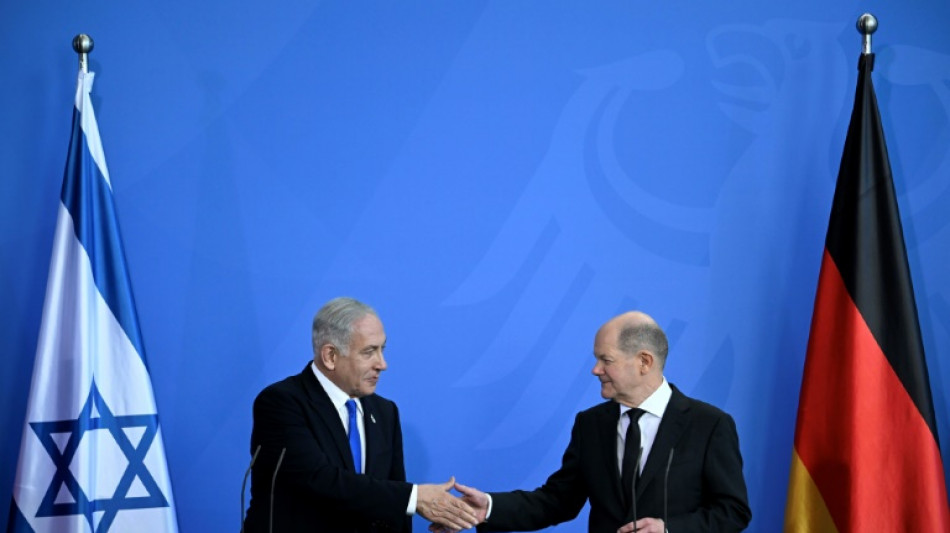
Netanyahu defiant over legal reforms as Scholz urges compromise / Photo: Tobias SCHWARZ - AFP

 Gauteng Health Department Warns of Rising Antibiotic Resistance Threat

 Bishop Museum Races to Save Rare Megamouth Shark Specimen

 Impauer Technologies Inc. Announces Third Quarter 2026 Financial Results and Equity Compensation Grants

 NiobiumX Mining Explains How it Will Hunt for Niobium at Shipshaw: Magnetic Lows, Thorium Highs, and Machine Learning Built for a District With One Producing Mine

 InterContinental Hotels Group PLC Announces Transaction in Own Shares - November 26

 Black Friday Discounts Cut Prices on Two Top-Rated Wiper Blades

 Luxembourg Pay Rise Delayed as Regional and World Headlines Develop

 Audience to Choose the Set List at Luxembourg's First FAMIL Jukebox Night

 Raheem Sterling Receives Suspended Sentence After Lamborghini Crash

 Luxembourg Housing Petition Passes Threshold for Parliamentary Consideration

Israeli Prime Minister Benjamin Netanyahu on Thursday fiercely defended disputed legal reforms on a visit to Berlin, where German Chancellor Olaf Scholz urged him to reconsider a compromise.
The package of judicial reforms has sparked weeks of protests in Israel since its introduction by Netanyahu's hard-right coalition, prompting Israel's president to warn the nation may be on the brink of "civil war".
Scholz admitted he was watching the debate unfold in Israel "with great concern" and said that "as Israel's friend, we hope that the last word has not been spoken" on President Isaac Herzog's proposals for compromise.
Herzog, who holds a largely ceremonial role, on Wednesday presented compromise plans -- swiftly rejected by Netanyahu who said they would "only perpetuate the existing situation and do not bring the required balance between the powers".
In Berlin, Netanyahu put on a defiant front, arguing his plans merely sought to bring Israel's democracy "in line with what is common and acceptable in just about every Western democracy".
He also hit out at "slanders and falsifications" against his own and his coalition's intentions.
"Israel is being constantly... maligned. I'm supposed to be some... potentate who's abolishing democracy and all this nonsense," he charged at a press conference, standing next to Scholz, adding, "this is absurd, it's preposterous".
- 'Civil war' threat -
Netanyahu's coalition, which includes ultra-Orthodox and extreme-right parties, says the reforms are needed to limit judicial overreach, but protesters say they threaten Israel's liberal democracy by weakening key checks and balances.
Ten consecutive weeks of nationwide demonstrations have followed, with critics also alleging the proposed changes aim to protect Netanyahu as he fights corruption charges in an ongoing court battle.
With the strife far from easing, Herzog warned late Wednesday that "anyone who thinks that a genuine civil war, with human lives, is a line that we could never reach, has no idea what he is talking about.
"It is precisely now, in the State of Israel's 75th year of independence, that the abyss is within touching distance. Today, I say to you what I told them: civil war is a red line.
"I will not allow it to happen," he said, adding he was convinced the majority of Israelis want a compromise.
- 'End of democracy?' -
The changes proposed by the coalition would allow lawmakers to override Supreme Court decisions that strike down legislation with a parliamentary majority, and then deny the court the right to review such a move.
It would also make it harder for the Supreme Court to strike down legislation it deems to contravene Basic Laws, Israel's quasi constitution.
Israeli protesters returned to the streets on Thursday, with some holding up placards saying the reforms spelled "the end of democracy".
In Berlin, several hundred protesters also turned out at the Brandenburg Gate, a short distance from the chancellery where Netanyahu and Scholz held talks.
Among them was Israeli Oren Goldberg, 44, who had travelled from the Netherlands to Berlin to join in the protest.
"I'm here to give a big welcome to the want to be dictator in Israel, to show him we won't accept it," he told AFP.
- 'Normal guest' -
The controversy in Israel puts Germany in an uncomfortable position.
The two nations forged strong diplomatic ties in the decades after World War II, with Berlin committed to the preservation of the Israeli state in penance for the Holocaust.
Successive German governments have described Israel's national security as a crucial foreign policy priority.
Government spokesman Steffen Hebestreit on Monday said Netanyahu is the "elected prime minister of Israel and therefore also a normal guest in Germany".
But amid the row in Israel, in carefully worded statements, German leaders have voiced their worries.
On the eve of talks with Netanyahu, German President Frank-Walter Steinmeier said he planned to raise the reforms with the Israeli prime minister.
G.P.Martin--AT
