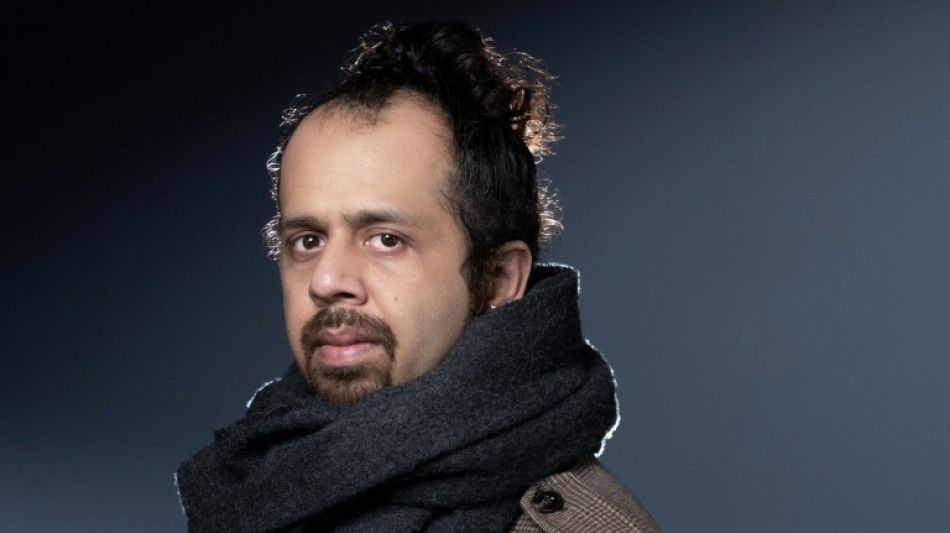
From Pakistani 'kill list' to comic book author / Photo: JOEL SAGET - AFP

 Gauteng Health Department Warns of Rising Antibiotic Resistance Threat

 Bishop Museum Races to Save Rare Megamouth Shark Specimen

 Impauer Technologies Inc. Announces Third Quarter 2026 Financial Results and Equity Compensation Grants

 NiobiumX Mining Explains How it Will Hunt for Niobium at Shipshaw: Magnetic Lows, Thorium Highs, and Machine Learning Built for a District With One Producing Mine

 InterContinental Hotels Group PLC Announces Transaction in Own Shares - November 26

 Black Friday Discounts Cut Prices on Two Top-Rated Wiper Blades

 Luxembourg Pay Rise Delayed as Regional and World Headlines Develop

 Audience to Choose the Set List at Luxembourg's First FAMIL Jukebox Night

 Raheem Sterling Receives Suspended Sentence After Lamborghini Crash

 Luxembourg Housing Petition Passes Threshold for Parliamentary Consideration

He barely escaped Pakistan with his life after angering its powerful military with his journalism. Now his story has become a comic book.
Taha Siddiqui's therapist told him not to dwell on the attempted kidnapping he suffered five years ago, or he would never escape his trauma.
"Clearly, I didn't listen to her at all," said Siddiqui with a smile.
He was speaking to AFP in his Paris bar, The Dissident Club, which he opened in 2020 as a refuge for exiles like himself.
It shares its name with his new autobiographical comic book -- co-authored with cartoonist Hubert Maury who was previously a French diplomat in Pakistan -- which is released on Wednesday in France and soon in other languages.
It opens with the moment in January 2018 when members of Pakistan's military pulled him from a taxi in broad daylight and shoved him into another car. Detention, torture and death were very real possibilities.
Two strokes of luck saved Siddiqui -- convincing the man holding his neck to release him, saying he would go quietly, and noticing that the passenger door was unlocked.
He leapt from the moving car, ran down the busy highway and managed to alert his media friends, swiftly organising a press conference about the attack in order to buy time.
Only after escaping to Paris did he discover he was on the military's "kill list" and could never return.
- The road to atheism -
The graphic novel goes beyond this incident to explain the spread of extremism and war in the region through the story of his religiously conservative upbringing in Saudi Arabia and Pakistan.
"I chose to tell my story as a comic book because I couldn't have any when I was young," said Siddiqui.
"It will definitely piss off my father. I hope he won't see it."
Not that they have a good relationship. His father's response to the attempted kidnapping was to say he was being punished by God for not praying enough.
It was a classic Romeo-and-Juliet experience that challenged Siddiqui's own faith, after his family opposed his marriage to a Shia girl he met at university. The divide between the Sunni and Shia branches of Islam is a fraught and often violent faultline in Pakistan.
"That really triggered this thing in me that there's something wrong with the way we live," said Siddiqui, who is now a full-blown atheist.
- 'No regrets' -
The attempted kidnapping put an end to a successful career. He had worked with many international media and won the prestigious Albert Londres prize for a piece on the Taliban banning polio vaccines.
His fearless criticism of the powerful Pakistani military made him a target, particularly a front-page story for the New York Times exposing their secret prisons.
"It was pretty crazy," said Maury, his co-author. "But that's what makes it such an interesting story.
"I find it impressive and remarkable. He risked not just his life but exile as well and cutting ties with his family."
Siddiqui said he has no regrets: "I chose this life but I didn't choose (the military's) reaction. That's on them, not me.
"Sometimes I'm sad. I really believed in the country at one time in my life but now less and less. Pakistan is a very dysfunctional country."
Siddiqui is already planning a follow-up that looks at the lives of other exiles.
"I wanted to take control because when I was attacked I lost control," he said.
Even his therapist is convinced, having recently visited the bar for a talk on exile and mental health.
"She said I was doing well and getting purpose out of what happened to me," he said. "I was really happy."
H.Thompson--AT
