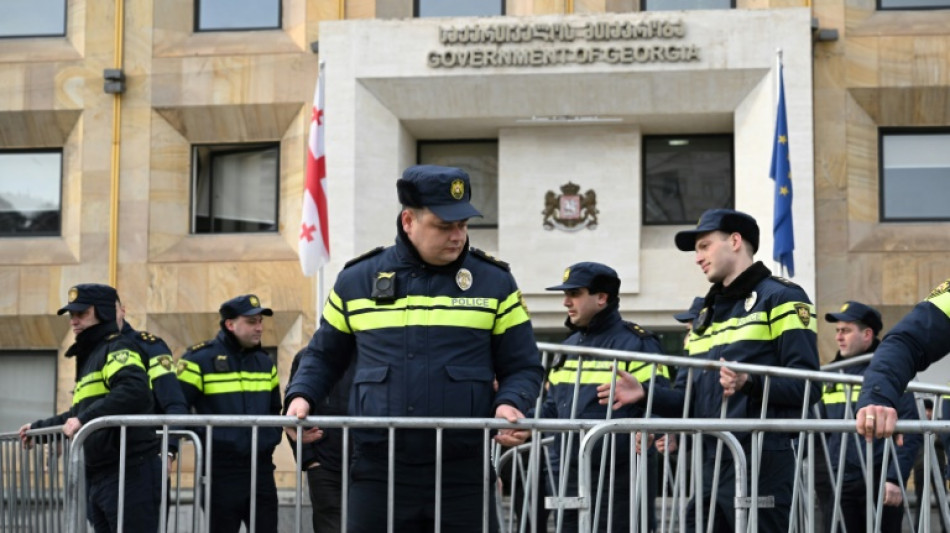
Clashes in Georgia over contentious 'foreign agents' law / Photo: Vano SHLAMOV - AFP

 Gauteng Health Department Warns of Rising Antibiotic Resistance Threat

 Bishop Museum Races to Save Rare Megamouth Shark Specimen

 Impauer Technologies Inc. Announces Third Quarter 2026 Financial Results and Equity Compensation Grants

 NiobiumX Mining Explains How it Will Hunt for Niobium at Shipshaw: Magnetic Lows, Thorium Highs, and Machine Learning Built for a District With One Producing Mine

 InterContinental Hotels Group PLC Announces Transaction in Own Shares - November 26

 Black Friday Discounts Cut Prices on Two Top-Rated Wiper Blades

 Luxembourg Pay Rise Delayed as Regional and World Headlines Develop

 Audience to Choose the Set List at Luxembourg's First FAMIL Jukebox Night

 Raheem Sterling Receives Suspended Sentence After Lamborghini Crash

 Luxembourg Housing Petition Passes Threshold for Parliamentary Consideration

Georgian police used tear gas and water cannon against protesters Tuesday as thousands of demonstrators took to the streets in the capital Tbilisi to oppose a controversial "foreign agents" bill.
At one point a protester opposed to the law, which would impose registration requirements on media and NGOs with foreign ties, threw a Molotov cocktail at a cordon of riot police, according to television footage.
The demonstration took place after Georgian lawmakers earlier Tuesday gave their initial backing to the draft law, which is reminiscent of Russia's legislation used to crack down on dissent.
In recent years Georgian authorities have faced mounting international criticism over perceived backsliding on democracy, seriously damaging Tbilisi's ties with Brussels.
In 2012, Russia adopted a law that allows authorities to take action against NGOs, media outlets and others deemed "foreign agents".
Georgian President Salome Zourabichvili expressed support for the demonstrators and vowed to veto the legislation.
"I stand with you because you are representing today the free Georgia which sees its future in Europe and will not let anyone steal this future," she said in a video from the United States where she is on an official visit.
"Nobody has the right to take away your future," she said in the address, with the Statue of Liberty seen in the background.
The US embassy in Georgia called the legislation "Kremlin-inspired" and said it was incompatible with the country's desire to join the European Union.
"Today is a dark day for Georgia's democracy," the embassy said in a statement, adding that the legislation raised questions about "the ruling party's commitment to Euro-Atlantic integration".
In Russia, the foreign agent label, which is reminiscent of the term "enemies of the people" of the Soviet era, has been used extensively by the authorities against political opponents, journalists and human rights activists accused of conducting foreign-funded political activities.
According to recently amended Russian legislation, anyone "under foreign influence" or receiving support from abroad -- not just foreign money -- can be declared a "foreign agent".
- Democratic backsliding -
Georgia applied for EU membership together with Ukraine and Moldova, days after Russia on February 24 invaded Ukraine.
In June last year, EU leaders granted formal candidate status to Kyiv and Chisinau but said Tbilisi must implement a number of reforms first.
Plans to join NATO and the EU are enshrined in Georgia's constitution and, according to opinion polls, are supported by at least 80 percent of the population.
In 2008, Russia and Georgia fought a five-day war but in recent years rights activists have accused the Georgian authorities of drifting towards the Kremlin.
Thousands of Russian men have fled to Georgia after President Vladimir Putin announced a military mobilisation last September.
Initially welcoming, Georgia has over the course of the past year deported a number of Russian activists with opposition views.
Georgian Prime Minister Irakli Garibashvili has defended his "balanced" Russia policy as aimed at ensuring "peace and stability".
The authorities have also been criticised over the worsening health of the jailed former president Mikheil Saakashvili.
Late last month European Union member states issued a formal diplomatic warning to Georgia's leaders over Saakashvili's health.
T.Perez--AT
