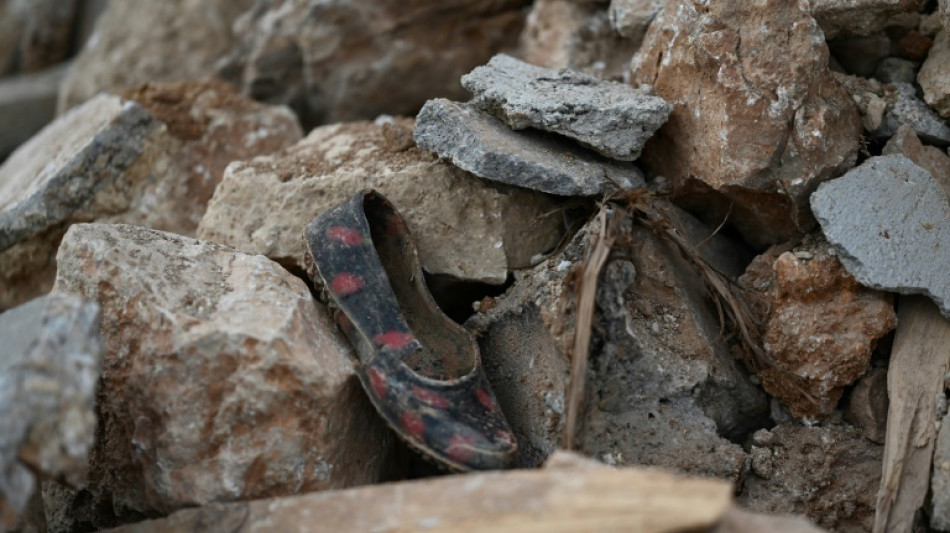
'Nobody warned us': Turkey struggles to rebuild month after quake / Photo: Eylul YASAR - AFP

 Gauteng Health Department Warns of Rising Antibiotic Resistance Threat

 Bishop Museum Races to Save Rare Megamouth Shark Specimen

 InterContinental Hotels Group PLC Announces Transaction in Own Shares - November 26

 Twickenham Grounds Team Prepares Pitch for Six Matches in Three Days

 Luxembourg Pay Rise Delayed as Regional and World Headlines Develop

 Audience to Choose the Set List at Luxembourg's First FAMIL Jukebox Night

 Raheem Sterling Receives Suspended Sentence After Lamborghini Crash

 Black Friday Discounts Cut Prices on Two Top-Rated Wiper Blades

 TCC Network Linked to 200% Surge in Global School Attacks
Buyuknacar was a picturesque village perched high in the mountains of southern Turkey until it was effectively wiped off the map by a catastrophic earthquake that killed tens of thousands a month ago.
Little is still standing in the settlement that was home to 2,000 people before the 7.8-magnitude struck on February 6, its epicentre just 26 kilometres (16 miles) to the south.
The tremor and its aftershocks claimed more than 45,000 lives in Turkey and 5,000 in neighbouring Syria.
It killed 120 people in Buyuknacar, an agricultural village surrounded by rugged mountains and lush valleys filled with oak and pine trees.
"Only four or five houses are still standing, but they are all damaged," said Ziya Sutdelisi, 53, a former village administrator.
"We were always told that our ground was solid. Nobody warned us our village was in peril," he said.
Few know what will happen next.
Turkey stretches across some of the world's most active fault lines and is no stranger to big shakes.
But none has been as damaging or deadly since Turkey became a republic after the collapse of the Ottoman Empire 100 years ago.
Ziya's wife Kiymet said the villagers felt relatively safe at more than 1,000 metres above sea level.
"Then everything crumbled in a few seconds," she said, surrounded by the rubble of stone and concrete homes.
- 'Our enemies'-
Survivors who stayed behind now live in tents, grieving and reliving the horrors of being woken in the pre-dawn hours by a jolt that upturned millions of lives.
Sutdelisi is still haunted by the rumble of the moving ground, which swung buildings like pendulums in the dark.
"It was as if 10 trains were passing by simultaneously,"he said.
The villagers said it took six days for help to reach them from neighbouring cities and towns, forcing families to claw their way through the rubble by hand in search of trapped loved ones.
They drove the injured to nearby hospitals on their own because ambulances could not reach them across damaged, snow-covered roads.
"For six days, we were 40 people in a makeshift tent. It was cold and snowy," Kiymet said.
Every family now has their own tent. A handful of container homes are arriving that villagers plan to assign to the elderly and most vulnerable.
But nothing will be firmly decided or change for Buyuknacar's survivors until officials conduct ground analyses to determine whether people will be allowed to stay here and rebuild.
The few remaining buildings could tip over from one of the thousands of aftershocks that have rumbled across Turkey in the past month.
"We would not dare go inside the houses," said villager Hulya Morgul. "They are like our enemies."
- 'Firm ground'-
Facing a difficult re-election in May, President Recep Tayyip Erdogan has vowed to rebuild the entire damaged region within a year.
Like the Sutdelisis, Erdogan also called Turkey's mountains "firm ground" that his government will focus on developing in the months to come.
"When planning new settlements, we steer our cities from the plains to the mountains as much as possible, to firm ground," Erdogan said after the quake.
Nurten Morgul, who is married with two children, said it was hard for her family to simply pick up and leave.
"The source of our income -- our fields, our animals -- are all here," she said.
Ziya Sutdelisi also struggles to focus on the future.
"It has been a month but we cannot think with clear heads," he said. "It will take a while to come to our senses."
United in grief and perseverance, the villagers have formed new bonds, which offer a glimmer of hope.
"We have all suffered, we are helping each other," Sutdelisi said with a smile as a barber from nearby city of Gaziantep offered him and two others free outdoor haircuts.
"Life has to go on for our kids," he said.
M.O.Allen--AT
