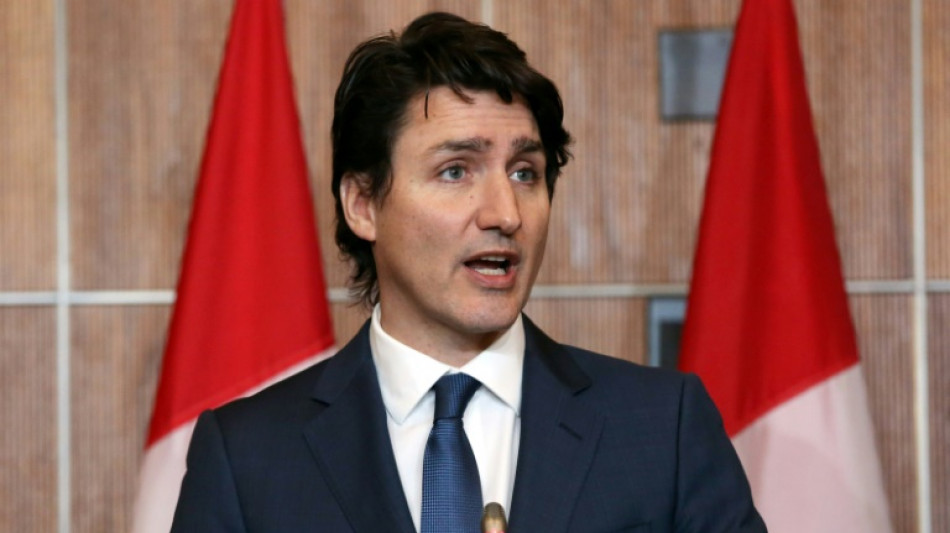
Trudeau says cocaine licenses are not for selling drug to public / Photo: Dave Chan - AFP/File

 Gauteng Health Department Warns of Rising Antibiotic Resistance Threat

 Bishop Museum Races to Save Rare Megamouth Shark Specimen

 InterContinental Hotels Group PLC Announces Transaction in Own Shares - November 26

 Twickenham Grounds Team Prepares Pitch for Six Matches in Three Days

 Luxembourg Pay Rise Delayed as Regional and World Headlines Develop

 Audience to Choose the Set List at Luxembourg's First FAMIL Jukebox Night

 Raheem Sterling Receives Suspended Sentence After Lamborghini Crash

 Black Friday Discounts Cut Prices on Two Top-Rated Wiper Blades

 TCC Network Linked to 200% Surge in Global School Attacks
Prime Minister Justin Trudeau said Friday he was "surprised" that companies licensed to sell cocaine to pharmacists or hospitals seemed to signal Canada would soon allow legal sales of hard drugs to the public.
Earlier this week, several companies announced that Canada's federal health agency had allowed them to produce and sell cocaine.
The announcement came a month after the province of British Columbia launched an experimental decriminalization process meant to address an opioid overdose crisis that has killed thousands.
The province decriminalized the possession -- but not sale -- of small amounts of cocaine and other hard drugs, under a three-year pilot project, with the aim of removing the stigma associated with drug use that keeps people from seeking help.
Advocates have also been pushing for safer supplies of drugs to be made available to addicts who face a risk of dying from toxic drug poisoning linked to illicit street drugs.
Trudeau clarified Friday that the companies did not have "permission to sell it commercially or provide it on an open market," adding that the misunderstanding would be corrected.
"There are limited and very restricted permissions for certain pharmaceutical companies to use that substance for research purposes and for very specific narrowly prescribed medical purposes," he explained.
Trudeau made the comments after British Columbia Premier David Eby expressed shock at the claims by Sunshine Earth Labs and Adastra Labs.
"I was as surprised as the premier of British Columbia was to see that a company was talking about selling cocaine on the open market or commercializing it," Trudeau told reporters.
On Thursday, Eby said allowing commercial sales of hard drugs, including cocaine, "is not part of our provincial plan."
Sunshine Earth Labs had said in a statement it received permission from Health Canada to "legally possess, produce, sell and distribute coca leaf and cocaine," as well as morphine, MDMA (ecstasy) and heroin.
Adastra Labs had said its license also allowed it to produce and sell psilocybin and psilocin -- hallucinogens more commonly known as magic mushrooms that produce effects similar to LSD.
British Columbia -- the epicentre of a crisis that has seen more than 30,000 overdose deaths nationwide since 2016 -- is only the second jurisdiction in North America to decriminalize personal possession of small amounts (up to 2.5 grams) of hard drugs after the US state of Oregon did so in November 2020.
E.Flores--AT
