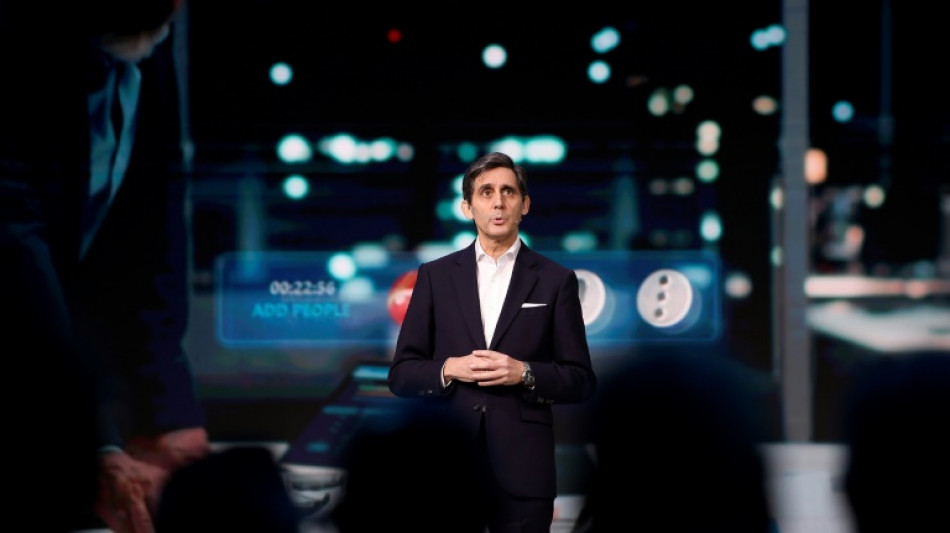
Phone firms promise 'tsunami of innovation' at Barcelona meeting / Photo: Josep LAGO - AFP

 Gauteng Health Department Warns of Rising Antibiotic Resistance Threat

 Bishop Museum Races to Save Rare Megamouth Shark Specimen

 InterContinental Hotels Group PLC Announces Transaction in Own Shares - November 26

 Twickenham Grounds Team Prepares Pitch for Six Matches in Three Days

 Luxembourg Pay Rise Delayed as Regional and World Headlines Develop

 Audience to Choose the Set List at Luxembourg's First FAMIL Jukebox Night

 Raheem Sterling Receives Suspended Sentence After Lamborghini Crash

 Black Friday Discounts Cut Prices on Two Top-Rated Wiper Blades

 TCC Network Linked to 200% Surge in Global School Attacks
The big beasts of the telecom industry kicked off their most important annual get-together in Barcelona on Monday, promising to lead a "tsunami of innovation", as they try to shrug off a major slump across the technology sector.
Some 80,000 delegates are expected at the four-day Mobile World Congress (MWC), which is back to near full strength following years of pandemic-related disruption.
Industrial titans like Huawei, Nokia and Samsung are set to showcase their latest innovations, flanked by smartphone makers like Oppo and Xiaomi and network operators like Orange, Verizon and China Mobile.
"We are at the doors of a new change of era driven by the intersection of Telco, Computing, Artificial Intelligence and Web3," said Jose Maria Alvarez-Pallete, boss of Spanish operator Telefonica and current chairman of industry body GSMA, which organises the Barcelona event.
He promised the telecoms industry would be at the forefront of the "tsunami of innovation", adding: "Without telcos there is no digital future."
But many of the firms are more concerned with finding a path back to profit as the global economy stutters and the wider tech sector slashes thousands of jobs.
In the first clear sign that the ills of the wider tech sector are reaching telecoms, equipment maker Ericsson announced 8,500 layoffs last week.
Overall sales of smartphones last year slumped by 11.3 percent compared with 2021, according to the IDC consultancy.
Research firm Gartner reckons sales of smartphones, tablets and computers will fall again by four percent this year.
And network operators are still struggling to make 5G pay, years after they spent billions in government auctions for the right to use the bandwidth.
- 'Unsustainable situation' -
A hugely popular idea for many at the show is to get the owners of bandwidth-hungry platforms like YouTube, Netflix and Facebook to pay network operators a "fair share".
Christel Heydemann, boss of French operator Orange, said the five largest users -- which she did not name -- account for 55 percent of daily traffic on European networks, costing telecoms firms 15 billion euros ($16 billion) a year.
She said it was an "unsustainable situation" and welcomed a public consultation launched by EU commissioner Thierry Breton last week.
But Breton told the MWC on Monday that it was not a "binary choice" or a battle between telecoms and big tech.
He said the idea was for everyone to make sure Europe had the best possible network by 2030 and warned that telecoms firms "will have to adapt to survive".
Critics of the "fair share" narrative point out that customers already pay the operators for use of their networks.
Netflix boss Greg Peters, who is unlikely to be enthusiastic about the fair share proposal, is expected at the MWC on Tuesday.
- Huawei centre stage -
The organisers are trumpeting the return of Chinese delegates as a vital boon to the event.
Chinese firms heavily sponsor the MWC and Huawei is once again getting pride of place, this time hosting the biggest dedicated pavilion in the event's decades-long history.
The Chinese tech giant was the second biggest smartphone maker in the world in 2020 but retreated after US regulators accused it of being controlled by Beijing.
The firm is now under pressure in Europe, where Breton and other commissioners are pushing for its equipment to be removed from 5G network infrastructure.
Huawei boss Eric Xu said before the event he would use the MWC to display products that would "help carriers meet evolving demand and unleash more opportunities for new growth".
In total, GSMA said the four-day show would host almost 750 operators and manufacturers and 2,000 exhibitors.
T.Perez--AT
