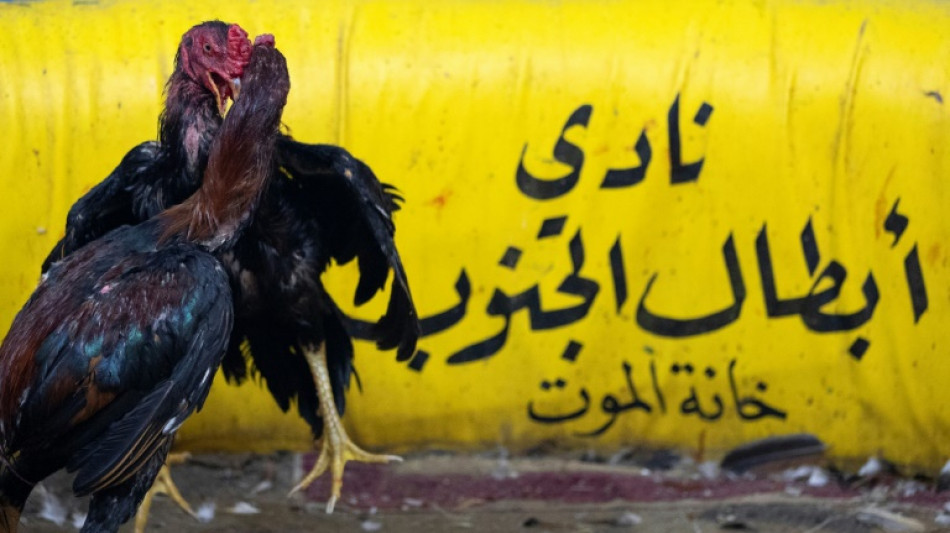
Cockfighting still a popular blood sport in southern Iraq / Photo: Hussein Faleh - AFP

 Gauteng Health Department Warns of Rising Antibiotic Resistance Threat

 Bishop Museum Races to Save Rare Megamouth Shark Specimen

 InterContinental Hotels Group PLC Announces Transaction in Own Shares - November 26

 Twickenham Grounds Team Prepares Pitch for Six Matches in Three Days

 Luxembourg Pay Rise Delayed as Regional and World Headlines Develop

 Audience to Choose the Set List at Luxembourg's First FAMIL Jukebox Night

 Raheem Sterling Receives Suspended Sentence After Lamborghini Crash

 Black Friday Discounts Cut Prices on Two Top-Rated Wiper Blades

 TCC Network Linked to 200% Surge in Global School Attacks
Two vicious roosters circle a filthy carpet in southern Iraq, facing off for a cockfight that has drawn dozens to a dimly lit cafe in the port city of Basra.
"This practice has been around since I was born in 1949," said referee Riad Ali, whose father introduced him to cockfighting when he was around 10.
The popular blood sport "dates back to the 1920s or earlier" in Basra and is thought to have arrived with boats at the port, he added.
Banned in many parts of the world due to concerns over animal cruelty, cockfighting has remained common from the Philippines to India, and is tolerated in areas including parts of northern France.
An AFP photographer witnessed several nights of fights in Basra, where red-crested roosters were locked in a violent dance, leaving smears of blood on their feet and neck as they leapt and pecked at each other.
Spectators on narrow seats near the red and yellow ring littered with feathers sipped tea as they watched, the smell of cigarettes and water pipes filling the air.
The avian bouts can last for an hour or two, and end when the birds are exhausted or when one of the owners withdraws his animal, said Ali, who has been an amateur cockfighting referee for around two decades.
Retiree Naji Hamza said he had been attending cockfights since the 1970s even though they were banned during the time of Saddam Hussein, Iraq's former dictator who was toppled following a 2003 US-led invasion.
"We were in secluded homes, not at a cafe or in public" like now, said the 70-year-old.
Islam prohibits gambling, and in conservative, Muslim-majority Iraq it is usually the animals' owners who make wagers, putting down between 25,000 and 100,000 dinars ($17-$68) per fight -- though spectators sometimes have a flutter too.
Mohammed, a 51-year-old mechanic who declined to provide his surname, said he had had birds in the ring since the early 1990s, and bought his three roosters in Turkey for between $900 and $1,100 each.
"We come to the cafe in the evening and spend an hour or two. We see our friends," he said.
"It's a pastime, a leisure activity during winter," he added.
T.Wright--AT
