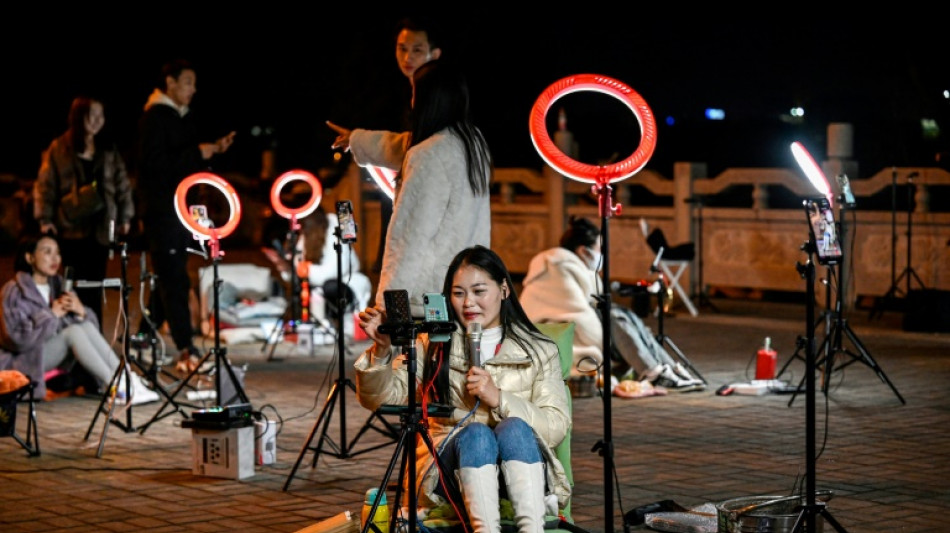
Chinese livestreamers flock outdoors for late-night tips / Photo: Jade GAO - AFP

 Gauteng Health Department Warns of Rising Antibiotic Resistance Threat

 Bishop Museum Races to Save Rare Megamouth Shark Specimen

 InterContinental Hotels Group PLC Announces Transaction in Own Shares - November 26

 Twickenham Grounds Team Prepares Pitch for Six Matches in Three Days

 Luxembourg Pay Rise Delayed as Regional and World Headlines Develop

 Audience to Choose the Set List at Luxembourg's First FAMIL Jukebox Night

 Raheem Sterling Receives Suspended Sentence After Lamborghini Crash

 Black Friday Discounts Cut Prices on Two Top-Rated Wiper Blades

 TCC Network Linked to 200% Surge in Global School Attacks
In the dead of night on a bridge in southern China, around two dozen livestreamers sat crooning and chatting into microphones, their identical ring lights spaced a few metres apart in glowing rows.
The broadcasters gather in spots like this in the city of Guilin most nights with the hopes of catching the attention of online "passers-by" scrolling through livestreams on Douyin, China's version of TikTok, where viewers can donate to their favourite streamers.
"There are too many indoor livestreamers," said 27-year-old Qiao Ya, who works from 9:00 pm to 3:00 am every night.
"For indoor livestreaming you need to look pretty to be able to attract viewers, but I'm too average for that."
Outdoor broadcasting took off about a year ago, and conditions can be harsh.
When AFP visited this week, the temperature had dropped to almost zero degrees Celsius (32 degrees Fahrenheit), with streamers bundled in thick blankets and some bringing small heaters.
"Viewers might feel if we're outdoors or just by ourselves late at night that it's very tough, so they might be nicer to us," said Qiao, whose only income comes from donations through her stream.
Livestreaming on apps like Douyin, which said it had 600 million users in 2020, is a popular way to make money in China.
Some -- like "Lipstick King" Li Jiaqi -- have become celebrities, making millions of dollars in endorsements and advertising fees through the platform.
But for those on the bridge, the earnings are much slimmer.
On a good day, Qiao makes up to 600 yuan ($87) over eight hours of streaming. On a bad day, her takings can be as low as 10 yuan ($1.50).
Like most Douyin performers, Qiao is signed with a livestreamer talent agency, which takes a 10 percent cut of her revenue in exchange for equipment rental and management of her social media presence.
Douyin takes another 50 percent, leaving streamers like Qiao with just 40 percent of what they make.
Douyin's parent company ByteDance, which also owns TikTok, reported $18.3 billion in revenue in the first quarter of 2022.
- 'Side job' -
Most of the streamers on the bridge on Monday were young women, with one of the few men wearing a furry frog suit.
For eyebrow tattooist Zhang Xiaoxiao, the broadcasts are an extra source of income.
She said the Covid pandemic had hit her profession hard, with beauty salons crippled by health restrictions.
"Pressure was very high and business was bleak... If not for this, I don't think I would be livestreaming," explained Zhang, 36, as she set up to work until 3:00 am.
"I really enjoy singing and dancing, so I thought I would make it a side job, to be able to do something I liked."
Last October, Douyin issued a warning against public disturbances caused by outdoor livestreaming, though that has largely gone unheeded after an initial crackdown.
Zhang said sometimes people walking past react angrily to her.
"Some look at us with some discrimination. They ask 'Why don't you find a normal job?'" she said.
"So we choose a place far away from the residents, to try to not disturb people, and where it's very safe."
The streamers' agencies send men who act as assistants and bodyguards -- with some telling AFP they occasionally had to move drunk people on or block inappropriate online viewers.
Despite the risks, big donations keep livestreamers like Qiao coming back.
"One guy scrolled past my roadside livestream one night at 2:20 am and felt very touched," Qiao said.
The anonymous man gave her a 3,000 yuan ($435) donation.
"I was so happy that I went home early that night," Qiao said.
"Livestreaming is actually very simple, it's like making friends."
W.Morales--AT
