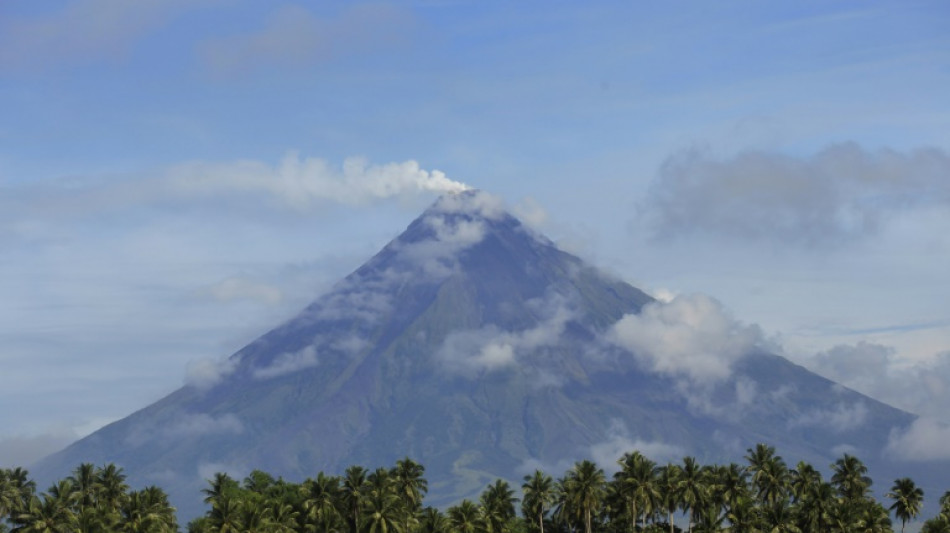
Rescuers climb Philippine volcano to reach plane crash site / Photo: Charism SAYAT - AFP/File

 Gauteng Health Department Warns of Rising Antibiotic Resistance Threat

 Bishop Museum Races to Save Rare Megamouth Shark Specimen

 InterContinental Hotels Group PLC Announces Transaction in Own Shares - November 26

 Twickenham Grounds Team Prepares Pitch for Six Matches in Three Days

 Luxembourg Pay Rise Delayed as Regional and World Headlines Develop

 Audience to Choose the Set List at Luxembourg's First FAMIL Jukebox Night

 Raheem Sterling Receives Suspended Sentence After Lamborghini Crash

 Black Friday Discounts Cut Prices on Two Top-Rated Wiper Blades

 TCC Network Linked to 200% Surge in Global School Attacks
Philippine rescue teams began climbing an active volcano Tuesday in a "very risky operation" to reach the wreckage of a small plane that crashed at the weekend, officials said.
Four people, including two Australians, were on board the Cessna 340 aircraft when it went missing Saturday morning after taking off for Manila from Bicol International Airport in the central province of Albay, several kilometres from Mayon volcano.
Civil aviation investigators on board a reconnaissance flight on Tuesday confirmed that wreckage spotted on the volcano over the weekend was the missing plane.
It is not known if there are any survivors.
Manila-based Energy Development Corporation said previously the missing plane belonged to the company. The Australians were technical consultants for the renewable energy company.
Rain, clouds and the risk of an eruption have hampered efforts to reach the crash site.
The Civil Aviation Authority of the Philippines (CAAP) said the plane was on the western side of the volcano, about "3,500 to 4,000 feet" (1,070 metres to 1,200 metres) above sea level.
A high-resolution camera was used to identify the wreckage, said CAAP spokesman Eric Apolonio.
Attempts to lower rescue teams to the crash site by helicopter were aborted Tuesday due to strong winds and cloud cover, officials said.
Instead, search and rescue teams, including veteran mountaineers, began making the steep climb on foot.
They were expected to camp overnight and reach the crash site Wednesday, said Carlos Baldo, mayor of Camalig municipality, which overlaps the crash site.
Mayon is the most active volcano in the country and last erupted in 2018, spewing tonnes of ash, rocks and lava. Access to its slopes is restricted.
Philippine Institute of Volcanology and Seismology director Teresito Bacolcol warned there was a risk of a "steam-driven eruption or a rockfall".
"It's a very risky operation," Bacolcol told AFP.
"If they are willing to take the risk, only professionally trained and experienced personnel should be involved."
George Cordovilla, one of the mountaineers involved in the rescue effort, has climbed Mayon several times in the past and told AFP it was a difficult ascent.
"It could easily erode and trigger rockfalls even if there's no eruption. Some are caused by wind, water or rain," he said.
Another Cessna plane went missing on January 24 in the northern province of Isabela. That plane's wreckage has still not been found, Apolonio said.
Ch.Campbell--AT
