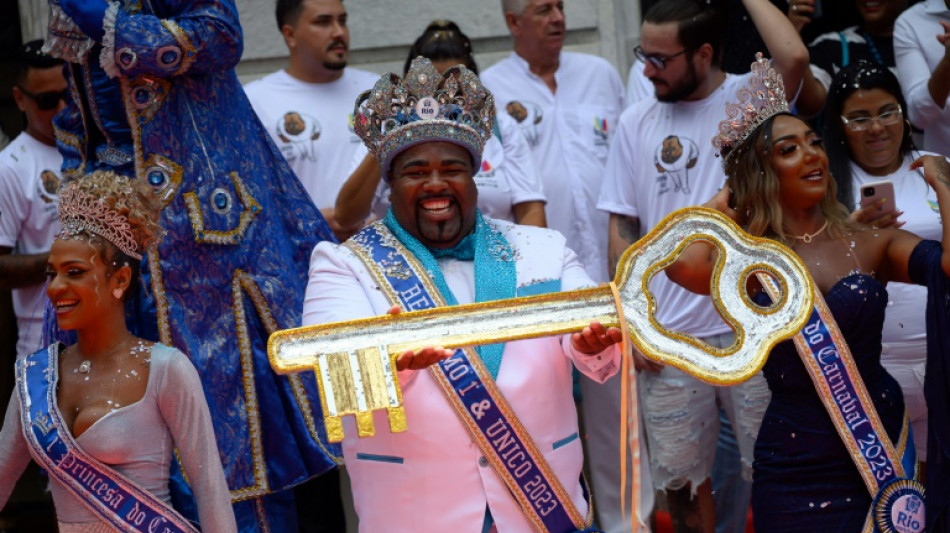
Rio holds first all-out carnival since Covid / Photo: MAURO PIMENTEL - AFP/File

 Gauteng Health Department Warns of Rising Antibiotic Resistance Threat

 Bishop Museum Races to Save Rare Megamouth Shark Specimen

 InterContinental Hotels Group PLC Announces Transaction in Own Shares - November 26

 Twickenham Grounds Team Prepares Pitch for Six Matches in Three Days

 Luxembourg Pay Rise Delayed as Regional and World Headlines Develop

 Audience to Choose the Set List at Luxembourg's First FAMIL Jukebox Night

 Raheem Sterling Receives Suspended Sentence After Lamborghini Crash

 Black Friday Discounts Cut Prices on Two Top-Rated Wiper Blades

 TCC Network Linked to 200% Surge in Global School Attacks
With a swirl of glitter, sequins and samba, Rio de Janeiro will kick off its famed carnival parades Sunday, the climax of the festival's first full-on edition since Covid-19 and Brazil's bitterly divisive elections.
The world's biggest carnival, which officially opened Friday, will hit peak party level at the all-night parade competition Sunday and Monday, where the city's top 12 samba schools will vie to become the champions with dazzling floats, thundering music and thousands of singers, drummers and dancers in skimpy, feather-covered costumes.
Mayor Eduardo Paes declared the party open Friday, symbolically handing the key to the city to "King Momo," the jovial "monarch" who "rules" Rio for the four-day free-for-all.
"It is with great happiness, celebrating life, celebrating democracy, that I have the honor of handing the keys to the city to King Momo," said Paes, an avowed carnival lover.
Rio is ready to party after two pandemic-disrupted carnivals and a polarizing presidential election in October, in which veteran leftist Luiz Inacio Lula da Silva ousted incumbent Jair Bolsonaro -- an ultra-conservative carnival critic accused of authoritarian tendencies.
Rio canceled carnival in 2021, and held a reduced version last year, banning the epic street parties known as "blocos" and postponing the parades by two months because of the pandemic, which has claimed nearly 700,000 lives in Brazil.
Now, the full-on festival is back.
- Return to roots -
"This is a moment of rebirth," said Pericles Monteiro, a founder of the massive annual street party known as "Heaven on Earth."
"We went through a very dark period, in terms of both politics and the pandemic," he told AFP at the party's 2023 edition -- one of hundreds of street parties being held around carnival for the first time in three years.
The samba schools, the pride of Rio's impoverished favelas, spend months assembling the costumes and creating the over-the-top floats that are the trademarks of the parades -- in reality, huge shows that tell a story on a chosen theme.
The parades were often politically charged during the Bolsonaro years, with thinly veiled criticism of the far-right government over issues such as racism, religious intolerance, environmental destruction and Brazil's disastrous management of Covid-19.
This year's parades are less political.
Many of the schools are returning to their roots, choosing themes linked to founding figures of the samba genre, the Afro-Brazilian culture from which it emerged, and Brazil's northeast -- the poor, majority-black and multiracial region that is the percussion-heavy musical style's spiritual home.
F.Wilson--AT
