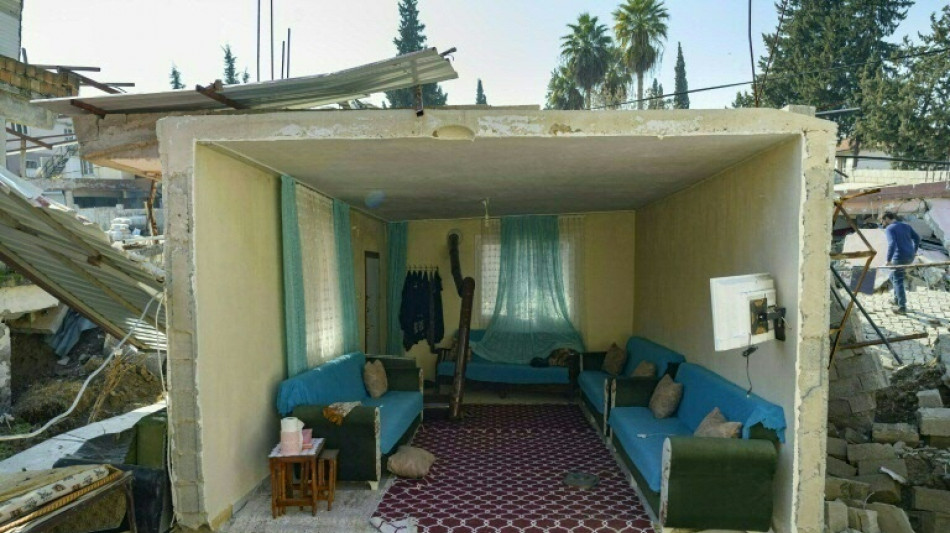
Turkey quake cuts village in two / Photo: Yasin AKGUL - AFP

 Gauteng Health Department Warns of Rising Antibiotic Resistance Threat

 Bishop Museum Races to Save Rare Megamouth Shark Specimen

 InterContinental Hotels Group PLC Announces Transaction in Own Shares - November 26

 Twickenham Grounds Team Prepares Pitch for Six Matches in Three Days

 Luxembourg Pay Rise Delayed as Regional and World Headlines Develop

 Audience to Choose the Set List at Luxembourg's First FAMIL Jukebox Night

 Raheem Sterling Receives Suspended Sentence After Lamborghini Crash

 Black Friday Discounts Cut Prices on Two Top-Rated Wiper Blades

 TCC Network Linked to 200% Surge in Global School Attacks
The small, grey house in southern Turkey that once looked out onto the road might appear untouched by last week's huge earthquake but it is now one floor lower.
Surrounding the building in Demirkopru village, home to 1,000 people, are bits of debris floating in murky water, broken pavements and lopsided houses.
The February 6 earthquake and its aftershocks that ravaged swathes of Turkey and Syria and killed more than 44,000 people has split Demirkopru in two.
"The houses sank four metres (13 feet)," said Mahir Karatas, a 42-year-old farmer and owner of the grey house. "The ground went up and down."
Half a dozen buildings, close to Karatas' house, seem to have suffered the wrath of God. The body of a black and white cow is stuck in dried mud inside what remains of a farm shed.
Fortunately, no one died in Demirkopru despite the heavy damage, but some were injured.
Rescue efforts in Hatay province have largely focused on Antakya, an ancient city that has been torn apart by the quake, 20 kilometres (12.5 miles) away from Demirkopru.
During the tremor, water rose from below ground then stagnated, residents said.
The ornately paved road no longer exists. Some bits are now a metre higher than others.
"Here, it became like an island," Murat Yar, a 38-year-old roofer, said.
"It went up, down, up, down, and then it slid down 30 metres. We saw water and sand gushing out," he added, mimicking the tremor's waves with his hands.
- 'Really scared' -
Residents could "jump out from the windows of their one and two-storey homes", Yar said, unlike in Antakya where people lived in multi-storey homes.
When the quake hit, the villagers scrambled to safety in an area designated by authorities in case of any tremors. But such was its force, even that cracked.
In front of a school whose gate was thrown 20 metres away is a yawning gap that zig zags but no damage is visible on the building's facade.
Further away four buildings belonging to another school appear like dominoes piled on top of a large earthen mound.
"I told myself, 'we're dead, we're finished'," Yar said.
Hatice Sahan, a 58-year-old woman wearing a headscarf, summed up how everyone felt on February 6: "We were really scared."
Ch.P.Lewis--AT
