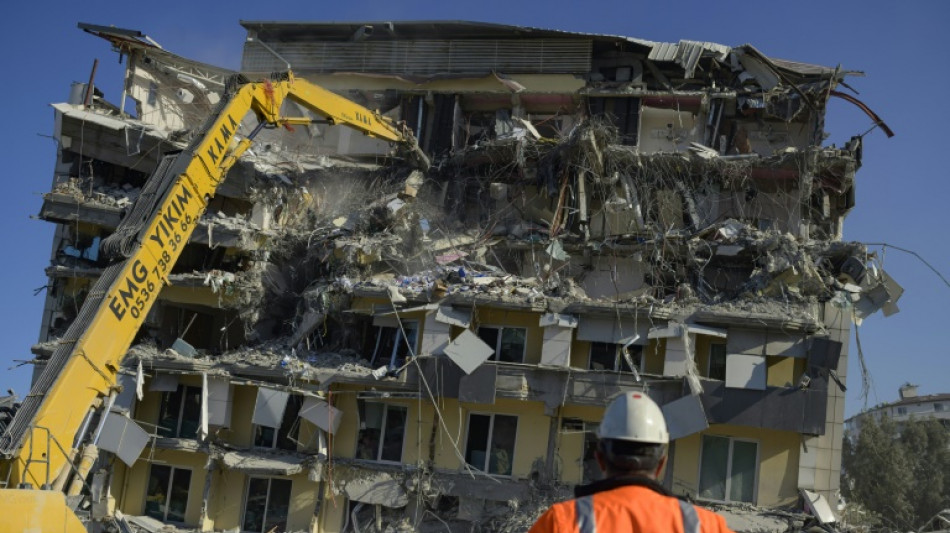
Turkey rescuers save two people 13 days after quake / Photo: Yasin AKGUL - AFP

 Gauteng Health Department Warns of Rising Antibiotic Resistance Threat

 Bishop Museum Races to Save Rare Megamouth Shark Specimen

 InterContinental Hotels Group PLC Announces Transaction in Own Shares - November 26

 Twickenham Grounds Team Prepares Pitch for Six Matches in Three Days

 Luxembourg Pay Rise Delayed as Regional and World Headlines Develop

 Audience to Choose the Set List at Luxembourg's First FAMIL Jukebox Night

 Raheem Sterling Receives Suspended Sentence After Lamborghini Crash

 Black Friday Discounts Cut Prices on Two Top-Rated Wiper Blades

 TCC Network Linked to 200% Surge in Global School Attacks
Turkish rescuers on Saturday pulled three people alive from the rubble 13 days after a massive quake killed tens of thousands, but one, a 12-year-old, later died.
More than 43,000 people died after a 7.8-magnitude earthquake rocked southeastern Turkey and northern Syria, the deadliest natural disaster in the region in centuries.
Teams have been finding survivors all week despite them being trapped under rubble for so long in freezing weather, but the numbers rescued alive have dropped to just a handful in the past few days.
Former Ghana international footballer Christian Atsu was among the dead after his manager confirmed on Saturday his body had been found beneath a collapsed building in Antakya city.
State news agency Anadolu shared images of rescuers placing a man and woman on stretchers after they and a child spent 296 hours buried under the rubble in Antakya.
The agency later reported the child died despite efforts to save them.
Turkish Health Minister Fahrettin Koca shared a video of the 40-year-old woman in a field hospital receiving treatment. "She is conscious," he tweeted.
The rescues come after teams on Friday pulled a 45-year-old man from rubble, several hours after others found three people including a 14-year-old boy alive under debris.
Rescues had once been met with applause and relief but in recent days, the reaction has been more sombre.
Turkish Vice President Fuat Oktay on Friday said rescue efforts continued at fewer than 200 sites as teams race against time to find more people alive.
- Lax building standards -
The quake -- in one of the world's most active seismic zones -- hit populated areas where many were asleep in homes that had not been built to resist such powerful ground vibrations.
Officials and medics said 39,672 people had died in Turkey and 3,688 in Syria from the February 6 quake, bringing the confirmed total to 43,360.
The disaster has put pressure on Turkish President Recep Tayyip Erdogan over the slow response to the quake and why poor quality buildings were allowed.
Turkish officials had promised in the wake of a quake in 1999 that killed more than 17,000 people in northwestern Turkey that building regulations would be strengthened.
The building where footballer Atsu died, a 12-storey luxury block of flats, was built in 2013 when Turkey had tougher rules on construction.
To the shock and anger of many in Turkey, Atsu's block toppled over like paper.
Turkish police have since arrested the building's contractor after he tried to flee the country, Anadolu reported last week.
Officers have arrested dozens of contractors as the government promises to crack down on lax building standards.
More than 84,000 buildings either collapsed, need urgent demolition or were severely damaged in the quake, Turkish Environment Minister Murat Kurum said on Friday.
- 'Not right to leave' -
One of the areas severely hit was Antakya, an ancient crossroads of civilisations.
Optician Cuneyt Eroglu, 45, sifts through the wreckage of his Kubat glasses shop.
The city has suffered several earthquakes -- almost one every 100 years -- and is no stranger to rebuilding.
"We will clean up and continue living here," he said surrounded by twisted glasses and paraphernalia.
Unlike other parts of the old town, the street in front of his shop has not yet been cleared of the vast quantity of rubble and twisted metal that engulfed much of the city.
Eroglu, whose family escaped the quake uninjured, is now staying in a tent in a village outside Antakya.
"It wouldn't be right to leave Antakya," he said.
T.Perez--AT
