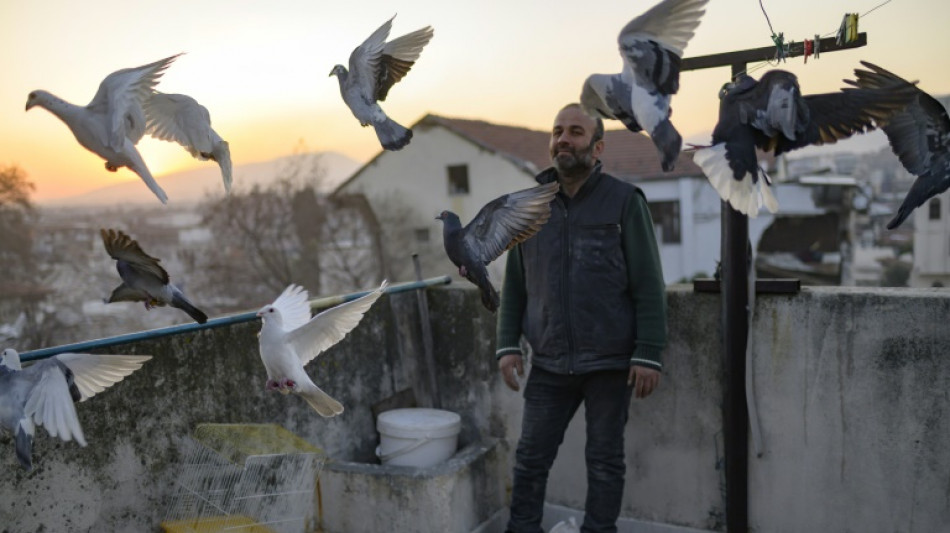
Bird man in Turkey vows to tend to flock after quake / Photo: Yasin AKGUL - AFP

 Gauteng Health Department Warns of Rising Antibiotic Resistance Threat

 Bishop Museum Races to Save Rare Megamouth Shark Specimen

 InterContinental Hotels Group PLC Announces Transaction in Own Shares - November 26

 Twickenham Grounds Team Prepares Pitch for Six Matches in Three Days

 Luxembourg Pay Rise Delayed as Regional and World Headlines Develop

 Audience to Choose the Set List at Luxembourg's First FAMIL Jukebox Night

 Raheem Sterling Receives Suspended Sentence After Lamborghini Crash

 Black Friday Discounts Cut Prices on Two Top-Rated Wiper Blades

 TCC Network Linked to 200% Surge in Global School Attacks
Murat Guzel scatters bird feed on the roof as the sun sets over the Antakya restaurant at which he used to work before the earthquake that destroyed the southern Turkish city.
Birds, mostly pigeons, some motley and scruffy, others pristine and plump, scrabble for the feed as Guzel, 40, calls to them.
"We take care of our birds the way we take care of our children -- and will continue to look after them," he says.
On the rooftop above Antakya's old town, he now keeps 40 birds following last week's 7.8-magnitude quake, having taken 110 back to the village he now calls home.
To reach the birds, Guzel walks through a debris-littered pantry, now covered with jam jars smashed during the tremors, up a narrow staircase to the rooftop of the traditional Turkish townhouse.
Two large white and brown birds nestle in a dovecote made of wire mesh and wood, while more than 20 others perch on a ledge in anticipation of food.
Before the quake that shattered tracts of southeastern Turkey and northern Syria killing more than 43,000 people, Guzel was the cook at the Antakya Breakfast House where guests would eat olives and cheese in the courtyard of the 300-year-old building.
"There's five of us at home, and the five of us came out safe and sound," he said after they were caught up in the quake in Antakya.
Guzel has three children aged nine, 15 and 17 -- the youngest of whom, Eren, has inherited his father's interest in birds.
- 'White rose' -
"Every morning we come to our birds and feed them (and) attend to their food, feathers and illnesses," he said.
The building, which was reinforced with steel girders and escaped with only cosmetic damage, is surrounded by destroyed homes and businesses in the heart of the city's historical quarter.
Antakya had been a popular tourist destination with visitors from Turkey and abroad.
Nearby orange trees that withstood the shocks stand half buried in rubble from broken stone walls and twisted wooden door frames.
Guzel gently grips a snow-coloured pigeon he called "white rose" and explained how healthy wings are vital to the bird's survival.
Diggers and excavators picking through ruined buildings could be heard nearby.
His father became a bird fancier before he was born but gave up the hobby following Guzel's arrival.
Pigeon keeping is a popular hobby in southeastern Turkey, particularly among the Kurdish community, and pigeon droppings are often used as fertiliser for watermelons.
Guzel and his brother gave each other a bird when he was just 15 -- and have built up their collection since.
"Our love for animals is something else, we like animals as much as humans... maybe more," he said.
Three or four regular avian visitors have disappeared in the wake of the quake, but have been replaced by 50 more as, he assumes, their keepers were killed.
- 'As long as they are here' -
Initially Guzel was mostly interested in carrier pigeons but now looks after a variety -- like humans "some are very handsome and some are very ugly".
Guzel, who has a salt and pepper beard and wears a body warmer and jumper, said his birds help to reduce stress when he sits with them.
Sometimes he sells specimens with special features -- but they occasionally come back.
Guzel pointed out one brown and white bird he called a "foreigner" -- not one of his own.
Despite now living in the relative safety of a nearby village, Guzel vowed to return daily to care for his regulars and visitors alike.
"As long as they are here, I will be," he said.
W.Nelson--AT
