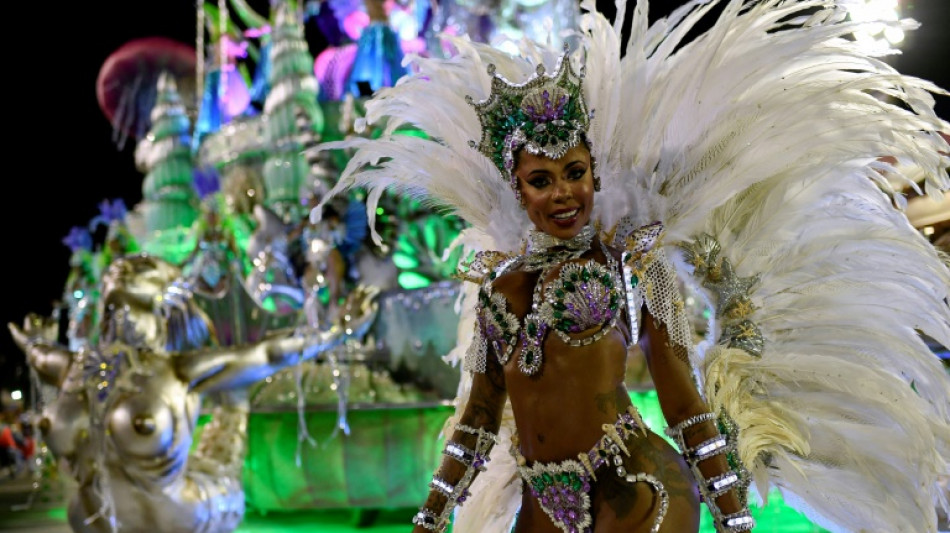
Rio carnival returns to roots after years of 'darkness' / Photo: MAURO PIMENTEL - AFP

 Gauteng Health Department Warns of Rising Antibiotic Resistance Threat

 Bishop Museum Races to Save Rare Megamouth Shark Specimen

 InterContinental Hotels Group PLC Announces Transaction in Own Shares - November 26

 Twickenham Grounds Team Prepares Pitch for Six Matches in Three Days

 Luxembourg Pay Rise Delayed as Regional and World Headlines Develop

 Audience to Choose the Set List at Luxembourg's First FAMIL Jukebox Night

 Raheem Sterling Receives Suspended Sentence After Lamborghini Crash

 Black Friday Discounts Cut Prices on Two Top-Rated Wiper Blades

 TCC Network Linked to 200% Surge in Global School Attacks
Get out the glitter, drums and jewel-encrusted bikinis: Rio de Janeiro will dance through the night at its famed carnival this weekend, a reembrace of samba spirit after the turmoil of Covid-19 and Brazil's bitterly divisive elections.
The world's biggest carnival, which has in reality been under way for weeks with massive street parties, will officially open Friday, and peak Sunday and Monday nights with the annual samba school parade competition.
Rio held a reduced version of carnival last year, postponed by two months because of the pandemic, and minus the epic street parties known as "blocos."
This year, the full-on festival is back -- and the samba schools are racing to put the finishing touches on the sparkling costumes and over-the-top floats that are its trademarks.
"We always give it everything we've got. We work until dawn, we sleep right here, we have no social lives. Whatever it takes to bring people that happiness on carnival day," said Rogerio Sampaio, 54, a prop master at the Viradouro samba school.
The festivities officially start Friday, when Mayor Eduardo Paes symbolically hands the key to the city to "King Momo," the jovial "monarch" who "rules" Rio for carnival.
Paes, an avowed carnival lover, calls it "the greatest show on Earth."
Officials are expecting a sold-out crowd of more than 70,000 people each night at the "Sambadrome," the avenue-turned-stadium where the 12 topflight samba schools will compete for the coveted title of parade champions.
Millions more people will be watching on live TV.
And more than five million are expected for the iconic beach city's street parties.
- Emerging from 'darkness' -
Rio is ready to party, after two years of pandemic disruptions.
Many in the carnival community are also celebrating the end of four years of ex-president Jair Bolsonaro, a critic of carnival whose far-right policies were often a target of protest messages during the samba school parades.
In the parade competition, the samba schools, which were born in Rio's impoverished favelas, assemble thousands of dancers, singers, and drummers and corteges of dazzling floats to tell a story on a chosen theme, vying to wow the jury.
During Bolsonaro's presidency, the shows often included politically charged messages on topics such as racism, intolerance, environmental destruction and Brazil's disastrous management of Covid-19.
This year's parades mark a return to the roots.
Many of the schools chose themes linked to founding figures of the samba genre, the Afro-Brazilian culture from which it emerged, and Brazil's northeast -- the poor, majority-black and -mixed-race region that is the spiritual home of the percussion-heavy musical style.
The northeast voted overwhelmingly for leftist President Luiz Inacio Lula da Silva against Bolsonaro in October's elections.
It's "no coincidence" the region features prominently in this year's carnival, said Leandro Vieira, creative director at the samba school Imperatriz Leopoldinense.
"Carnival is a mirror of Brazil," he told news magazine Veja.
"This is a moment when Brazil needs to reaffirm what's best about itself, after a dark period for both politics and popular culture. This is a time of light after the darkness."
His own school's parade will tell the story of Lampiao, a northeastern outlaw-hero from the 1920s and 30s who has been called Brazil's version of Robin Hood or Jesse James.
- Raking it in -
Beyond sociopolitical messages, this year's carnival will be "a great expression of joy," said Adair Rocha, head of cultural programming at Rio de Janeiro State University.
"It's all about life, about overcoming difficulties," he told AFP.
The city estimates carnival will move 4.5 billion reais ($880 million) for the local economy.
Hotel occupancy rates are expected to top 95 percent.
Rio is ready for the crowds: it has set up 34,000 portable toilets in public areas, and deployed a small army of sanitation workers, who typically clean up around 1,000 tons of carnival trash.
E.Rodriguez--AT
