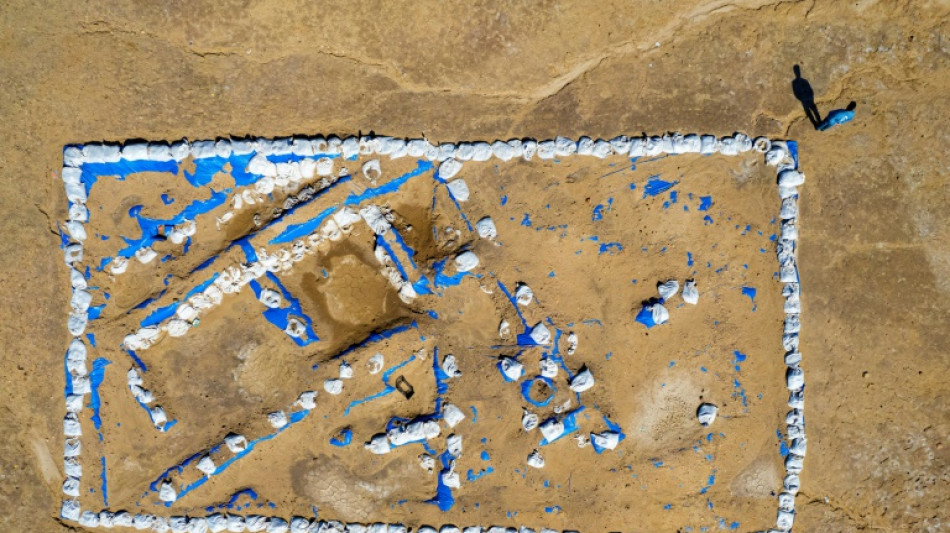
Iraq dig uncovers 5,000 year old pub restaurant / Photo: Asaad NIAZI - AFP

 Gauteng Health Department Warns of Rising Antibiotic Resistance Threat

 Bishop Museum Races to Save Rare Megamouth Shark Specimen

 InterContinental Hotels Group PLC Announces Transaction in Own Shares - November 26

 Twickenham Grounds Team Prepares Pitch for Six Matches in Three Days

 Luxembourg Pay Rise Delayed as Regional and World Headlines Develop

 Audience to Choose the Set List at Luxembourg's First FAMIL Jukebox Night

 Raheem Sterling Receives Suspended Sentence After Lamborghini Crash

 Black Friday Discounts Cut Prices on Two Top-Rated Wiper Blades

 TCC Network Linked to 200% Surge in Global School Attacks
Archaeologists in southern Iraq have uncovered the remains of a tavern dating back nearly 5,000 years they hope will illuminate the lives of ordinary people in the world's first cities.
The US-Italian team made the find in the ruins of ancient Lagash, northeast of the modern city of Nasiriyah, which was already known to have been one of the first urban centres of the Sumerian civilisation of ancient Iraq.
The joint team from the University of Pennsylvania and the University of Pisa discovered the remains of a primitive refrigeration system, a large oven, benches for diners and around 150 serving bowls.
Fish and animal bones were found in the bowls, alongside evidence of beer drinking, which was widespread among the Sumerians.
"So we've got the refrigerator, we've got the hundreds of vessels ready to be served, benches where people would sit... and behind the refrigerator is an oven that would have been used... for cooking food," project director Holly Pittman told AFP.
"What we understand this thing to be is a place where people -- regular people -- could come to eat and that is not domestic," she said.
"We call it a tavern because beer is by far the most common drink, even more than water, for the Sumerians", she said, noting that in one of the temples excavated in the area "there was a beer recipe that was found on a cuneiform tablet".
- 'Regular people' -
The world's first cities developed in what is now southern Iraq, after agricultural surpluses from the domestication of the first crops allowed the emergence of new social classes not engaged directly in food production.
The Lagash area, close to the confluence of the Tigris and Euphrates rivers, was dubbed the "garden of the gods" by the ancients for its fertility and gave rise to a string of Sumerian cities dating back to the early dynastic period.
"Lagash was one of the important cities of southern Iraq," Iraqi archaeologist Baker Azab Wali told AFP, after working with the US-Italian team on the site.
"Its inhabitants depended on agriculture, livestock, fishing, but also on the exchange of goods," he said.
Pittman said the team was eager to learn more about the occupations of the people who used the tavern in its heyday in around 2700 BC to throw new light on the social structure of the first cities.
Detailed analysis would need to be carried out on the samples taken during the excavations the team completed in November.
"There is so much that we do not know about this early period of the emergence of cities and that is what we are investigating," she said.
"We hope to be able to characterise the neighbourhoods and the kinds of occupation... of the people that lived in this big city who were not the elite," she added.
"Most of the work done at the other sites focuses on kings and priests. And that is all very important but the regular people are also important."
A.O.Scott--AT
