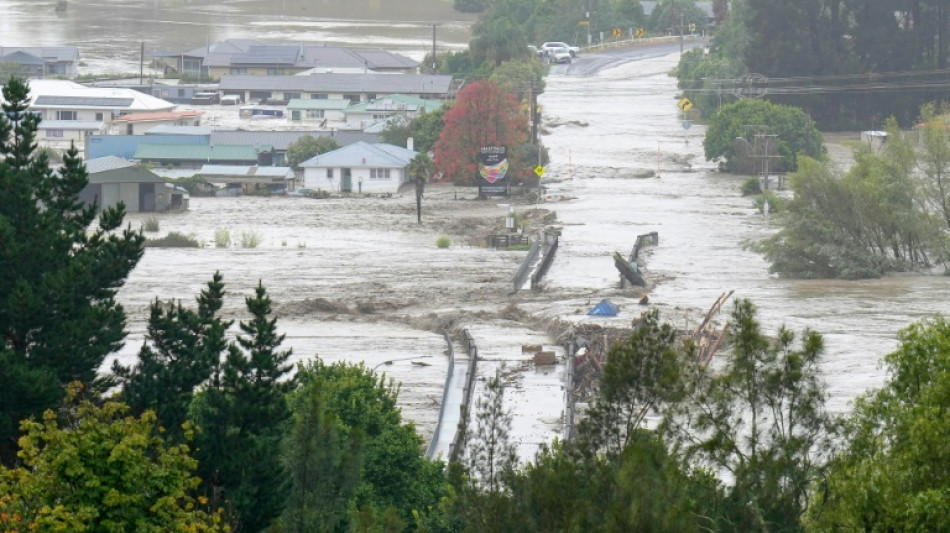
Three dead in New Zealand cyclone / Photo: STR - AFP

 Gauteng Health Department Warns of Rising Antibiotic Resistance Threat

 Bishop Museum Races to Save Rare Megamouth Shark Specimen

 InterContinental Hotels Group PLC Announces Transaction in Own Shares - November 26

 Twickenham Grounds Team Prepares Pitch for Six Matches in Three Days

 Luxembourg Pay Rise Delayed as Regional and World Headlines Develop

 Audience to Choose the Set List at Luxembourg's First FAMIL Jukebox Night

 Raheem Sterling Receives Suspended Sentence After Lamborghini Crash

 Black Friday Discounts Cut Prices on Two Top-Rated Wiper Blades

 TCC Network Linked to 200% Surge in Global School Attacks
Authorities on Wednesday confirmed three deaths after Cyclone Gabrielle cut a trail of destruction across northern New Zealand, with helicopters plucking hundreds from their roofs as floods surged overnight.
One body was found near where a volunteer firefighter went missing during the storm, while another woman was killed when her house was crushed by a landslip in the Hawke's Bay region on the east coast.
A third body was also found in Hawke's Bay, but authorities said the circumstances of that death remained unclear.
Emergency Management Minister Kieran McAnulty said the government was particularly worried about the situation in Hawke's Bay, a sprawling expanse of lush farmland, rugged mountains and hard-to-reach towns.
"There's still gaps in our knowledge. Some areas haven't had communications for a couple of days and we know there's a shortage of food and water," he told radio station Newstalk ZB.
Authorities are now starting to grapple with the full extent of damage in isolated towns where floodwaters washed away roads and cut communications.
About 10,500 people have been displaced from their homes, McAnulty said.
Although electricity is slowly being restored in the north of the country, McAnulty said more than 140,000 people remained without power.
He hailed the "phenomenal" effort of rescue workers and military personnel who plucked "roughly 300 people from rooftops" in Hawke's Bay.
He said a group of 60 people had been rescued from one large building marooned by floodwaters.
McAnulty said New Zealand had a "long path ahead" dealing with damaged roads, homes, and bridges.
"This is a significant disaster which is going to take many weeks for those areas affected to recover.
"We are in this for the long haul."
Authorities on Tuesday announced a national state of emergency for only the third time in the country's history.
More than three-quarters of New Zealand's five million residents live on the North Island, which endured the brunt of the storm.
Cyclone Gabrielle formed off the northeastern coast of Australia in the Coral Sea on February 8, before barrelling across the South Pacific.
It bore down on New Zealand's northern coast on Sunday, bringing gusts of 140 kilometres (87 miles) an hour.
Over the next 24 hours, coastal communities were doused with 20 centimetres (almost eight inches) of rain and pounded by 11-metre (36-foot) waves.
Many parts of northern New Zealand were already waterlogged when Cyclone Gabrielle hit, having been drenched by record rainfall two weeks ago.
W.Moreno--AT
