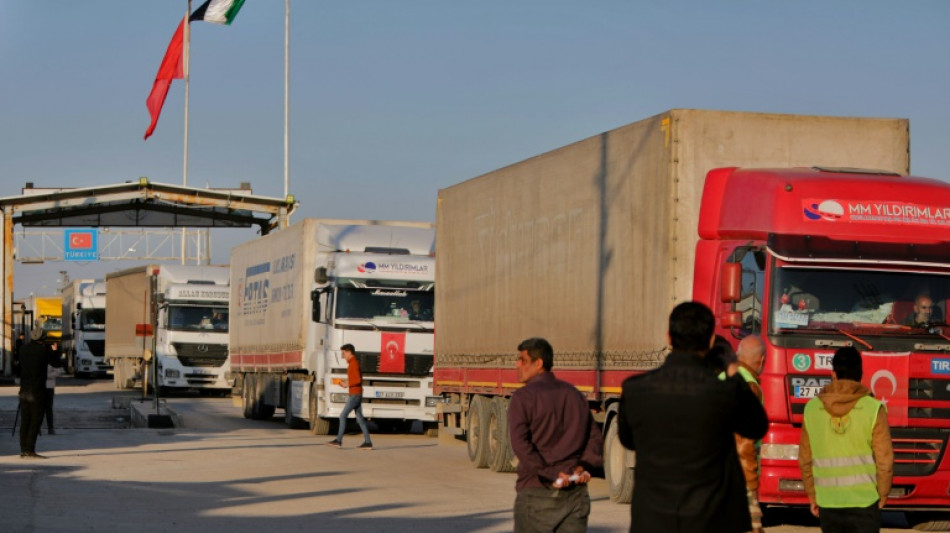
New aid route to rebel-held Syria opens as quake toll nears 40,000 / Photo: Bakr ALKASEM - AFP

 Gauteng Health Department Warns of Rising Antibiotic Resistance Threat

 Bishop Museum Races to Save Rare Megamouth Shark Specimen

 InterContinental Hotels Group PLC Announces Transaction in Own Shares - November 26

 Twickenham Grounds Team Prepares Pitch for Six Matches in Three Days

 Luxembourg Pay Rise Delayed as Regional and World Headlines Develop

 Audience to Choose the Set List at Luxembourg's First FAMIL Jukebox Night

 Raheem Sterling Receives Suspended Sentence After Lamborghini Crash

 Black Friday Discounts Cut Prices on Two Top-Rated Wiper Blades

 TCC Network Linked to 200% Surge in Global School Attacks
An aid convoy on Tuesday passed through a newly re-opened border crossing into rebel-held north Syria, where help has been slow to arrive since last week's earthquake, which killed nearly 40,000 people in the region.
As hopes fade of finding people alive under the debris more than 200 hours after the 7.8-magnitude quake struck, the focus has switched to providing food and shelter to the vast numbers of survivors.
A caravan of 11 United Nations trucks entered Syria through the re-opened Bab al-Salama border point, after Damascus agreed to let the world body use the crossing for aid.
Before the earthquake struck, almost all the crucial humanitarian aid for the more than four million people living in rebel-controlled areas of northwest Syria was being delivered through just one crossing.
The trucks were loaded with essential humanitarian assistance, including shelter materials, mattresses, blankets and carpets, Paul Dillon, a spokesman for the UN's International Organization for Migration (IOM), told AFP.
A UN delegation also travelled from Turkey into the rebel-held area for the first time since the quake on an fact-finding mission.
Activists and emergency teams locally have decried the UN's slow response to the quake in rebel-held areas, contrasting it with the planeloads of humanitarian aid that have been delivered to government-controlled airports.
"I don't want to sit here and give excuses, but I wanted to share that we are all collectively in the same place," Sanjana Quazi, who heads the UN Office for the Coordination of Humanitarian Affairs in Turkey, told reporters in the rebel-held town of Sarmada.
- 'Mind-boggling' -
The UN also launched an appeal for $397 million to cover three months of "life-saving relief" for victims in Syria and said it was close to a similar plan for Turkey.
"Millions of people across the region are struggling for survival, homeless and in freezing temperatures," UN Secretary-General Antonio Guterres said.
Fears have grown for survivors on both sides of the border, with the UN saying more than seven million children have been negatively impacted between Syria and Turkey, and noting fears that "many thousands" more had died.
"It is tragically clear that numbers will continue to grow," said James Elder, spokesman for the UN children's agency UNICEF, adding that the final toll would be "mind-boggling".
Following the disaster, residents faced the hard realities of surviving in cities turned to ruin in the middle of the winter freeze.
In Turkey's Kahramanmaras, huge crowds depended on a single toilet that still functioned in a central mosque.
"There are no toilets, the toilets should be set up in tents," Husne Duz, 53, who has lived with thousands of others in a tent city for the past week.
"I walk five kilometres every day to come here for a toilet. We cannot find any other place," Erdal Lale, 44, told AFP.
The acrid smell of smoke from hundreds of fires lit to keep away the cold permeated much of Turkey's disaster zone.
"We need to take showers. There is a need for washing machines for clothes," Duz said.
- Rescue hopes -
In the devastated Turkish city of Antakya, clean-up teams have been shifting rubble and putting up basic toilets as the telephone network started to come back in parts of the town, an AFP reporter said.
And a week after the February 6 quake toppled buildings across the region, people were still being found alive under the rubble.
In the late afternoon, a middle-aged woman was pulled from the debris and put into an ambulance, according to an AFP team on the ground.
Doctors at the local field hospital were trying to save people who emerged after being buried for days.
"It's a miracle to find a patient still alive under the rubble," doctor Yilmaz Aydin told AFP.
"From now on, the survivors are likely to be in a more critical condition. The majority of them will need life-saving treatment," said Aydin.
One was 25-year-old Syrian woman Abir, who spent 180 hours trapped under the rubble.
"Her heart stopped two times but we managed to bring her back," said doctor Nihat Mujdat Hokenek.
The count has barely changed in Syria for several days and was expected to rise.
burs-sea/jmm
P.A.Mendoza--AT
