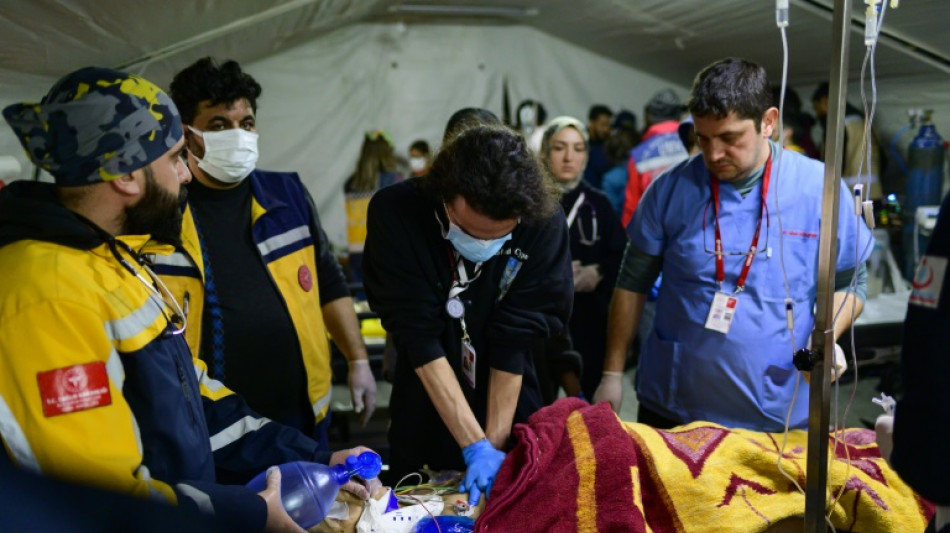
Battle to save lives in field hospital after Turkey quake / Photo: Yasin AKGUL - AFP

 Gauteng Health Department Warns of Rising Antibiotic Resistance Threat

 Bishop Museum Races to Save Rare Megamouth Shark Specimen

 InterContinental Hotels Group PLC Announces Transaction in Own Shares - November 26

 Twickenham Grounds Team Prepares Pitch for Six Matches in Three Days

 Luxembourg Pay Rise Delayed as Regional and World Headlines Develop

 Audience to Choose the Set List at Luxembourg's First FAMIL Jukebox Night

 Raheem Sterling Receives Suspended Sentence After Lamborghini Crash

 Black Friday Discounts Cut Prices on Two Top-Rated Wiper Blades

 TCC Network Linked to 200% Surge in Global School Attacks
After being trapped beneath rubble for 180 hours, 25-year-old Abir is now fighting for her life in a field hospital after a catastrophic earthquake hit Turkey and Syria.
But survival is a battle.
The Syrian woman lies in a field hospital in the southern city of Antakya, where doctors are trying to save people who were pulled out after being buried for days under debris in the freezing cold.
Those who emerge are often barely clinging to life.
When Abir's heart briefly stopped after her miraculous rescue, frantic medics took turns pushing hard and fast on her chest.
It seemed hopeless until suddenly, one medic shouted: "I can hear her pulse!"
Abir is one of tens of thousands of people injured in last week's 7.8-magnitude tremor and its aftershocks, which have claimed more than 35,000 lives.
The death toll is expected to rise.
The wails of ambulance sirens had provided the backdrop for the search and rescue work conducted across the ruins of Antakya's Hatay province since the February 6 quake.
But those wails have fallen silent as the chances of finding people recede.
The focus for emergency doctors like Yilmaz Aydin is on survivors like Abir.
"It's a miracle to find a patient still alive under the rubble," Aydin said.
- 'Most extraordinary rescue' -
In a three-hour period that AFP visited, half a dozen ambulances brought injured victims to the makeshift hospital, which lies near a large Antakya hospital that has been destroyed by the quake.
"From now on, the survivors are likely to be in a more critical condition. The majority of them will need life-saving treatment," said Aydin.
Doctor Nihat Mujdat Hokenek, who is supervising victims' treatment, said Abir had abnormal air and gas in the membrane around the lungs that lines the chest cavity.
"Her heart stopped two times but we managed to bring her back. We did everything the medical literature recommends. And after an hour and a half, she pulled through," he said.
"It was a very special moment, perhaps the most extraordinary rescue of my life" because of the circumstances in which it happened, said Omar, one of the nurses who performed a cardiac massage.
"I've saved many lives but I've never been this happy," she said.
Two other women have been evacuated to a more permanent facility.
"Is my father here? Is my mother here?" one of them said through tears before she was put in a helicopter.
- 'They could survive' -
There can be more miraculous survivals, Hokenek said.
Despite the freezing temperatures, some victims could be stuck in a safe pocket under the rubble, perhaps even with food or water, although Aydin admitted this was rare.
"They could survive for a longer period," he said.
One foreign rescue worker, who declined to give his name, said that for this, "the person must be really young and in good health, hypothermia being an aggravating factor."
Several minutes later, Abir is placed on a stretcher and taken to an ambulance.
But as a helicopter waits to take her to a hospital in Adana, 200 kilometres (120 miles) away, her condition deteriorates once again.
Her life will now be in the hands of the Adana doctors. But she is far from the only one facing an uncertain fate.
Two metres away, another grey-haired victim is undergoing the same procedure by nurses. But AFP did not see the older woman emerge from the emergency treatment.
Turkish authorities say around 80,000 people have been injured.
B.Torres--AT
