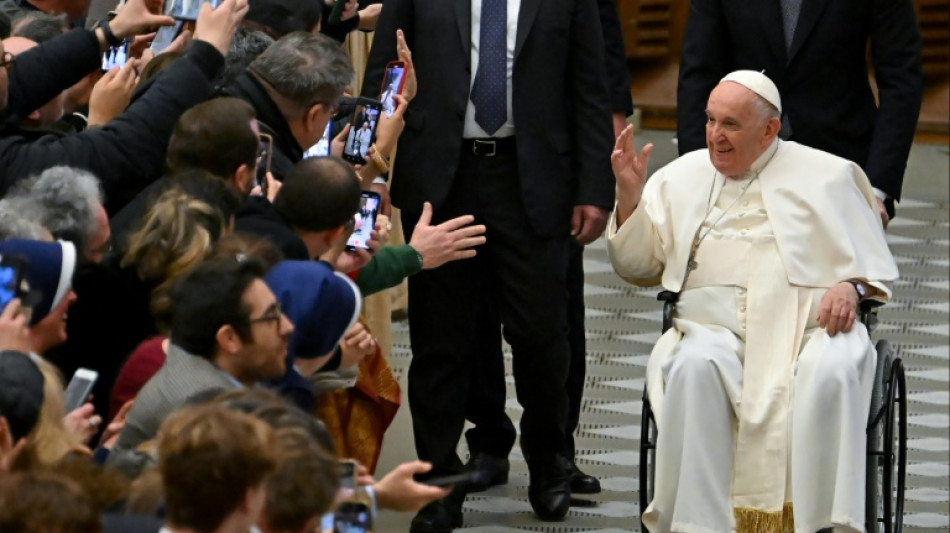
Pope Francis faces 'civil war' at heart of church / Photo: Alberto PIZZOLI - AFP

 Gauteng Health Department Warns of Rising Antibiotic Resistance Threat

 Bishop Museum Races to Save Rare Megamouth Shark Specimen

 InterContinental Hotels Group PLC Announces Transaction in Own Shares - November 26

 Twickenham Grounds Team Prepares Pitch for Six Matches in Three Days

 Luxembourg Pay Rise Delayed as Regional and World Headlines Develop

 Audience to Choose the Set List at Luxembourg's First FAMIL Jukebox Night

 Raheem Sterling Receives Suspended Sentence After Lamborghini Crash

 Black Friday Discounts Cut Prices on Two Top-Rated Wiper Blades

 TCC Network Linked to 200% Surge in Global School Attacks
From his reforms to his foreign relations, criticism of Pope Francis has intensified since the death of his predecessor Benedict XVI, revealing a climate of "civil war" at a time when the Catholic Church is engaged in a global conversation about its future.
Benedict, a conservative German theologian who was pope for eight years before resigning in 2013, died on December 31 at the age of 95.
Within days of his death, his closest aide, Georg Gaenswein, revealed Benedict's concerns at some of the changes made by his successor Pope Francis, notably his decision to restrict the use of the Latin mass.
The criticism was not new. Many in the conservative wing of the Roman Curia, which governs the Church, have long complained the Argentine pontiff is authoritarian and too focused on pastoral matters at the expense of theological rigour.
But it was followed by the death of Australian cardinal George Pell, and the subsequent revelation that he had authored an anonymous note published last year that directly attacked Francis.
The note had described the current papacy as a "catastrophe", and among others criticised "heavy failures" of Vatican diplomacy under his watch.
Pell, a former close adviser to Francis, was jailed for child sexual abuse before being acquitted in 2020.
Then, at the end of the month, German Cardinal Gerhard Mueller published a book adding fuel to the fire.
The former head of the Vatican's powerful congregation for the doctrine of the faith denounced Francis' "doctrinal confusion" and criticised the influence of a "magic circle" around him.
- Civil war -
Mueller's book caused consternation among some inside the Vatican.
"When you accept a cardinal's cap, you agree to support and help the pope. Criticisms are made in private, not in public," said one senior official in the Secretariat of State.
Pope Francis himself told reporters on his plane back from South Sudan last Sunday that his critics have "exploited" Benedict's death to further their cause.
"And those who exploit such a good person, such a man of God... well I would say they are unethical people, they are people belonging to a party, not to the Church," he said.
Italian Vatican expert Marco Politi said Mueller's book "is a new stage in the unstoppable escalation by the pope's adversaries".
"There is a civil war in the heart of the church which will continue until the last day of the papacy," he told AFP.
- Global consultations -
The tensions come as the Catholic Church conducts a vast global consultation on its future, the "Synod on Synodality" launched by Pope Francis in 2021.
Designed to decentralise the governance of the church, it has revealed key differences, with the German Catholic Church, for example, showing distinctly more appetite for reform than Rome.
Discussions include everything from the place of women in the church to how to handle the scandal of child sex abuse, from whether priests should marry to how the Church welcomes LGBTQ believers.
With the synod, which is due to conclude in 2024, "we will see the weight of the different currents within the Church", Politi said.
He said critics of Pope Francis are already converging into a "current of thought capable of influencing the next conclave", and by extension the next papacy.
A conclave, a global gathering of cardinals, would be called if Francis died or resigned.
The pope has said he would be willing to follow Benedict's example and resign if his health stopped him doing his job.
But despite knee problems that have seen him use a wheelchair in recent months, he remains active and in charge -- and extremely popular all over the world, as the crowds during his recent trip to Africa showed.
"This knee is annoying, but I go on, slowly, and we'll see," the 86-year-old said on Sunday, quipping: "You know that the bad weed never dies!"
R.Lee--AT
