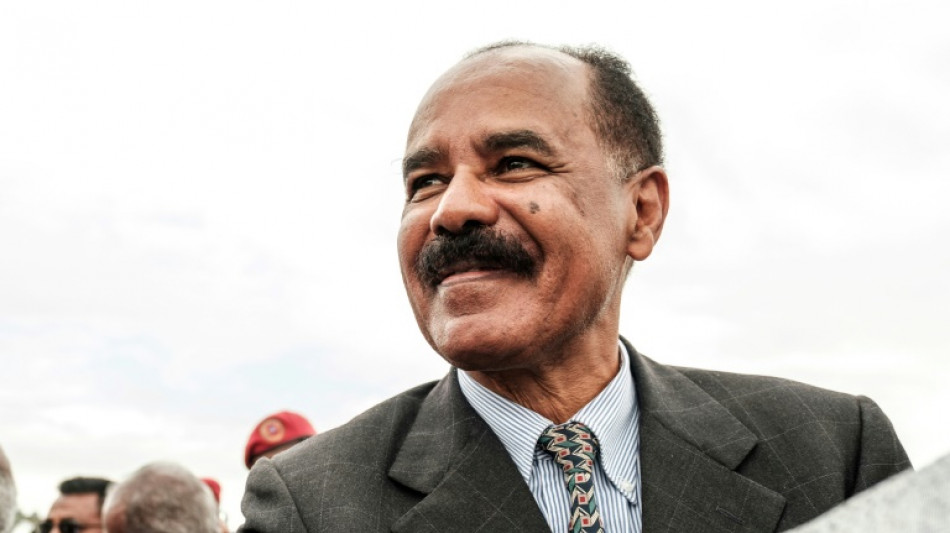
Eritrea leader calls Tigray rights abuse claims a 'fantasy' / Photo: EDUARDO SOTERAS - AFP/File

 Gauteng Health Department Warns of Rising Antibiotic Resistance Threat

 Bishop Museum Races to Save Rare Megamouth Shark Specimen

 InterContinental Hotels Group PLC Announces Transaction in Own Shares - November 26

 Twickenham Grounds Team Prepares Pitch for Six Matches in Three Days

 Luxembourg Pay Rise Delayed as Regional and World Headlines Develop

 Audience to Choose the Set List at Luxembourg's First FAMIL Jukebox Night

 Raheem Sterling Receives Suspended Sentence After Lamborghini Crash

 Black Friday Discounts Cut Prices on Two Top-Rated Wiper Blades

 TCC Network Linked to 200% Surge in Global School Attacks
Eritrean President Isaias Afwerki said Thursday that allegations of rights abuses by Eritrean troops in Ethiopia's Tigray region during the two-year war there amounted to "fantasy".
"This is a fantasy in the minds of those who are... in this factory I call a factory of fabricating misinformation," Isaias told reporters during a visit to Kenya, deflecting questions about the presence of Eritrean troops in Ethiopia.
Eritrea's army supported Ethiopian forces during the federal government's war against the Tigray People's Liberation Front (TPLF) and has been accused by the United States and rights groups of some of the conflict's worst atrocities.
The war ended with a peace deal signed in November last year that called for the withdrawal of foreign forces, but there was no specific mention of Eritrea, whose regime considers the TPLF its arch-enemy.
Asmara was not a party to the agreement and its troops continue to be present in parts of Tigray, according to residents who accuse the soldiers of murder, rape and looting.
Asked about the continued presence of Eritrean troops in Tigray, Isaias said: "I have no intention of interfering in this matter in spite of the disinformation campaign going on trying to disrupt the process of peace in Ethiopia and trying to create conflict between Eritrea and Ethiopia."
"Don't take Eritrea as a pretext for the problems in Ethiopia or elsewhere in the whole region. Don't try to drag us into a situation. It is a fantasy of those who want to derail any peace process achieving its goal," he added.
One of the world's most authoritarian states, Eritrea was sanctioned by the United States in 2021 following its decision to send troops into Tigray in support of Ethiopia and has been accused of massacring hundreds of civilians.
- 'Ongoing withdrawal' -
The devastating conflict in northern Ethiopia that erupted in November 2020 has killed untold numbers of civilians, displaced more than two million and left millions more in need of humanitarian aid.
Under the terms of the peace deal, the TPLF agreed to disarm and re-establish the authority of the federal government in return for the restoration of access to Tigray, which was largely cut off from the outside world during the war.
Since the peace agreement, there has been some resumption of aid deliveries to Tigray, which has long faced dire shortages of food, fuel, cash and medicines.
Basic services such as communications, banking and electricity are slowly being restored to the stricken region of six million people, with national carrier Ethiopian Airlines resuming commercial flights between Addis Ababa and Tigray's capital Mekele in December.
The TPLF announced it has begun disarming, while the United States said late last month there was an "ongoing withdrawal" of Eritrean troops from Tigray.
Access to Tigray is restricted, and it is impossible to verify independently the situation on the ground.
Ethiopia's government and the TPLF agreed to create a joint monitoring body to ensure that the peace deal was respected by all sides and any violations addressed, with its members set to hold their first meeting on Friday.
Estimates of casualties from the brutal conflict vary widely, with the United States saying that as many as half a million people have died.
M.White--AT
