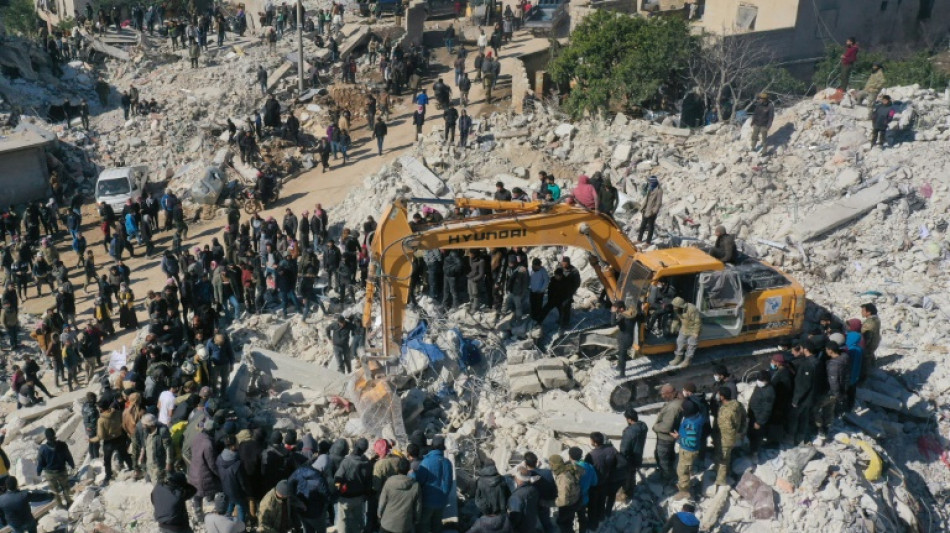
UN pleads for access to deliver quake relief to NW Syria / Photo: Omar HAJ KADOUR - AFP

 Gauteng Health Department Warns of Rising Antibiotic Resistance Threat

 Bishop Museum Races to Save Rare Megamouth Shark Specimen

 InterContinental Hotels Group PLC Announces Transaction in Own Shares - November 26

 Twickenham Grounds Team Prepares Pitch for Six Matches in Three Days

 Luxembourg Pay Rise Delayed as Regional and World Headlines Develop

 Audience to Choose the Set List at Luxembourg's First FAMIL Jukebox Night

 Raheem Sterling Receives Suspended Sentence After Lamborghini Crash

 Black Friday Discounts Cut Prices on Two Top-Rated Wiper Blades

 TCC Network Linked to 200% Surge in Global School Attacks
A leading United Nations official on Wednesday called for the facilitation of aid access to rebel-held areas in Syria's northwest, warning that relief stocks will soon be depleted.
Rebel-held areas near Turkey's border -- hard hit by the 7.8 magnitude earthquake that struck on Monday -- cannot receive aid from government-held parts of Syria without Damascus's authorisation.
"Put politics aside and let us do our humanitarian work," the UN's resident Syria coordinator El-Mostafa Benlamlih said in an interview with AFP, warning: "We can't afford to wait and negotiate. By the time we negotiate, it's done, it's finished."
Monday's earthquake devastated entire sections of major cities in Turkey and Syria, killing more than 11,700 people, injuring thousands more and leaving many more without shelter in the winter cold.
In Syria alone, at least 2,662 people have been killed, according to the government and rescuers in rebel-held areas.
Speaking to AFP from Damascus, Benlamlih said the destruction in government-held provinces "is huge".
"But we know also that the destruction in the northwest is huge and we need to get there to assess," he said.
"We still have to negotiate and we still have to get access to, for example, the northwest area, it's not easy."
No fresh deliveries have been sent to the region from within Syria in about three weeks, according to the UN official.
The UN has some stocks in the area -- enough to feed 100,000 people for one week, he said.
"Once it's depleted, we need to replenish and this is my call," he said.
"We need the support of all interested parties to facilitate access, be it to the northwest of Syria or to the rest of Syria because there also, they are suffering."
On Tuesday, the UN said the sole border crossing used to shuttle life-saving aid from Turkey into conflict-ravaged Syria has seen its operations disrupted.
But the UN's regional humanitarian coordinator for Syria said Wednesday that he hoped aid delivery could resume as soon as the next day.
"Luckily today we are hearing that the road is opening, we do have a possibility hopefully to access the border," Muhannad Hadi said, adding that the UN was working with Turkish authorities.
"We are hoping that tomorrow we will be able to deliver something and cross the border," he told a news conference, noting that trucks were ready to leave if necessary.
But he cautioned that there was some uncertainty about the road on the Syrian side, citing information that was "hard to verify."
Since 2011, Syria's war has killed nearly half a million people and forced around half of the country's prewar population from their homes, with many seeking refuge in Turkey.
Even before Monday's earthquake, the majority of the population was in need of humanitarian assistance. The latest disaster has only piled on more misery.
"This is a crisis over a crisis," Benlamlih said.
"There is not enough equipment for the search and rescue, there is not enough medical equipment, there is not enough medicine."
Th.Gonzalez--AT
