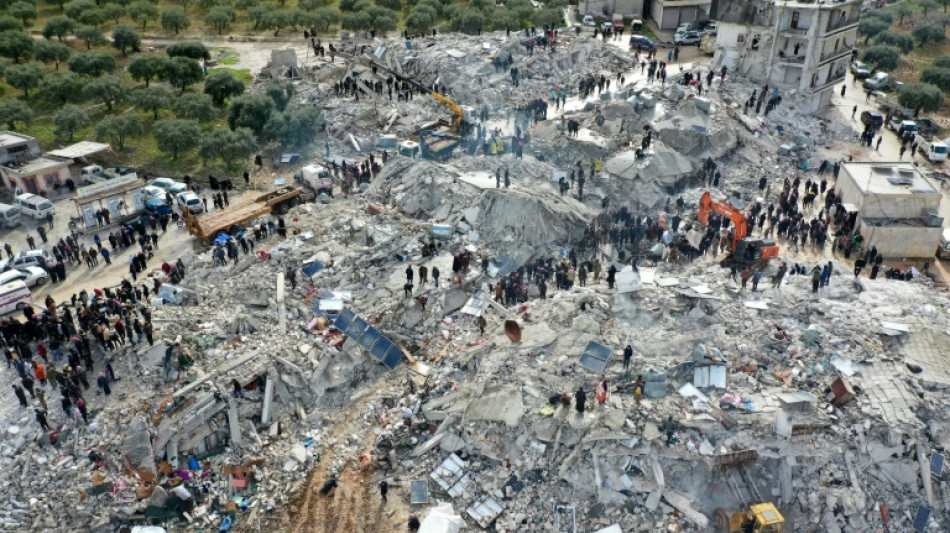
Turkey, Syria quake could affect up to 23 mn: WHO / Photo: Omar HAJ KADOUR - AFP

 Gauteng Health Department Warns of Rising Antibiotic Resistance Threat

 Bishop Museum Races to Save Rare Megamouth Shark Specimen

 InterContinental Hotels Group PLC Announces Transaction in Own Shares - November 26

 Twickenham Grounds Team Prepares Pitch for Six Matches in Three Days

 Luxembourg Pay Rise Delayed as Regional and World Headlines Develop

 Audience to Choose the Set List at Luxembourg's First FAMIL Jukebox Night

 Raheem Sterling Receives Suspended Sentence After Lamborghini Crash

 Black Friday Discounts Cut Prices on Two Top-Rated Wiper Blades

 TCC Network Linked to 200% Surge in Global School Attacks
Up to 23 million people could be affected by the massive earthquake that has killed thousands in Turkey and Syria, the WHO warned on Tuesday, promising long-term assistance.
"Event overview maps show that potentially 23 million people are exposed, including around five million vulnerable populations," the World Health Organization's senior emergencies officer Adelheid Marschang said.
"Civilian infrastructure and potentially health infrastructure have been damaged across the affected region, mainly in Turkey and northwest Syria," she said.
The WHO "considers that the main unmet needs may be in Syria in the immediate and mid-term," Marschang told the WHO's executive committee in Geneva.
She spoke as rescuers in Turkey and Syria braved freezing cold, aftershocks and collapsing buildings, as they dug for survivors buried by a string of earthquakes that killed more than 5,000 people.
"It is now a race against time," said WHO chief Tedros Adhanom Ghebreyesus, explaining that the UN health agency was urgently sending aid to the area.
"We're mobilising emergency supplies and we have activated the WHO network of emergency medical teams to provide essential health care for the injured and most vulnerable."
Disaster agencies said several thousand buildings were flattened in cities across a vast Turkey-Syria border region -- pouring misery on an area already plagued by war, insurgency, refugee crises and a recent cholera outbreak.
Through the night, survivors used their bare hands to pick over the twisted ruins of multi-storey apartment blocks -- trying to save family, friends and anyone else sleeping inside when the first massive 7.8-magnitude quake struck early Monday.
The situation is particularly dire in northern Syria, which has already been decimated by years of war.
"The movement of aid through the border into northwest Syria is likely to be or is already disrupted due to the damage caused by the earthquake," Marschang said.
"This in itself would be a huge crisis already."
She addressed a special meeting on the tragedy, which held a minute's silence for the victims.
The WHO chief vowed that the agency would "work closely with all partners to support authorities in both countries in the critical hours and days ahead, and in the months and years to come as both countries recover and rebuild."
M.White--AT
