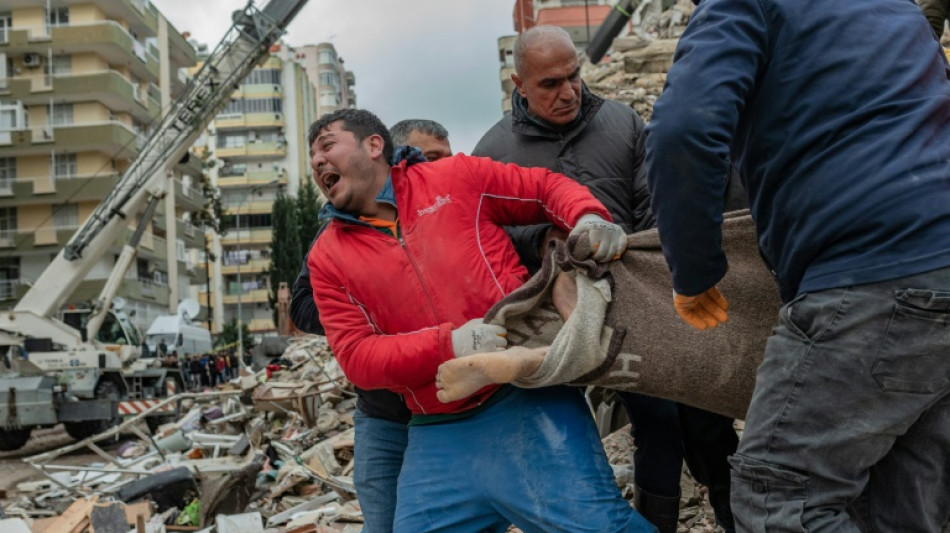
Earthquake kills more than 3,000 in Turkey, Syria / Photo: Can EROK - AFP

 Gauteng Health Department Warns of Rising Antibiotic Resistance Threat

 Bishop Museum Races to Save Rare Megamouth Shark Specimen

 InterContinental Hotels Group PLC Announces Transaction in Own Shares - November 26

 Twickenham Grounds Team Prepares Pitch for Six Matches in Three Days

 Luxembourg Pay Rise Delayed as Regional and World Headlines Develop

 Audience to Choose the Set List at Luxembourg's First FAMIL Jukebox Night

 Raheem Sterling Receives Suspended Sentence After Lamborghini Crash

 Black Friday Discounts Cut Prices on Two Top-Rated Wiper Blades

 TCC Network Linked to 200% Surge in Global School Attacks
A major earthquake struck Turkey and Syria on Monday, killing more than 3,000 people and flattening thousands of buildings as rescuers dug with bare hands for survivors.
Dozens of nations have pledged aid since the 7.8-magnitude quake, which hit as people were still sleeping and amid freezing weather that has hampered emergency efforts.
Multi-storey apartment buildings full of residents were among the 5,606 structures reduced to rubble in Turkey, while Syria announced dozens of collapses, as well as damage to archaeological sites in Aleppo.
"That was the first time we have ever experienced anything like that," said Melisa Salman, a 23-year-old reporter in the southeastern Turkish city of Kahramanmaras.
"We thought it was the apocalypse."
The head of Syria's National Earthquake Centre, Raed Ahmed, called it "the biggest earthquake recorded in the history of the centre".
The initial quake was followed by dozens of aftershocks, including a 7.5-magnitude tremor that jolted the region in the middle of search and rescue work on Monday.
"We managed to save three people, but two were dead," said Halis Aktemur, 35, in Turkey's southeastern city of Diyarbakir after the quake that was felt as far away as Greenland.
In the southeastern Turkish city of Sanliurfa, rescuers were working into the night to try and pull survivors from the wreckage of a seven-storey building that had collapsed.
"There is a family I know under the rubble," said 20-year-old Syrian student Omer El Cuneyd.
"Until 11:00 am or noon, my friend was still answering the phone. But she no longer answers. She is down there."
Despite temperatures falling below zero, frightened residents in the city were preparing to spend the night on the streets, huddling around fires to warmth.
Nearby Mustafa Koyuncu was sitting packed inside his stationary car with his wife and their five children, scared to move.
"We are waiting here because we can't go home," the 55-year-old told AFP. "Everyone is afraid."
- 'Apocalypse' -
At least 1,293 people died across Syria, the government and rescuers said.
Turkish government officials reported another 1,762 fatalities, putting the combined total at 3,055.
Turkey declared seven days of mourning for the dead.
Monday's first earthquake struck at 4:17am (0117 GMT) at a depth of about 18 kilometres (11 miles) near the Turkish city of Gaziantep, which is home to around two million people, the US Geological Survey said.
Denmark's geological institute said tremors reached the east coast of Greenland about eight minutes after the main quake struck Turkey.
More than 12,000 people are injured in Turkey, the disaster management agency said, while Syria said at least 3,411 people were injured.
- 'People under debris' -
Osama Abdel Hamid, a quake survivor in Syria, said his family was sleeping when the shaking began.
"The walls collapsed over us, but my son was able to get out," he said.
"He started screaming and people gathered around, knowing there were survivors, and they pulled us out from under the rubble."
The United States, the European Union and Russia all immediately sent condolences and offers of help.
Ukrainian President Volodymyr Zelensky offered to provide "the necessary assistance" to Turkey, whose combat drones are helping Kyiv fight the Russian invasion.
Images on Turkish television showed rescuers digging through rubble across neighbourhoods of almost all the big cities running along the border with Syria.
Some of the heaviest devastation occurred near the quake's epicentre between Kahramanmaras and Gaziantep, where entire city blocks lay in ruins under gathering snow.
A famous mosque dating back to the 13th century partially collapsed in the province of Maltaya, along with a 14-story building with 28 apartments that housed 92 people.
- Power outages -
The Syrian health ministry reported damage across the provinces of Aleppo, Latakia, Hama and Tartus, where Russia is leasing a naval facility.
AFP correspondents in northern Syria said terrified residents ran out of their homes after the ground shook.
Even before the tragedy, buildings in Aleppo -- Syria's pre-war commercial hub -- often collapsed due to the dilapidated infrastructure, which has suffered from lack of war-time oversight.
Officials cut off natural gas and power supplies across the region as a precaution, also closing schools for two weeks.
Turkey is in one of the world's most active earthquake zones.
The Turkish region of Duzce suffered a 7.4-magnitude earthquake in 1999, when more than 17,000 people died.
Experts have long warned a large quake could devastate Istanbul, a megalopolis of 16 million people filled with rickety homes.
burs-rox/ach
A.O.Scott--AT
