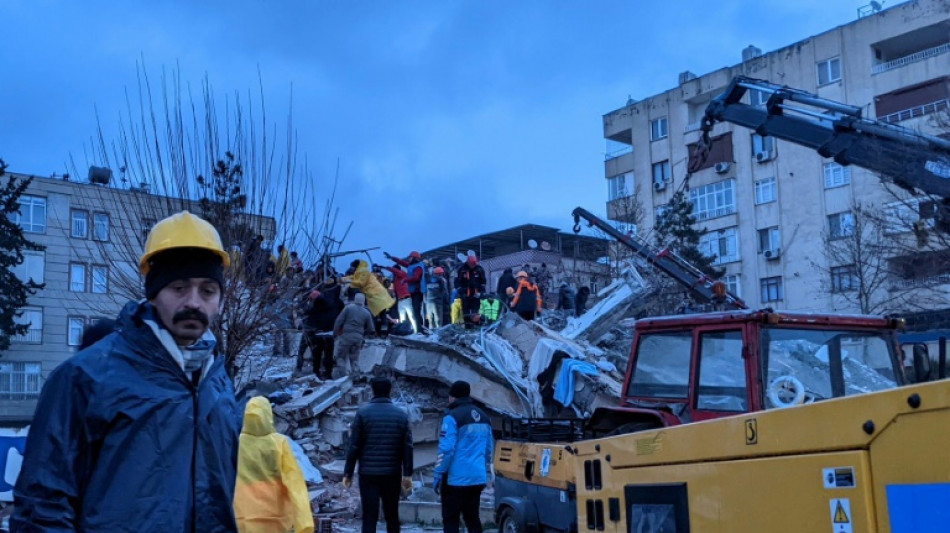
Silent phones, freezing rain and anguish in Turkey quake / Photo: REMI BANET - AFP

 Gauteng Health Department Warns of Rising Antibiotic Resistance Threat

 Bishop Museum Races to Save Rare Megamouth Shark Specimen

 InterContinental Hotels Group PLC Announces Transaction in Own Shares - November 26

 Twickenham Grounds Team Prepares Pitch for Six Matches in Three Days

 Luxembourg Pay Rise Delayed as Regional and World Headlines Develop

 Audience to Choose the Set List at Luxembourg's First FAMIL Jukebox Night

 Raheem Sterling Receives Suspended Sentence After Lamborghini Crash

 Black Friday Discounts Cut Prices on Two Top-Rated Wiper Blades

 TCC Network Linked to 200% Surge in Global School Attacks
A stream of cars crawled north out of the shattered city of Sanliurfa, taking traumatised residents a little further from the scene of Turkey's most powerful earthquake in decades.
On the opposite side of the road, a distraught family walked in the freezing rain, their belongings piled into a stroller, looking for shelter to spend the night.
Sanliurfa, one of the bigger cities of southeastern Turkey, was hammered by the massive quake that claimed at least 3,000 lives across the mostly Kurdish region and neighbouring Syria.
The disaster toppled nearly 3,500 buildings across 10 provinces, injuring more than 11,000 people and leaving an unknown number trapped under debris.
The sheer scale of the disaster seemed overwhelming.
But it came into focus on one of Sanliurfa's main boulevards, where dozens of rescuers were trying to pull survivors from a seven-story building that was reduced to mounds of dirt and debris.
At least 30 people are known to have died in this province, where 200 buildings crumbled from the 7.8-magnitude pre-dawn tremor and incessant waves of aftershocks.
Omer El Cuneyd hoped against hope that it would not climb here any further.
"There is a family I know under the rubble," said the 20-year-old Syrian student, who lives nearby.
"Until 11:00 am or noon, my friend was still answering the phone. But she no longer answers. She is down there. I think her battery ran out," he said, trying to stay positive.
- 'We will stay' -
But it was no simple task -- In front of him lay the gutted remains of a sofa, a chair with splintered metal legs, and some torn curtains, all signs of the calm, simple life left behind.
Dozens of people tried to lift huge chunks of concrete debris, urgently listening for hints of life.
They would take silent pauses, peering into the rubble, filled with a mixture of exhaustion, anguish and hope.
Omer said he and his friends would stay here all night, no matter the rain and cold.
"I have to," he said.
A short walk away, Emin Kacmaz huddled around an improvised fire he built up with his three salesmen outside their furniture store.
Wrapped tightly in threadbare blankets, the stood guarding the shattered shop from thieves.
The store's gigantic windows were shattered and its huge columns cracked, barely able to support the seven stories of the damaged building looming ominously overhead.
"The building is not safe," the 30-year-old said, but he was not about to budge.
"We will stay here all night. It's our livelihood."
- 'Everyone is afraid' -
A few hundred metres away, in a parking lot on the same avenue, Mustafa Koyuncu, 55, his wife and their five children sat crammed in a white car.
They were not moving -- few people seemed to be.
"We are waiting here because we can't go home. For the moment, it is forbidden," Koyuncu said, referring to a government order for everyone to stay out on the street for their safety.
He still held out some hope of being able to return home later Monday.
But if that did not work out, they would all head to a neighbourhood mosque, which like many others has been transformed into a reception centre.
"Our building is safe," Koyuncu insisted.
His oldest daughter dared to disagree.
"No, he's not so sure it is!" she interjected.
The father's reassuring tone quickly faded.
"Who isn't afraid right now?" he conceded. "Everyone is afraid."
H.Gonzales--AT
