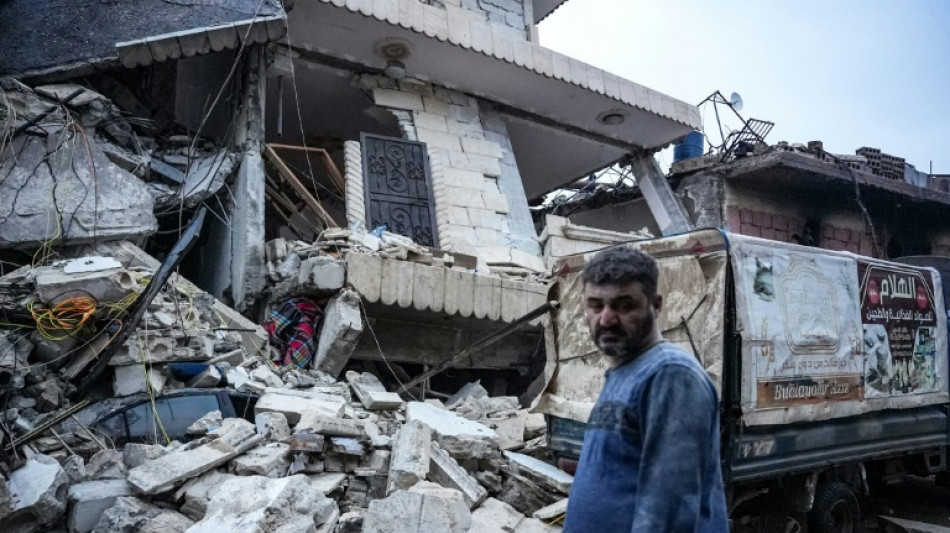
What we know about the Turkey and Syria earthquake / Photo: Rami al SAYED - AFP

 Gauteng Health Department Warns of Rising Antibiotic Resistance Threat

 Bishop Museum Races to Save Rare Megamouth Shark Specimen

 InterContinental Hotels Group PLC Announces Transaction in Own Shares - November 26

 Twickenham Grounds Team Prepares Pitch for Six Matches in Three Days

 Luxembourg Pay Rise Delayed as Regional and World Headlines Develop

 Audience to Choose the Set List at Luxembourg's First FAMIL Jukebox Night

 Raheem Sterling Receives Suspended Sentence After Lamborghini Crash

 Black Friday Discounts Cut Prices on Two Top-Rated Wiper Blades

 TCC Network Linked to 200% Surge in Global School Attacks
A large earthquake hit southeastern Turkey and neighbouring Syria in the early hours of Monday, devastating cities and killing or injuring thousands.
Here's what we know about the disaster so far:
- When and where -
The first 7.8-magnitude quake struck at 04:17 am (0117 GMT) at a depth of about 18 kilometres (11 miles) near the Turkish city of Gaziantep, which is home to around two million people, the US Geological Survey said.
It was followed by a slightly smaller 7.5-magnitude tremor and more than 50 aftershocks.
The quakes devastated entire sections of major cities in Turkey and war-ravaged Syria.
The region is also filled with millions who have fled the civil war in Syria and other conflicts.
- Casualties -
More than 2,300 people have been killed and thousands more injured, authorities and medical sources reported, with efforts ongoing to save those trapped under rubble.
At least 810 people have died in rebel and government-controlled parts of Syria, state media and medical sources said.
Another 1,498 people died in Turkey, according to the emergency services.
The rescue was being hampered by a winter blizzard that covered major roads in ice and snow. Turkish officials said the quake made three major airports in the area inoperable, further complicating deliveries of vital aid.
- Destruction -
Some of the heaviest devastation occurred near the quake's epicentre between Kahramanmaras and Gaziantep, where entire city blocks lay in ruins.
Turkey said nearly 3,000 buildings had collapsed in seven different provinces, including public hospitals.
A famous mosque dating back to the 13th century partially collapsed in the province of Maltaya, where a 14-story building with 28 apartments that housed 92 people collapsed.
Social media posts showed a 2,200-year-old hilltop castle built by Roman armies in Gaziantep lying in ruins, its walls partially turned to rubble.
In Syria, the health ministry reported damage across the provinces of Aleppo, Latakia, Hama and Tartus, where Russia is leasing a naval facility.
Dozens of building collapsed in the quake, particularly in the pre-war commercial hub of Aleppo, a UNESCO World Heritage Site.
Even before the tragedy, buildings in Aleppo often collapsed due to poor infrastructure and many buildings there are dilapidated after more than a decade of war.
- International aid -
Condolences and offers of aid have poured in, including from the European Union, the United Nations, NATO, Washington and Russia.
Despite political tensions, both Greece and Sweden pledged their support for Turkey.
Russian President Vladimir Putin said Moscow was sending rescue teams to both countries, while Ukrainian President Volodymyr Zelensky offered to provide "the necessary assistance" to Turkey.
Israel's Prime Minister Benjamin Netanyahu said he had given the go-ahead to send aid to Syria, after receiving a request through diplomatic channels since the neighbours have no official relations.
K.Hill--AT
