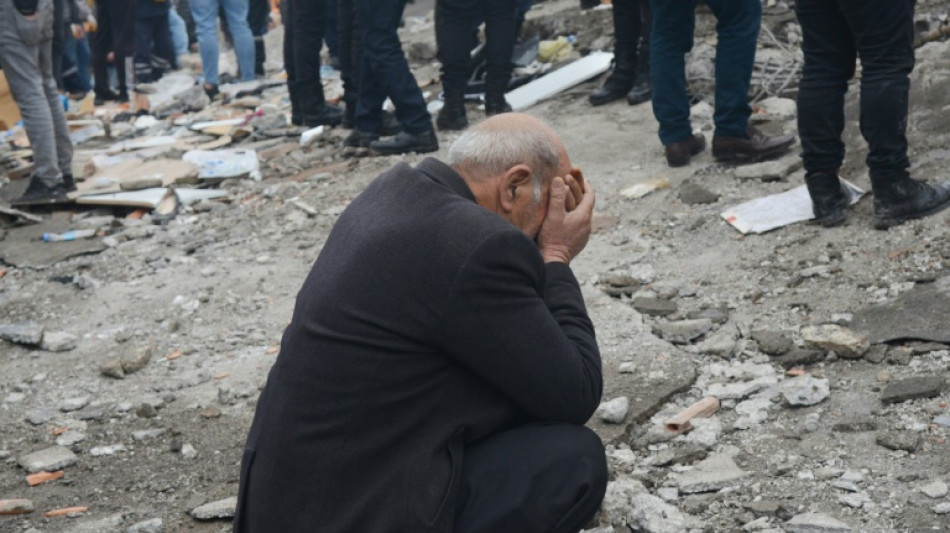
'So scared': Fear of aftershocks in debris-strewn Turkey / Photo: ILYAS AKENGIN - AFP

 Gauteng Health Department Warns of Rising Antibiotic Resistance Threat

 Bishop Museum Races to Save Rare Megamouth Shark Specimen

 InterContinental Hotels Group PLC Announces Transaction in Own Shares - November 26

 Twickenham Grounds Team Prepares Pitch for Six Matches in Three Days

 Luxembourg Pay Rise Delayed as Regional and World Headlines Develop

 Audience to Choose the Set List at Luxembourg's First FAMIL Jukebox Night

 Raheem Sterling Receives Suspended Sentence After Lamborghini Crash

 Black Friday Discounts Cut Prices on Two Top-Rated Wiper Blades

 TCC Network Linked to 200% Surge in Global School Attacks
Tulin Akkaya had just started to gather her thoughts after being woken by the biggest earthquake to strike Turkey in nearly a century when a second massive jolt sent her scrambling for safety on the street.
Buildings lay in ruins around her southeastern city of Diyarbakir -- home to many of the millions who have fled war and poverty in neighbouring Syria.
The same crescent of devastation stretched across major cities running along the two countries' border in the wake of the 7.8-magnitude pre-dawn quake.
Officials have put the combined death tell at more than 1,500.
It was certain to grow and Akkaya was trying to piece together the remains of her life when a second jolt shook her house and sent her rushing out of her apartment.
"I am so scared. I felt (the aftershock) so strongly because I live on the top floor," the 30-something housewife said.
"We rushed outside in panic. It was almost the same as the morning's earthquake. I can't go back to my apartment now, I don't know what will happen next."
- 'Apocalypse' -
The aftershock was registered at a magnitude of 7.5 -- a size that scientists say strikes only around 20 times around the world a year.
That two earthquakes of that strength hit the same remote and largely undeveloped area in rapid succession underscores the scale of the challenge facing rescuers and recovery workers in both Turkey and Syria.
Officials counted more than 50 aftershocks within the first 10 hours of the initial disaster. They warned that more would rumble on for many more days.
The relentless shacking sent damaged buildings crumbling in both Diyarbakir and nearby cities such as Kahramanmaras.
The second big blow came just as survivors had started to wonder back into their apartments to pick up belongings that could help them survive the cold night ahead.
Most of the region has lost access to gas and power. The weather service was promising rain and sleet across southeastern Turkey for much of the remaining week.
"Since I live in an earthquake zone, I am used to being shaken," said Kahramanmaras-based reporter Melisa Salman.
"But that was the first time we have ever experienced anything like that," the 23-year-old told AFP. "We thought it was the apocalypse."
- Child pulled out alive -
There were some glimmers of hope and rays of joy.
Turkish television and social media periodically lit up Monday with news that a child had been pulled alive from under huge slabs of concrete debris.
NTV television showed a little girl named Zehra -- looking slightly dazed and asking for her father -- being wrapped in a wool blanket and put in the back of a waiting sedan.
The medical car then drove off through the snow-cowered street as the crowd dispersed in search of new survivors.
The 35-year-old was among the first to arrive on the scene of the first big building to collapse in his predominantly Kurdish city.
"We managed save three people, but two were dead," Aktemur recalled. "After the second quake, I can't go anywhere. I am thinking they will need my help again."
T.Wright--AT
