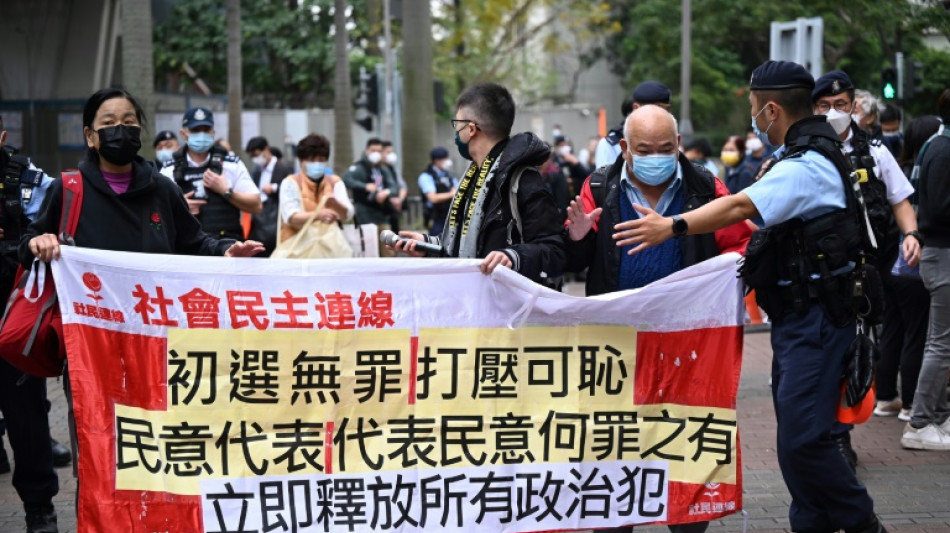
Hong Kong's largest national security trial opens / Photo: Peter PARKS - AFP

 Gauteng Health Department Warns of Rising Antibiotic Resistance Threat

 Bishop Museum Races to Save Rare Megamouth Shark Specimen

 InterContinental Hotels Group PLC Announces Transaction in Own Shares - November 26

 Twickenham Grounds Team Prepares Pitch for Six Matches in Three Days

 Luxembourg Pay Rise Delayed as Regional and World Headlines Develop

 Audience to Choose the Set List at Luxembourg's First FAMIL Jukebox Night

 Raheem Sterling Receives Suspended Sentence After Lamborghini Crash

 Black Friday Discounts Cut Prices on Two Top-Rated Wiper Blades

 TCC Network Linked to 200% Surge in Global School Attacks
Hong Kong's largest national security trial opened Monday with dozens of pro-democracy figures accused of trying to topple the government in a case critics say reflects the criminalisation of dissent in the Chinese territory.
The 47 defendants, who include some of the city's most prominent activists, face up to life in prison if convicted.
Sixteen of them have pleaded not guilty to charges of "conspiracy to commit subversion" related to their involvement in an unofficial primary election organised ahead of legislature polls.
The other 31 have pleaded guilty and will be sentenced after the trial.
A rare, small protest erupted before the court convened, with supporters carrying a banner that read "Crackdown is shameless" and "Immediately release all political prisoners".
Another protester was seen raising a fist in solidarity as a large number of police stood nearby.
More than 100 people had queued outside the court, some overnight, in the hopes of seeing the trial begin.
The defendants say they are being persecuted for routine politics, while rights groups and observers say the trial illustrates how the legal system is being used to crush what remains of the opposition.
Most of the group have already spent nearly two years behind bars.
They now face proceedings expected to last more than four months, overseen by judges handpicked by the government.
Theirs is the largest case to date under the sweeping national security law that China imposed on Hong Kong after democracy protests in 2019.
Beijing says the law was needed to curb the unrest, which brought tear gas and police brawls onto the streets of the Asian financial hub.
Wielded against students, unionists and journalists, the law has transformed the once-outspoken city to more closely resemble the authoritarian mainland.
"The trial shows the path Hong Kong is now taking," 21-year-old journalism student Robin told AFP from outside the court where he had been waiting for over 14 hours.
- 'Retaliation' -
Those on trial represent a cross-section of Hong Kong's opposition -- from prominent legal scholar Benny Tai, to former lawmakers such as Claudia Mo, Au Nok-hin and Leung Kwok-hung, to activists such as Joshua Wong and Lester Shum.
The group was jointly charged in March 2021 after organising an unofficial primary a year earlier to select opposition candidates.
Their stated aim was to win a majority in the city's partially elected legislature, which would allow the bloc to push the protesters' demands and potentially force the resignation of Hong Kong's leader.
According to authorities, their goals were tantamount to trying to bring down the government.
Defying official warnings, more than 610,000 people -- about one-seventh of the city's voting population -- cast ballots.
Hong Kong authorities later scrapped the official election, and Beijing brought in a new political system that strictly vetted who could stand for office.
"This is a retaliation against all the Hong Kongers who supported the pro-democratic camp," Eric Lai, a fellow of Georgetown University's Center for Asian Law, told AFP of the trial.
"Beijing will go all out -- even weaponising the laws and court -- to make sure democratic politics in Hong Kong cannot go beyond the lines it drew."
- Test for the judiciary -
Analysts are closely watching the case as a key test of Hong Kong's judicial independence and rule of law.
The trial is being heard in an open court but without a jury, a departure from the city's common law tradition.
"It is as if the national security law is now the new constitution for Hong Kong and the judges are playing their role in making sure that happens," said Dennis Kwok, Hong Kong's former legal sector legislator.
Weeks before the hearings began, Hong Kong's Chief Justice Andrew Cheung defended the courts against accusations of politicisation.
Veteran lawyer Ronny Tong said he was confident in the city's "very independent judiciary".
"If people were to commit a crime, they will be punished -- that has nothing to do with the political inclinations," he told AFP.
R.Garcia--AT
