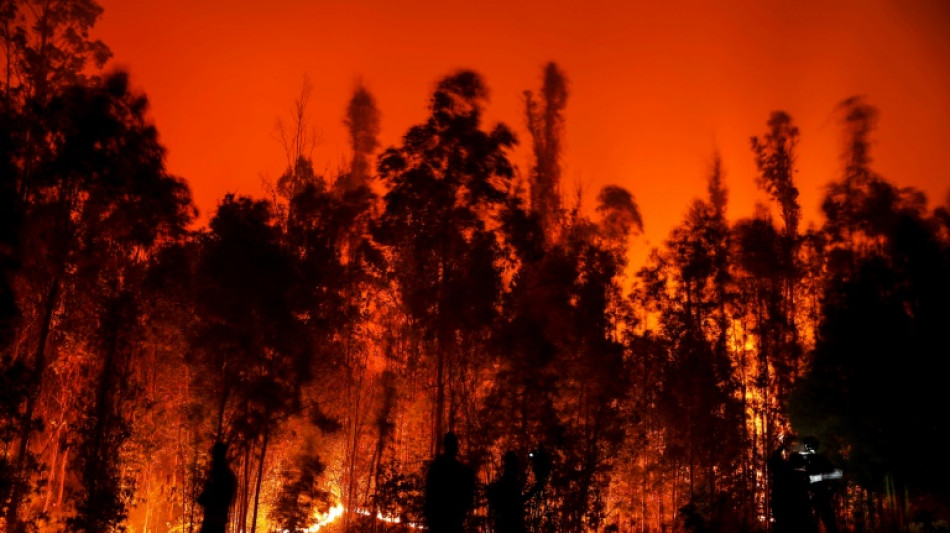
Chileans who survived deadly forest fire fear flames will return / Photo: JAVIER TORRES - AFP

 Gauteng Health Department Warns of Rising Antibiotic Resistance Threat

 Bishop Museum Races to Save Rare Megamouth Shark Specimen

 InterContinental Hotels Group PLC Announces Transaction in Own Shares - November 26

 Twickenham Grounds Team Prepares Pitch for Six Matches in Three Days

 Luxembourg Pay Rise Delayed as Regional and World Headlines Develop

 Audience to Choose the Set List at Luxembourg's First FAMIL Jukebox Night

 Raheem Sterling Receives Suspended Sentence After Lamborghini Crash

 Black Friday Discounts Cut Prices on Two Top-Rated Wiper Blades

 TCC Network Linked to 200% Surge in Global School Attacks
Maria Ines Hernandez described forest fires ravaging central Chile with the death so far of 24 people as hell on earth.
The 55-year-old social worker in the town of Santa Juana in the hard-hit Bobio farming region said many houses in he area were reduced to ashes.
"It is a miracle that some of the houses were spared," Hernandez told AFP. "Now we are afraid that the fire will return.... Where will we find refuge? Where? How?"
Santa Juana is considered ground zero in the fires that have been burning for five days now. Ten of the fatalities happened in the town, five of them from just one family.
It is home to about 13,000 people, including in adjacent farming estates set amid rolling hills.
"It is rough land, with difficult access," mayor Ana Albornoz said Saturday.
"Most of the homes were lost because we got no help. With help from the air we could have saved most of the houses, but this was not the case," said Hernandez.
Parts of Santa Juana appeared as disaster zones: buildings in smoldering ruins, shells of vehicles baked into the scarred earth, all enveloped in a smokey, orange-tinted sky.
Some of the areas burned in these fires are poor and isolated, and beset with violent clashes between Mapuche Indigenous people on one hand and the government, timber companies and private land owners on the other.
- 'We die right here' -
Miguel Angel Henriquez, a 58-year-old farmer in Santa Juana, said he and his wife deliberated too long over whether to escape the approaching flames and are lucky to be alive.
"We waited until the end, but the fire cut us off on all sides," he said.
They went back in the direction from which they had started and ran into firefighters, neighbors and police.
"As the fire approached I told them, 'either we get out of here now or we die right here.' We hid behind the firetruck."
Henriquez recalls seeing a neighbor brave the flames to try and rescue some of his animals. "He did not come out. I yelled at him to come out of the fire, but he didn't listen."
The home of Carmen Cuevas, 49, escaped all damage, so she went out in a pickup truck to distribute water and other relief supplies to hard hit neighbors.
"This hurts all of us. It is a shame to see all of this reduced to ash," she said.
Other towns were also heavily damaged in the fires, such as Puren in the Araucania region. The stories of total loss come one after another.
A Mapuche man named Jose Ankalao said 70 percent of his village in an ancestral area called Wallmapu was destroyed, including land he inherited from his great-great-grandfather.
P.Smith--AT
