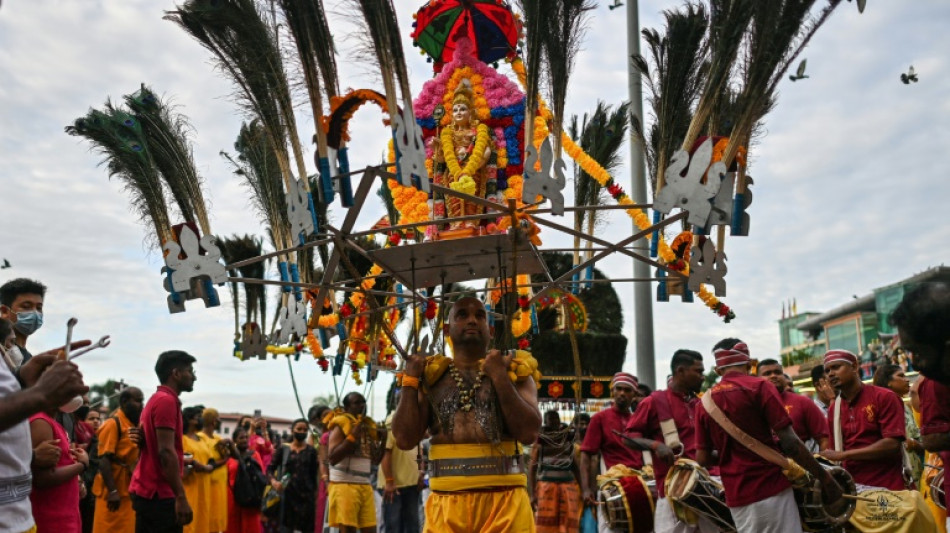
Piercings and prayer: Malaysian Hindus celebrate Thaipusam / Photo: Mohd RASFAN - AFP

 Gauteng Health Department Warns of Rising Antibiotic Resistance Threat

 Bishop Museum Races to Save Rare Megamouth Shark Specimen

 InterContinental Hotels Group PLC Announces Transaction in Own Shares - November 26

 Twickenham Grounds Team Prepares Pitch for Six Matches in Three Days

 Luxembourg Pay Rise Delayed as Regional and World Headlines Develop

 Audience to Choose the Set List at Luxembourg's First FAMIL Jukebox Night

 Raheem Sterling Receives Suspended Sentence After Lamborghini Crash

 Black Friday Discounts Cut Prices on Two Top-Rated Wiper Blades

 TCC Network Linked to 200% Surge in Global School Attacks
Ethnic Indian Malaysians massed in Hindu temples across the country Sunday to celebrate the annual Thaipusam festival, months after the relaxation of Covid-19 restrictions that had barred large crowds.
Tens of thousands of people gathered at the Batu Caves temple just outside Kuala Lumpur over the weekend, many piercing their bodies with hooks and skewers in an act of devotion to the deity Lord Murugan.
The event commemorates the day when the goddess Parvathi gave her son Lord Murugan a powerful lance to fight evil demons.
Bearing offerings such as milk pots and heavy ornate metal structures called kavadis, devotees walked barefoot up 272 steps to reach the temple -- an important religious site for local Hindus.
This year's celebration was the liveliest seen in recent years, with devotees glad at being allowed to return to observe their rituals.
"(Previously) we couldn't do our vows due to the Covid-19 lockdown," Kupuvanes Tetchanamwoorthy, 45, told AFP.
"This year we could come here and take our vows ... I feel so grateful."
Some devotees appeared to be in a state of trance as they carried the kavadis, which can weigh as much as 100 kilograms (220 pounds).
Others pierced their bodies with skewers or hung multiple hooks and chains from their bodies in an act of penance.
Prior to Thaipusam, devotees will typically hold daily prayer sessions, abstain from sex and stick to a strict vegetarian diet for weeks.
"When we pray for something, we need to give him (Lord Murugan) back something as a blessing," devotee Bahvani Kumaran, 63, told AFP.
"Sometimes with your vow, you carry the kavadi, or carry the milk. Whichever way, it is something that you give back to him."
While more than half Malaysia's 32 million people are Muslim, the country is home to around two million ethnic Indians.
Lord Murugan is particularly revered in southern India and among ethnic Tamil communities in Southeast Asia, with Thaipusam also celebrated in India and Singapore.
N.Walker--AT
