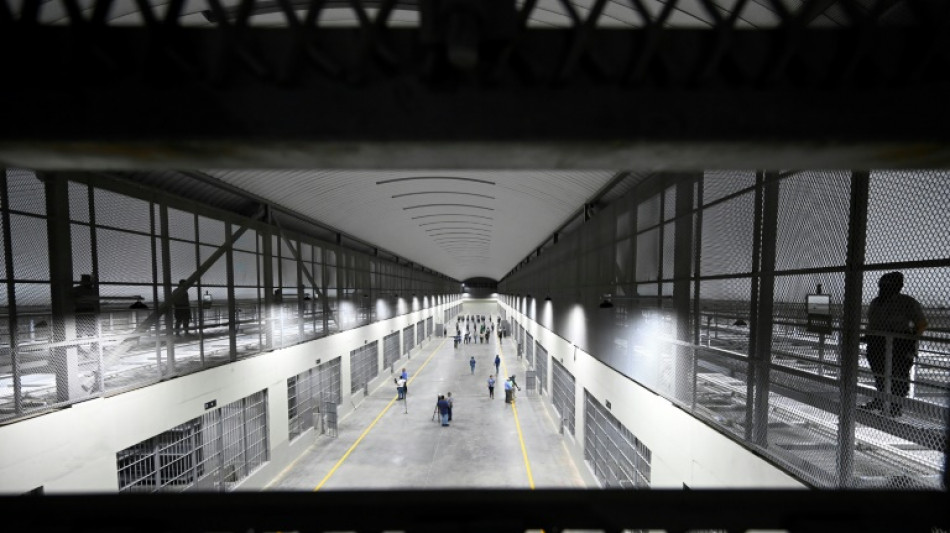
A visit to Salvador's new 'mega-prison' points to severe conditions / Photo: Marvin RECINOS - AFP/File

 Gauteng Health Department Warns of Rising Antibiotic Resistance Threat

 Bishop Museum Races to Save Rare Megamouth Shark Specimen

 InterContinental Hotels Group PLC Announces Transaction in Own Shares - November 26

 Twickenham Grounds Team Prepares Pitch for Six Matches in Three Days

 Luxembourg Pay Rise Delayed as Regional and World Headlines Develop

 Audience to Choose the Set List at Luxembourg's First FAMIL Jukebox Night

 Raheem Sterling Receives Suspended Sentence After Lamborghini Crash

 Black Friday Discounts Cut Prices on Two Top-Rated Wiper Blades

 TCC Network Linked to 200% Surge in Global School Attacks
Conditions inside a huge new mega-prison designed to house 40,000 alleged gang members in El Salvador will be particularly severe, according to accounts from a visiting team of AFP journalists.
Miguel Montenegro, director of the nongovernmental Human Rights Commission of El Salvador, has warned of the "risks of violence" in a prison he said would likely end up being badly overcrowded.
"There will most likely be more than the (announced capacity of) 40,000," considering that 63,000 presumed gang members have been arrested since President Nayib Bukele declared a state of emergency last spring allowing arrests without warrants, in the violence-plagued country.
Montenegro has assailed the vast prison -- a 166-hectare (410-acre) facility known as the Terrorism Containment Center, or CECOT -- as "an embarrassment for the country."
An AFP team visited the sprawling complex late Friday into early Saturday, along with other journalists.
What they saw suggested a very different reality from the images broadcast by national television on Tuesday when Bukele inaugurated the facility.
Built on Bukele's orders after he declared a "war" on gangs last March, the prison in Tecoluca, 74 kilometers (46 miles) southeast of the capital San Salvador, consists of eight buildings made of reinforced concrete.
Each one has 32 cells of about 100 square meters (1,075 square feet), designed to hold "more than 100" inmates, according to Public Works Minister Romeo Rodriguez. But each cell will have only two sinks and two toilets.
- 80 bunks for 100 inmates -
Prisoners will leave the cell only for legal hearings (by videoconference), or to be punished in a windowless and unlit isolation cell.
There are only 80 metal bunks for every 100 prisoners.
"There will be no mattresses in the cells," the prison warden -- who wore a ski mask to protect his identity -- told journalists.
A network of dozens of cameras will help guards keep constant watch over detainees.
While the prison is equipped with dining halls, exercise rooms and Ping-Pong tables, they are exclusively for guards' use.
Ensuring the security of the facility is a two-kilometer-long, 11-meter-high wall with seven guard towers -- and an electrified fence.
- A 'gigantic job' -
It took 3,000 workers seven months to complete construction of the vast facility, officials said. They have yet to reveal its cost or opening date.
Bukele praised the "gigantic job," saying the prison would prove to be an "essential element for total victory in the war against the gangs."
He declared that "war" in late March after a wave of killings left 87 people dead in just three days.
Bukele blamed what he said was the laxity of previous governments, which he said had allowed inmates access to "prostitutes, PlayStations, cell phones and computers."
Anyone entering the new prison's perimeter will be scanned visually and electronically for weapons and contraband.
Six hundred soldiers and 250 police officers will provide around-the-clock security, and electronic jamming equipment will prevent any communication by prisoners with the outside world.
Inside the cell blocks, guards will carry pistols and assault rifles.
"All the terrorists responsible for the losses and suffering of the Salvadoran people will serve their sentences... under the strictest regime," said deputy justice minister Osiris Luna.
Detainees will be forced to work "to repair part of the damage they have caused to society," he added.
But Andreu Oliva, rector of the Central American University in San Salvador, has argued that prisoners need a chance to be "rehabilitated," adding, "They deserve a second chance."
New York-based Human Rights Watch recently denounced what it said was "severe prison overcrowding" in El Salvador's 20 existing detention facilities, meant to accommodate a total of 30,000 prisoners.
Y.Baker--AT
