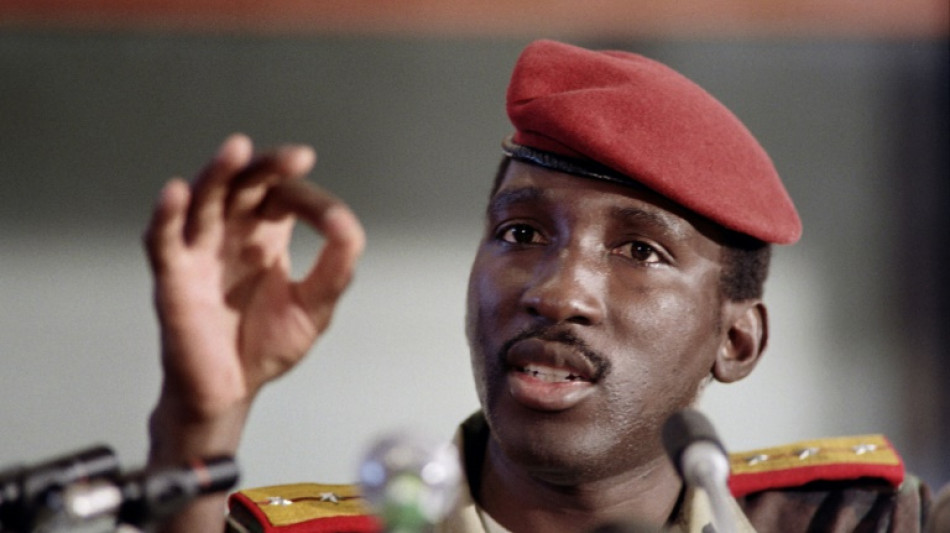
Burkina's slain leader Sankara to be buried at assassination site / Photo: DOMINIQUE FAGET - AFP/File

 Gauteng Health Department Warns of Rising Antibiotic Resistance Threat

 Bishop Museum Races to Save Rare Megamouth Shark Specimen

 InterContinental Hotels Group PLC Announces Transaction in Own Shares - November 26

 Twickenham Grounds Team Prepares Pitch for Six Matches in Three Days

 Luxembourg Pay Rise Delayed as Regional and World Headlines Develop

 Audience to Choose the Set List at Luxembourg's First FAMIL Jukebox Night

 Raheem Sterling Receives Suspended Sentence After Lamborghini Crash

 Black Friday Discounts Cut Prices on Two Top-Rated Wiper Blades

 TCC Network Linked to 200% Surge in Global School Attacks
The body of Burkina Faso's revered revolutionary leader Thomas Sankara is to be buried alongside 12 comrades at the spot where in 1987 they were assassinated, the country's ruling junta said on Friday.
The ceremony will take place "in February" at the site of a memorial that already marks the location, the government's spokesman, Communications Minister Jean-Emmanuel Ouedraogo, said in a statement, without giving a date.
Sankara came to power in August 1983 as an army captain aged just 33.
Nicknamed Africa's Che Guevara, he was a fiery Marxist-Leninist who blasted the West for neo-colonialism and hypocrisy.
He changed the country's name from the colonial-era Upper Volta to Burkina Faso -- "the land of honest men" -- and pushed through a range of reforms, including promoting vaccination and banning female genital mutilation.
Sankara was idolised by supporters of pan-Africanism and egalitarianism, but his tenure was short-lived.
He and a dozen other leaders were gunned down by a hit squad at a meeting of the ruling National Revolutionary Council in the capital Ouagadougou on October 15, 1987.
The killings took place on the same day that Sankara's comrade-in-arms, Blaise Compaore, seized power.
He went on to rule for 27 years, during which Sankara's death was a strict taboo. He was ousted by public protests and fled to Ivory Coast.
After Compaore's downfall, the 13 bodies were exhumed from a cemetery on the outskirts of the city for an investigation.
It led to a lengthy trial that culminated in April 2022 in life terms in absentia for Compaore and the suspected hit squad leader, and a similar term for a detained general who had been army commander at the time.
In the light of this trial, the 13 should be buried "honourably," Friday's statement said.
Burkina Faso, a landlocked state in the heart of West Africa's Sahel, is battling a seven-year-old jihadist insurgency that has claimed thousands of lives and driven more than two million people from their homes.
Anger within the military at failures to stem the bloodshed helped spark two coups last year.
T.Wright--AT
