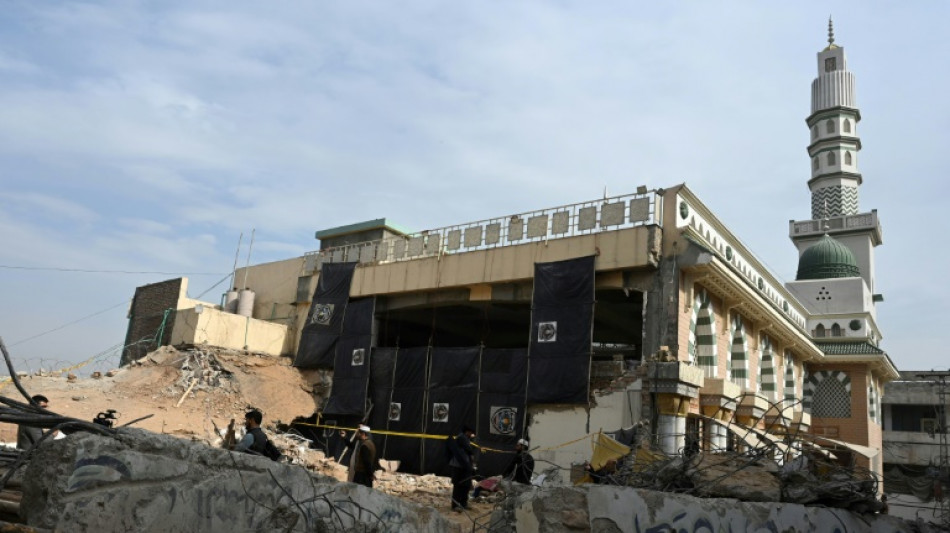
Pakistan police feel 'abandoned' in militancy fight after mosque blast / Photo: Abdul MAJEED - AFP

 Gauteng Health Department Warns of Rising Antibiotic Resistance Threat

 Bishop Museum Races to Save Rare Megamouth Shark Specimen

 InterContinental Hotels Group PLC Announces Transaction in Own Shares - November 26

 Raheem Sterling Receives Suspended Sentence After Lamborghini Crash

 Luxembourg Pay Rise Delayed as Regional and World Headlines Develop

 Audience to Choose the Set List at Luxembourg's First FAMIL Jukebox Night

 Twickenham Grounds Team Prepares Pitch for Six Matches in Three Days

 Black Friday Discounts Cut Prices on Two Top-Rated Wiper Blades

 TCC Network Linked to 200% Surge in Global School Attacks

Pakistan police officers say they have been "thrown to the beasts" in their battle against rising militancy after a blast at a city headquarters killed dozens of their colleagues.
A suicide bomber wearing a police uniform infiltrated the heavily guarded compound in Peshawar on Monday and blew himself up during afternoon prayers at a mosque, in the deadliest attack Pakistan has seen for several years.
"We are in a state of shock, every other day our colleagues are dying, how long will we have to suffer?" one police officer told AFP on condition of anonymity.
"If the protectors are not safe, then who is safe in this country?"
Authorities say the blast, which also killed a civilian, was carried out in revenge for police operations against relentless assaults by Islamist groups in the region, which borders Afghanistan.
"We are at the frontline of this war, we are protecting the schools, offices, and public places but today we feel abandoned," a junior officer said.
"The state has tied our hands and thrown us to the beasts."
Bickering politicians who are months away from contesting a general election have traded blame for the deteriorating security situation, with the country also weighed down by a severe economic crisis.
The lack of leadership has given space for militants to regroup and target the state, analysts say.
- 'Tomorrow it could be me' -
A few dozen police officers protested in Peshawar on Wednesday, frustrated at the deepening risks they are facing.
The anger is all the greater since the bombed complex, which also houses intelligence and counter-terrorism offices, was one of the best monitored areas of the city.
"It's incomprehensible to me," said Inayat Ullah, a 42-year-old policeman who spent several hours under the rubble of a collapsed wall before being rescued, losing a thumb.
"When we leave our house, we never know where we might be targeted. Today it's him, tomorrow it might be me," he said, speaking about a close friend who was killed on Monday.
The biggest threat comes from the Pakistani Taliban, separate from the Afghan Taliban but with a similar ideology.
The group emerged in 2007, allied with Al-Qaeda, killing tens of thousands of Pakistani civilians and members of the security forces in less than a decade, with Peshawar at the heart of daily attacks.
Largely crushed in a major military crackdown launched in 2014, they have resurged since the Taliban came to power across the border in August 2021 following the withdrawal of US and NATO troops.
Known as the Tehreek-e-Taliban Pakistan (TTP), they have attempted to rebrand themselves as a less brutal outfit, avoiding civilians in favour of targeting security and police personnel in low casualty assaults.
Police attributed Monday's attack to Jamaat-ul-Ahrar, a more radical group occasionally affiliated to the TTP, which has denied any involvement.
"Every time we leave our homes, we hug our loved ones and they hug us. We don't know if we will come back alive or not," said another policeman, who lost six friends in the blast.
- 'Void can never be filled' -
Father of two Atif Mujeed, 36, was the pillar of his family -- a police officer who had already survived an IED explosion which killed seven of his colleagues in 2013.
But on Monday there was no escape from the explosion that erupted among the rows of worshippers and caused a wall to collapse and bury officers.
"This incident stunned us. The void it leaves can never be filled," his brother-in-law, Rizwan Ahmed, told AFP. "His death broke the backbone of this family."
The TTP continues to resort to its old methods: targeted assassinations, bombs, kidnappings and extortion as they regroup along the border.
Pakistan blames Afghanistan for letting militants use Afghan soil to plan attacks, which Kabul denies.
Peace negotiations between the TTP and Pakistan, mediated by the Afghan Taliban, fell through in November, shattering a shaky ceasefire.
During the talks, the militants had their numbers boosted by the release of around 100 low-level fighters from Pakistani jails.
That has only added to the confusion among police ranks.
"One day we're told there's a ceasefire and peace talks, the next day we're told the ceasefire isn't holding and we have to be ready to fight... It's disconcerting," said one of the police officers who requested anonymity.
Pakistan's Federal Cabinet announced Wednesday that the police and anti-terror section in the province of Khyber Pakhtunkhwa, of which Peshawar is the capital, would be reorganised, better trained and better equipped.
A new military operation against armed Islamist groups, which are highly factional, is also being discussed.
But in Peshawar, some are resigned to a cycle of violence being here to stay.
"I have already spent half my life witnessing a bloodbath," said bereaved brother-in-law Ahmed.
"But I still don't have the slightest hope of ever seeing peace in this town."
J.Gomez--AT
