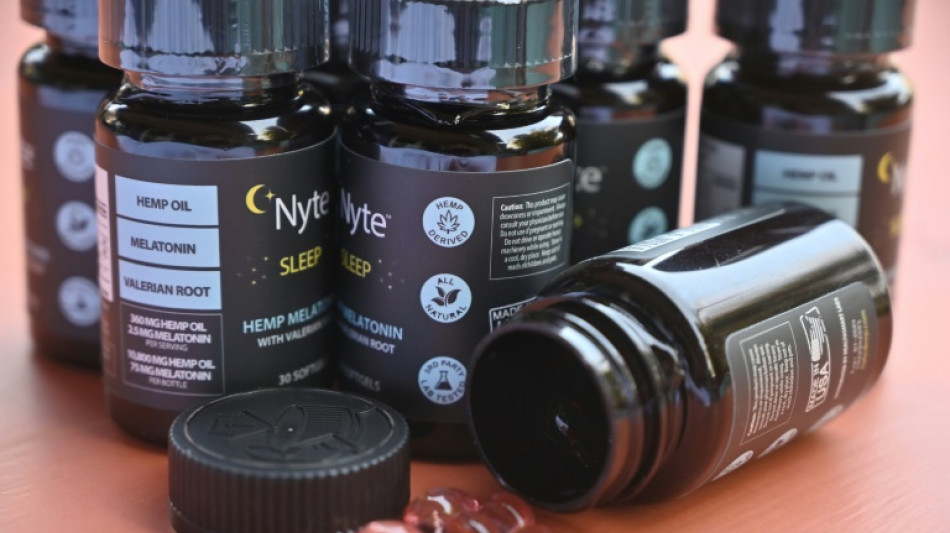
Hong Kong bans CBD, ranking it alongside heroin and cocaine / Photo: Peter PARKS - AFP/File

 Gauteng Health Department Warns of Rising Antibiotic Resistance Threat

 Bishop Museum Races to Save Rare Megamouth Shark Specimen

 InterContinental Hotels Group PLC Announces Transaction in Own Shares - November 26

 Raheem Sterling Receives Suspended Sentence After Lamborghini Crash

 Luxembourg Pay Rise Delayed as Regional and World Headlines Develop

 Audience to Choose the Set List at Luxembourg's First FAMIL Jukebox Night

 Twickenham Grounds Team Prepares Pitch for Six Matches in Three Days

 Black Friday Discounts Cut Prices on Two Top-Rated Wiper Blades

 TCC Network Linked to 200% Surge in Global School Attacks

A new law criminalising the possession, consumption and selling of cannabidiol (CBD) in Hong Kong came into effect on Wednesday, placing the substance on par with heroin in terms of legal classification.
CBD, a non-psychoactive derivative of the cannabis plant, is touted by its users as reducing pain, stress, anxiety and inflammation.
Hong Kong authorities, however, have said those claims "lack authoritative scientific proof" and have justified their ban by arguing the products could be converted into the intoxicating compound THC, which was already illegal in the city.
Penalties include possible life imprisonment and a fine of up to HK$5 million ($638,000) for importing, exporting or manufacturing CBD, which joins more than 200 other "dangerous drugs" that are prohibited in the territory.
Possession or consumption could lead to seven years in prison and a HK$1 million ($128,000) fine.
Globally, the popularity of CBD-infused products has surged in recent years, with gummies, coffee, beers and beauty creams all part of an industry expected to be worth $47 billion by 2028, up from $4.9 billion in 2021.
CBD is legal in the United States and parts of Europe, as well as in some Asian nations such as Japan and Thailand.
In Hong Kong, authorities gave businesses and residents three months to discard any potential contraband before the strict penalties came into effect Wednesday.
Around 77,400 items had been offloaded at government bins as of Sunday, according to official data.
Customs officials last week reminded consumers to beware of products branded with hemp leaves, and on Wednesday ran full-page newspaper ads saying: "Anything with CBD? No way!"
- 'Step backwards' -
The new regulations have impacted vendors in the recession-hit financial hub, even forcing some shops to shut completely.
"We had to stop selling a best-selling beer and we still get customers calling to ask about the product daily," Chris Wong, co-founder of the HK Brewcraft store, told AFP.
Cafe Found, which billed itself as the first in the city to offer a range of CBD-infused foods and drinks when it opened in 2020, shut in September, and Yardley Brothers Craft Brewery said it was forced to ditch a popular line.
"It feels like a bit of a step backwards for HK," Luke Yardley, the company's founder, told AFP.
While many countries have moved to legalise the substance, mainland China banned CBD in 2021.
In November, a veteran social worker questioned in Chinese-language newspaper Ming Pao whether the government had a solid basis to correlate CBD with drug abuse or if it was simply following the mainland's lead.
The city's Security Bureau accused the author of "sowing discord" between Hong Kong and China.
P.A.Mendoza--AT
