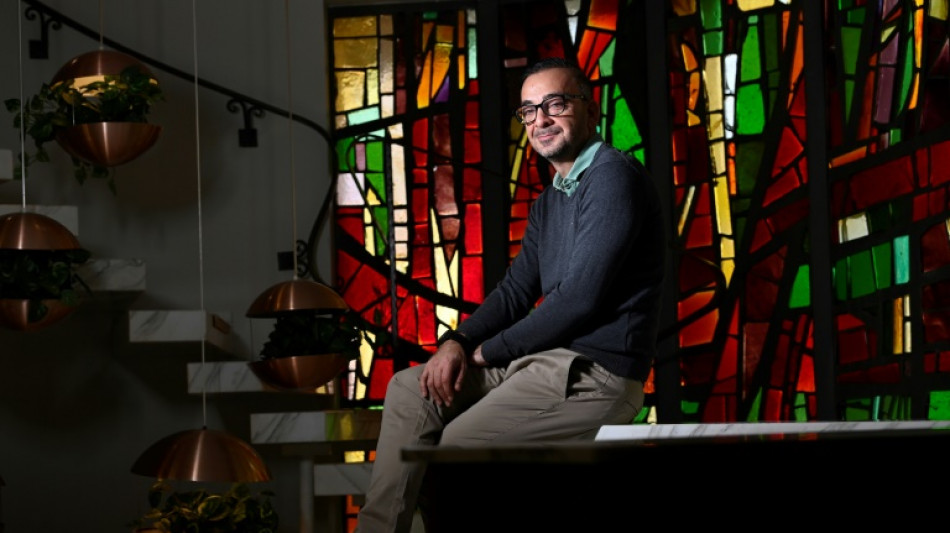
Oscar-bound short lifts veil on Iranian women rejecting male domination / Photo: JOHN THYS - AFP

 Gauteng Health Department Warns of Rising Antibiotic Resistance Threat

 Bishop Museum Races to Save Rare Megamouth Shark Specimen

 InterContinental Hotels Group PLC Announces Transaction in Own Shares - November 26

 Raheem Sterling Receives Suspended Sentence After Lamborghini Crash

 Luxembourg Pay Rise Delayed as Regional and World Headlines Develop

 Audience to Choose the Set List at Luxembourg's First FAMIL Jukebox Night

 Twickenham Grounds Team Prepares Pitch for Six Matches in Three Days

 Black Friday Discounts Cut Prices on Two Top-Rated Wiper Blades

 TCC Network Linked to 200% Surge in Global School Attacks

Short movies nominated for an Oscar often don't get wide public attention. But when one is about an Iranian girl seeking freedom from male domination by taking off her veil, interest is sure to spike.
That's the premise of "The Red Suitcase", a 17-minute movie that, at the Oscar ceremony in Los Angeles on March 12, will shine a bright light on the protests that have gripped Iran since last September.
Set in Luxembourg's airport, it tells the story of a 16-year-old Iranian girl freshly arrived from Tehran who, with trepidation, takes off her veil to escape an unhappy fate dictated by men.
For director Cyrus Neshvad, born in Iran but of Luxembourgish nationality, the Oscar nomination is a chance to highlight what the "virus" of the Islamic regime is doing to the "beautiful body" of his birth country.
"Once we get this virus out, the body will be flourishing again," he told AFP.
The demonstrations in Iran were sparked by the September 16 death in custody of a young Iranian woman, Mahsa Amini, who was detained for incorrectly wearing the headscarf mandated by the country's religious rulers.
Since then they have spread to become one of the most serious popular challenges to the hardline Islamic theocrats who took power in 1979.
The regime has responded by cracking down on the protesters with arrests and executions -- but also turning against those voicing support, among the country's sportspeople and filmmakers.
- 'Take your hijab off' -
For Neshvad, "The Red Suitcase" wasn't born of the current uprising in Iran -- it was filmed a year before it started.
But it has its roots in the injustices faced by his family -- of the Bahai religion, systematically persecuted in Iran -- as well as those long experienced by Iranian girls and women before Amini's death brought them to global attention.
"For me, it (the movie) was about a woman, which are the women in Iran being under domination of the man," said the director, aged in his 40s.
In Iran, "If a woman wants to do something, or go visit something, the man (her father or husband) has to consent and write the paper and sign it," he said.
For the girl in his movie to take her veil off, it was a moment of "courage" -- for her to rebel against a path forced upon her, but also to inspire those watching.
"It will be a message: 'Follow me -- like me, take your hijab off, don't accept this domination, and let's be free, at least have the free will to decide'," Neshvad said.
His actress, Nawelle Evad, 22, isn't Iranian and used a dialogue coach to deliver the few lines in Farsi required.
But as a French-Algerian, the issue of women and Islamic headscarves -- and the debate in the West around them -- was familiar to her.
"I had a Muslim upbringing and I used to wear it," she told AFP in Paris, where she lives.
But for her "it was never an obligation" to wear one, she noted.
And even for her character in the movie, when she takes her headscarf off, "It's not of her will, it's despite herself that she removes it -- I think there are many women in Iran, and elsewhere, where the headscarf is an extension of themselves."
- Criticism of West too -
In the film though, by removing the headscarf, her character ultimately "chooses herself".
"That's what I find so beautiful in this film... the doubts that anybody, in any country, in any culture, faces... What do I choose for myself? Do I listen to my family? Am I making my own choices?"
Neshvad's French scriptwriting partner, Guillaume Levil, also suggested that the sexualised airport ads in the film underline that the West, too, can be criticised for exploiting women and their public image.
The final image of the movie, an ad showing a blonde model with abundant curly hair, was emblematic of both social diktats, the director said.
"The closer we go with the camera on her face, slowly we see that she's not happy, and when we are very, very close, we see that (she) is even frightened," he said.
"And with this, I wanted to finish the movie. So to have both sides, not only one side, but both sides."
E.Flores--AT
