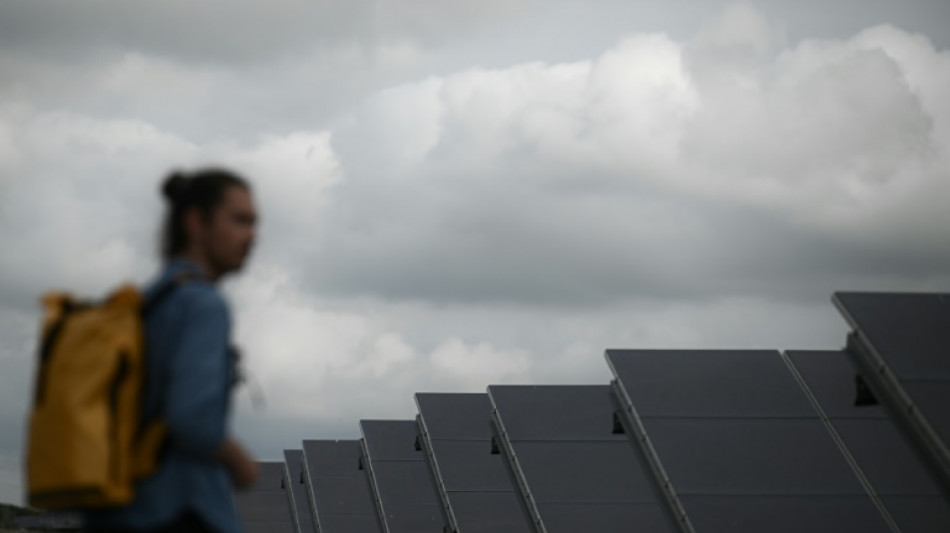
EU crafts response to US green tech subsidies / Photo: Philippe LOPEZ - AFP/File

 Gauteng Health Department Warns of Rising Antibiotic Resistance Threat

 Bishop Museum Races to Save Rare Megamouth Shark Specimen

 InterContinental Hotels Group PLC Announces Transaction in Own Shares - November 26

 Raheem Sterling Receives Suspended Sentence After Lamborghini Crash

 Luxembourg Pay Rise Delayed as Regional and World Headlines Develop

 Audience to Choose the Set List at Luxembourg's First FAMIL Jukebox Night

 Twickenham Grounds Team Prepares Pitch for Six Matches in Three Days

 Black Friday Discounts Cut Prices on Two Top-Rated Wiper Blades

 TCC Network Linked to 200% Surge in Global School Attacks

The EU will present long-awaited proposals on Wednesday to counter sweeping US subsidies on green tech that threaten Europe's industry, already struggling with soaring energy prices and unfair competition from China.
Faced with member states divided between free market supporters and state aid advocates, European Commission President Ursula von der Leyen is under pressure to urgently respond to the US Inflation Reduction Act (IRA).
- Why must the EU respond? -
The United States adopted the IRA last year, lavishing subsidies and tax cuts worth $370 billion for US buyers of electric vehicles -- if they "Buy American" -- and leaving European car manufacturers aghast.
European industry has sounded the alarm over the IRA's impact on the continent, as high energy costs and US subsidies could push companies to leave.
Unlike their American counterparts, European businesses already face massive energy bills, unable to turn to cheap Russian gas after Moscow's invasion of Ukraine.
Gas prices imposed on European manufacturers have tripled compared with the average for the past decade, while gas bills have remained stable in Asia and North America.
The EU has already committed to invest hundreds of billions of euros in green tech including solar panels, batteries and hydrogen.
The bloc, however, risks becoming dependent on Chinese companies that benefit from both massive subsidies and fewer environmental constraints.
"Many companies already relocate partially or totally their production outside Europe," said BusinessEurope, the EU's main business lobby.
Thousands of jobs are at stake in the chemicals, steel and other sectors.
- What are the available options? -
Mandated in December by EU member states to develop a European response, von der Leyen seeks to ease regulatory constraints weighing on green industries.
She has already announced plans for a new law that will make it possible to support strategic European projects, by speeding up and simplifying permits and financing.
She has also proposed temporary relief from state aid rules, targeted at those sectors affected by the IRA.
But the measure is controversial. It would help the bloc's richest countries, especially France and Germany, since they could pour money into their businesses at the expense of EU competitors.
Germany and France represent respectively 53 and 24 percent of state aid notified to Brussels since March 2022 as part of the relaxation of rules following the war in Ukraine. Italy came in third, representing seven percent.
In a letter signed by seven countries including Austria, Denmark and Finland, they stressed that the bloc's "competitiveness and better investment environment... cannot be built on permanent or excessive non-targeted subsidies".
Some EU members led by France are calling for new common funds. Von der Leyen promised to work on a new European sovereignty fund paid for by an increase in the bloc's budget.
But such a mechanism will only be possible with the support of Germany and other "frugal" northern EU members, which oppose joint borrowing or any increase to their budgetary contributions.
The EU's single market commissioner, Thierry Breton, has suggested other ways to finance the response including the mobilisation of the 800-billion-euro European recovery plan's remaining funds and loans from the European Investment Bank.
- When will the EU decide? -
EU members will decide on von der Leyen's proposals during a high-level summit in Brussels between heads of government and state.
While there is consensus that there is a need to act fast, a proposal for a sovereignty fund will likely be pushed back to later this year as countries including Germany, the Netherlands and Sweden oppose it.
The extent of Wednesday's package beyond easing regulatory pressures and relaxing state aid rules is uncertain.
There are real fears in Europe of a trade war with the United States, while many remain concerned about a response that violates free market principles.
The EU and the United States "have so much more to gain when we work with each other", the commission's three executive vice presidents wrote in the Financial Times on Thursday.
Valdis Dombrovskis, Frans Timmermans and Margrethe Vestager also called for "an open, thriving transatlantic marketplace" and warned of the risk to the single market of a "massive surge" in state subsidies.
Th.Gonzalez--AT
