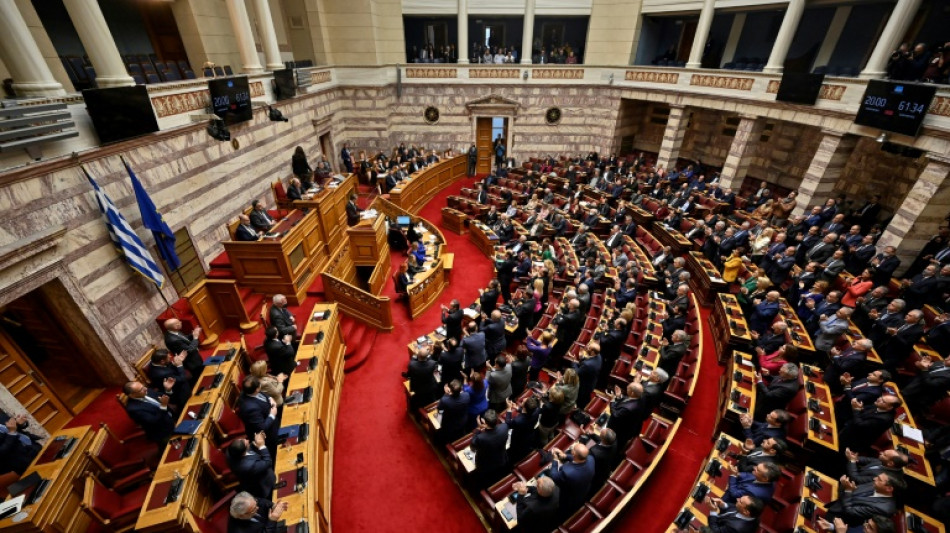
Greek government survives vote over wiretap scandal / Photo: Louisa GOULIAMAKI - AFP

 Gauteng Health Department Warns of Rising Antibiotic Resistance Threat

 Bishop Museum Races to Save Rare Megamouth Shark Specimen

 InterContinental Hotels Group PLC Announces Transaction in Own Shares - November 26

 Raheem Sterling Receives Suspended Sentence After Lamborghini Crash

 Luxembourg Pay Rise Delayed as Regional and World Headlines Develop

 Audience to Choose the Set List at Luxembourg's First FAMIL Jukebox Night

 Twickenham Grounds Team Prepares Pitch for Six Matches in Three Days

 Black Friday Discounts Cut Prices on Two Top-Rated Wiper Blades

 TCC Network Linked to 200% Surge in Global School Attacks

Greece's government on Friday easily survived a no-confidence vote called by the opposition over a long-running wiretap scandal in which top officials were targeted by state intelligence for months.
The censure motion was defeated by 156 votes to 143 in the 300-seat chamber, parliament vice chairman Haralambos Athanassiou said after the official count.
Prime Minister Kyriakos Mitsotakis had welcomed the vote ahead of time as an opportunity to promote his government's record ahead of elections in spring.
But leftist former premier Alexis Tsipras called for the no-confidence vote on Wednesday, calling Mitsotakis the "mastermind and leader" behind a "criminal network" that had wiretapped officials' phones.
Tsipras said that the head of Greece's communications watchdog ADAE told him that an audit of national telecom operators last month uncovered that several senior officials had been under surveillance.
He identified Greece's former energy minister, army chief and former national security advisor as being among the officials.
Tsipras said the ADAE's chairman Christos Rammos had told him on Tuesday that the officials had been under surveillance by state intelligence agency EYP.
Tsipras said Mitsotakis, whose office has oversight over EYP, had "consciously lied" for six months and had "thrown the entire weight of his authority" to prevent the truth from coming out.
- Predator spyware -
But Mitsotakis insisted the wiretaps cited by Tsipras had been approved by a prosecutor at the state intelligence agency and were thus legal.
"The (monitoring) was legal, we need to clarify this," the prime minister said.
The government has accused Tsipras of seeking to weaponise the ADAE, noting that its head Rammos was appointed to the post by Tsipras's leftist government just before elections in 2019.
The scandal broke in July when Nikos Androulakis, MEP and leader of the Greek socialist party (Pasok-Kinal), took legal action against an attempt to infiltrate his mobile phone using spyware known as Predator.
After the revelation, Mitsotakis admitted that state intelligence had monitored Androulakis, without disclosing the reason, but denied that authorities had used the Predator malware.
The government has also strongly denied news reports that dozens of prominent Greeks were under surveillance via Predator, including former premier Antonis Samaras, several serving cabinet ministers, military chiefs, media owners and journalists.
Mitsotakis has called the reports "conspiracy theories" and "fairy tales... without a shred of evidence".
In August, the Greek intelligence service chief, as well as a close aide and nephew to the prime minister, both resigned over the socialist leader's surveillance.
The use of spyware, which many governments and law enforcement agencies argue is necessary to fight crime and terrorism, has become controversial in recent years over concerns that the technology could be used against political opponents.
O.Brown--AT
