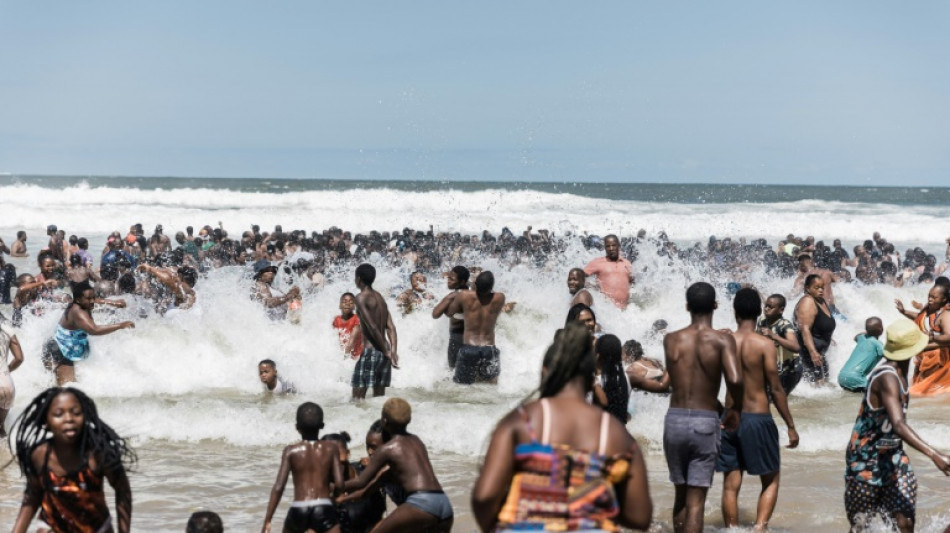
South Africa battles drownings with survival pools / Photo: RAJESH JANTILAL - AFP

 Gauteng Health Department Warns of Rising Antibiotic Resistance Threat

 Bishop Museum Races to Save Rare Megamouth Shark Specimen

 InterContinental Hotels Group PLC Announces Transaction in Own Shares - November 26

 Raheem Sterling Receives Suspended Sentence After Lamborghini Crash

 Luxembourg Pay Rise Delayed as Regional and World Headlines Develop

 Audience to Choose the Set List at Luxembourg's First FAMIL Jukebox Night

 Twickenham Grounds Team Prepares Pitch for Six Matches in Three Days

 Black Friday Discounts Cut Prices on Two Top-Rated Wiper Blades

 TCC Network Linked to 200% Surge in Global School Attacks

A red shipping container lies in a school playground in a small South African town.
The imposing steel structure has an unexpected function -- to help save youngsters in a country gripped by an epidemic of drownings.
Within it is a swimming pool -- the only one within 25 kilometres (15 miles) around -- where children will learn the basics of how to stay afloat.
South Africa has thousands of kilometres of beaches, and in rich neighbourhoods, swimming pools dot the gardens.
Yet just one South African in seven knows how to swim, and each year around 1,500 people drown, according to a local rescue institute -- an average of four individuals per day.
In the Cape Town suburb of Riebeek-Kasteel, Meiring primary school, which hosts the container, has suffered its own drowning tragedy.
A framed photo in the entrance hall pays tribute to a 12-year-old lad who perished in a dammed lake at a nearby farm in 2021.
"If he just knew how to float in water, he could have saved his own life," said school principal Brenton Cupido.
"It gets very hot here, especially in summer, and our (pupils) flock every afternoon, unsupervised, to the nearby dams. But most of them can't swim."
The toll is a "huge public health issue" rooted in historical inequalities, said Jill Fortuin, director of drowning prevention at the National Sea Rescue Institute (NSRI).
Most fatalities are black South Africans.
"Apartheid is a big portion of the problem," said Fortuin, herself a person of mixed heritage.
Under segregation, swimming pools and holiday beaches were limited to the white minority, providing little incentive for the majority to learn how to swim.
Three decades after the advent of democracy, stark inequalities remain, with limited infrastructure and opportunities.
"Government schools, where most disadvantaged people go to, often do not have swimming pools," said Fortuin.
Faced with choosing between putting food on the table or paying for swimming lessons, most families opt for the former, she added.
"Swimming is not seen as a priority".
- 'Safe water' -
To help tackle drowning, NSRI has deployed 1,350 volunteer lifeguards across the country's beaches and installed 1,500 bright pink buoys on various water bodies to help rescuers aid people in distress.
But prevention is paramount, said the group, whose awareness-raising campaign has reached more than three million people in recent years.
With climate change fuelling floods and heatwaves, the need increases, said Fortuin.
The "Survival Swimming Centre" pool installed at Meiring is the brainchild of Andrew Ingram, a 58-year-old drowning prevention manager.
In their homes, some of "the children... don't even have toilets that flush. So how on earth are they going to have a swimming pool?" he asked.
"We provide safe water and somebody to teach them."
The container pool is six metres (20 feet) long and one metre (3.25 feet) deep.
Children are taught how to help friends in difficulty, control breathing, orient themselves under the water and use an empty bottle as an emergency buoy.
Half of the school's children now know how to float -- and most of them are the first in their families to learn, said Cupido.
Jonathan Van der Merwe used to be very "concerned" that his daughter, who was one of the first to take lessons at Meiring's survival pool, might get into trouble in one of the many ponds around the wine farming area.
"Now, I'm very calm and relaxed about it," he said.
A sister container will soon be installed at a school in KwaZulu-Natal, an eastern province ravaged by deadly floods last year. One more is already in place in Eastern Cape province.
Petro Meyer, 62, NSRI's water safety instructor, has introduced about 100 students aged between six to 12 to survival swimming.
"You should see their smiles when they realise they're floating by themselves for the first time," she said. "We want to create a new culture in these kids."
Ch.Campbell--AT
