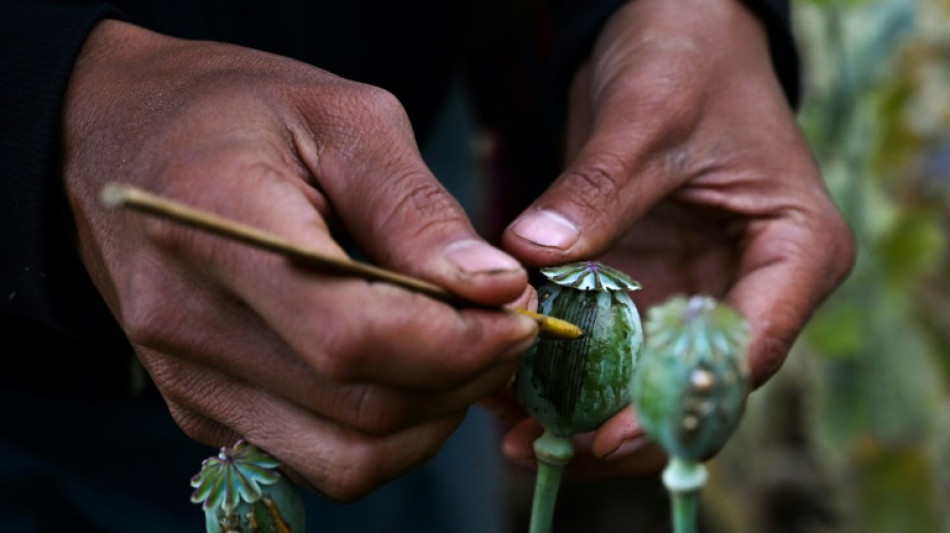
Myanmar opium farming booming after coup: UN / Photo: Ye Aung THU - AFP/File

 Gauteng Health Department Warns of Rising Antibiotic Resistance Threat

 Bishop Museum Races to Save Rare Megamouth Shark Specimen

 InterContinental Hotels Group PLC Announces Transaction in Own Shares - November 26

 Raheem Sterling Receives Suspended Sentence After Lamborghini Crash

 Luxembourg Pay Rise Delayed as Regional and World Headlines Develop

 Audience to Choose the Set List at Luxembourg's First FAMIL Jukebox Night

 Twickenham Grounds Team Prepares Pitch for Six Matches in Three Days

 Black Friday Discounts Cut Prices on Two Top-Rated Wiper Blades

 TCC Network Linked to 200% Surge in Global School Attacks

Opium poppy production in Myanmar ramped up dramatically following the 2021 military coup, the UN's drugs office said Thursday, as political and economic turmoil drove farmers to cultivate the crop.
The country's economy has been paralysed following the military power grab in February 2021 and subsequent fighting between the junta and anti-coup rebels.
The area of land used for opium poppy cultivation expanded by a third to just over 40,000 hectares in 2021-22 -- the first full growing season since the coup -- according to a United Nations Office on Drugs and Crime (UNODC) report released Thursday.
The potential output also shot up by nearly 90 percent compared with the previous year, to 790 tonnes.
The results show that there is a "significant expansion" of Myanmar's opium economy, the UNODC report said.
"Economic, security and governance disruptions that followed the military takeover of February 2021 have converged, and farmers... have had little option but to move back to opium," UNODC regional representative Jeremy Douglas said.
"The growth we are witnessing in the drug business is directly connected to the crisis the country is facing."
The report, based on satellite imagery and fieldwork, said the downward trend in opium production seen from 2014 to 2020 had gone into reverse.
- Economic hit -
The UNODC estimates Myanmar's opium economy is worth around $2 billion -- the equivalent of up to three percent of the country's GDP in 2021.
Despite the spike in production, farm gate prices for opium have also soared to around $280 a kilo, the report said -- a 69 percent rise on the previous year.
This compares with a farm gate price of around $203 in Afghanistan, the world's leading opium producer.
But the report said higher incomes from opium are not translating into greater buying power for farmers, because of higher petrol and fertiliser prices as a result of the Ukraine war.
A combination of the pandemic and the aftermath of the coup hammered Myanmar's economy with an 18 percent contraction in 2021, according to the World Bank.
Around 40 percent of the population was living in poverty in 2022, and Douglas said financial hardship had forced many labourers to leave urban areas to work in poppy cultivation in the countryside.
Farmers need outside support to boost their livelihoods growing other crops to compete with the opium economy, UNODC Myanmar country manager Benedikt Hofmann said.
"Opium cultivation is really about economics, and it cannot be resolved by destroying crops which only escalates vulnerabilities," he said.
The report cited figures from Myanmar's Central Committee for Drug Abuse Control stating 1,403 hectares of opium poppies had been eradicated by the end of last year -- a 70 percent decline on the previous year.
T.Sanchez--AT
