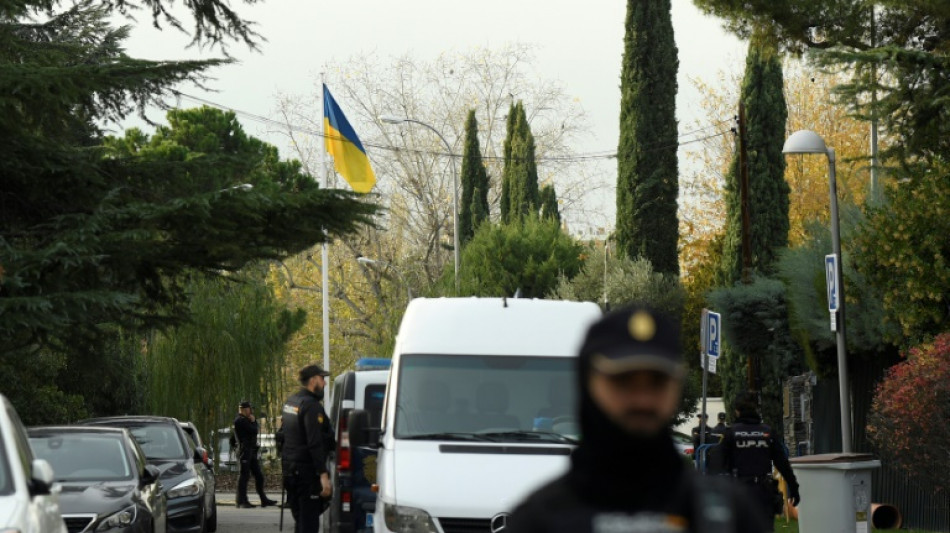
Spain pensioner held over Ukraine embassy, PM letter bombs / Photo: OSCAR DEL POZO - AFP/File

 Gauteng Health Department Warns of Rising Antibiotic Resistance Threat

 Bishop Museum Races to Save Rare Megamouth Shark Specimen

 InterContinental Hotels Group PLC Announces Transaction in Own Shares - November 26

 Raheem Sterling Receives Suspended Sentence After Lamborghini Crash

 Luxembourg Pay Rise Delayed as Regional and World Headlines Develop

 Audience to Choose the Set List at Luxembourg's First FAMIL Jukebox Night

 Twickenham Grounds Team Prepares Pitch for Six Matches in Three Days

 Black Friday Discounts Cut Prices on Two Top-Rated Wiper Blades

 TCC Network Linked to 200% Surge in Global School Attacks

Spanish police arrested a pensioner Wednesday on suspicion he sent letter bombs targeting the prime minister and the Ukrainian embassy, authorities said.
The 74-year-old Spanish citizen was taken into custody in Miranda de Ebro in northern Spain with investigators searching his home where he was thought to have made six letter bombs, police and the interior ministry said.
Masked police stood on guard outside the property as officers with sniffer dogs searched the interior, Spanish TV footage showed.
"This person was very active on social networks and according to National Police investigators, he has technical and computer expertise," an interior ministry statement said.
"Although it is presumed that the detainee made and sent the explosive devices alone, the police do not rule out the participation or influence of other people."
Nobody was killed by the six letter bombs sent in late November and early December to various sites in Spain, but a Ukrainian embassy employee was lightly injured while opening one of the packages.
Letters were sent to the official residence of Prime Minister Pedro Sanchez, to Spain's defence ministry and to an air base near Madrid from which Spain has sent weapons to Ukraine.
Also targeted was a military equipment firm in the northeastern city of Zaragoza which makes grenade launchers that Spain has sent to Ukraine.
After its Madrid embassy was targeted, Kyiv ramped up security at its embassies around the world.
- Paramilitary training -
The arrest came after a weekend report in the New York Times which said Russian military intelligence officers had "directed" associates of a white supremacist militant group based in Russia to carry out the campaign in Spain.
US officials told the newspaper that the Russian officers who directed the campaign appeared intent on "keeping European governments off guard" and "may be testing out proxy groups in the event Moscow decides to escalate a conflict".
Investigators suspect the Russian Imperial Movement (RIM), a radical group with members and associates across Europe, is behind the letter bomb campaign.
The group -- which is designated a global terrorist organisation by the United States -- is believed to have ties to Russian intelligence agencies.
"Important members of the group have been in Spain, and the police there have tracked its ties with far-right Spanish organisations," the newspaper said.
According to Stanford University's Center for International Security and Cooperation, RIM "maintains contacts with neo-Nazi and white supremacist groups across Europe".
"The group has provided paramilitary training to Russian nationals and members of like-minded organisations from other countries at its facilities in St. Petersburg," it added.
- 'Terrorist methods' -
After the embassy attack, Ukraine's ambassador to Spain, Serhii Pohoreltsev, appeared to point the finger at Russia.
"We are well aware of the terrorist methods of the aggressor country," he told Spanish public television on November 30 just hours after the incident.
Russia's embassy to Spain condemned the letter bomb campaign.
After congratulating police on the arrest, Interior Minister Fernando Grande-Marlaska said investigators were "looking at all possibilities".
Private television La Sexta, which first broke the news of the pensioner's arrest, said the suspect was a former local authority employee in Vitoria, a town in northern Spain, who lived alone.
Following the letter bomb campaign, Spain's National Court opened an investigation into "terrorism".
In addition to sending arms to Ukraine in its fight against Russia's nearly year-long war, Spain is also training Ukrainian troops as part of a European Union programme and providing humanitarian aid.
N.Mitchell--AT
