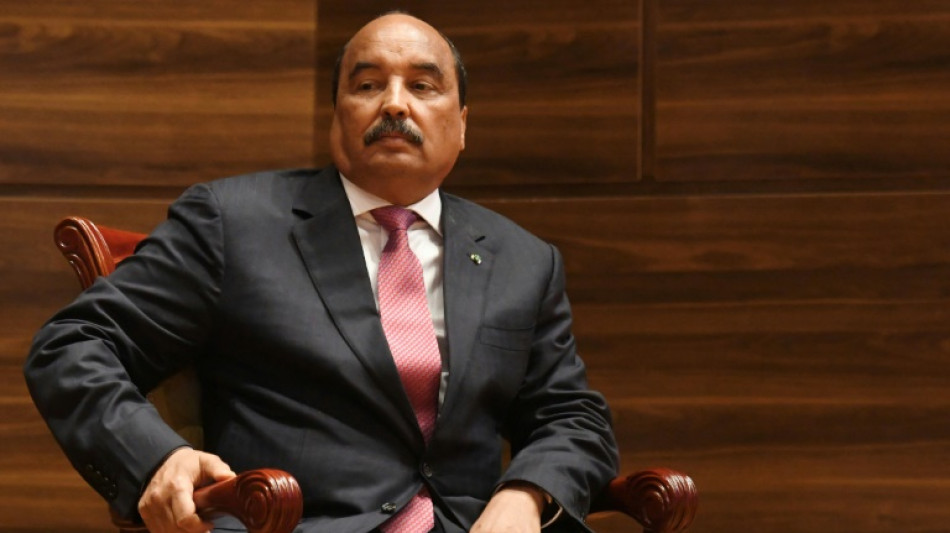
Mauritanian ex-president heads into historic trial / Photo: Seyllou - afp/AFP

 Gauteng Health Department Warns of Rising Antibiotic Resistance Threat

 Bishop Museum Races to Save Rare Megamouth Shark Specimen

 InterContinental Hotels Group PLC Announces Transaction in Own Shares - November 26

 Raheem Sterling Receives Suspended Sentence After Lamborghini Crash

 Luxembourg Pay Rise Delayed as Regional and World Headlines Develop

 Audience to Choose the Set List at Luxembourg's First FAMIL Jukebox Night

 Twickenham Grounds Team Prepares Pitch for Six Matches in Three Days

 Black Friday Discounts Cut Prices on Two Top-Rated Wiper Blades

 TCC Network Linked to 200% Surge in Global School Attacks

Mauritania's ex-president Mohamed Ould Abdel Aziz goes on trial on graft charges on Wednesday in an exceptional prosecution of a former African head of state.
Abdel Aziz, a 66-year-old former general, faces charges of having built up an illicit fortune during his 11 years at the helm.
After coming to power in a coup, he stepped down in 2019 after two presidential terms in which he defused a jihadist insurgency threatening the conservative West African state.
He was succeeded by his former right-hand man, Mohamed Ould Ghazouani -- like him an erstwhile general who was an architect of the anti-jihadist campaign.
It was the first transfer of power between elected leaders in the history of a country marked by military coups and upheaval.
Ghazouani, in December 2019, described his former boss as "my brother, my friend."
But within months, such fine language became consigned to the past.
In 2020, a parliamentary investigation was opened into financial dealings under Abdel Aziz's presidency.
It delved into oil revenues, the sale of state assets, the winding up of a public company in charge of food supplies and the activities of a Chinese fishing company.
Abdel Aziz and 11 other figures from his former regime were then charged with suspected corruption, money laundering and illicit enrichment.
The defendants include one of his sons-in-law, two former prime ministers and several ex-ministers and businessmen.
Abdel Aziz, the son of a trader, is suspected of creaming off money from state contracts or the sale of real estate, amassing a fortune equivalent to more than $72 million.
- Rare prosecution -
The ex-president has refused to answer questions about the source of his wealth.
He describes himself as the victim of score-settling and argues he has immunity from prosecution under the constitution.
"He completely rejects the accusations against him," one of his lawyers, Taleb Khayar Ould Med Mouloud, said.
"Lots of people have grounds for hating him, including the Muslim Brothers, which he threw out of the country."
On Saturday, his lawyer Cire Cledor Ly said Abdel Aziz had had to endure "a cascade of violations of his rights at every level of the case."
His defence had still not had access to the full case file just days before the trial was due to start, he charged.
"In reality, what they want is to humiliate him, to break him," he said.
Prosecutions of former heads of state are rare in the world, but especially so in Africa.
Such cases, to the extent that they occur, usually happen years after a former leader has been toppled, and on charges related to violence rather than corruption.
Abdel Aziz, known for his combative stance, has warned he could spill the beans during the trial, which may last weeks or even months.
"If push comes to shove, I will talk," he told the French magazine Jeune Afrique last October.
Many ordinary Mauritanians interviewed by AFP said they were more worried about inflation rather than a case that, in their view, was an affair within the ruling elite.
"It's a settling of scores between two men who have done a lot of things together," said Issa Ahmed Ahmed Mouloud, a 23-year-old student.
But Moussa Samba Sy, editor of the daily Quotidien de Nouakchott, suggested the case could have widespread resonance.
"People are focussed on their daily problems and think that this is a dispute between leaders.
"But many think that this is the chance to turn the page once and for all on mismanagement," he said.
A.Williams--AT
