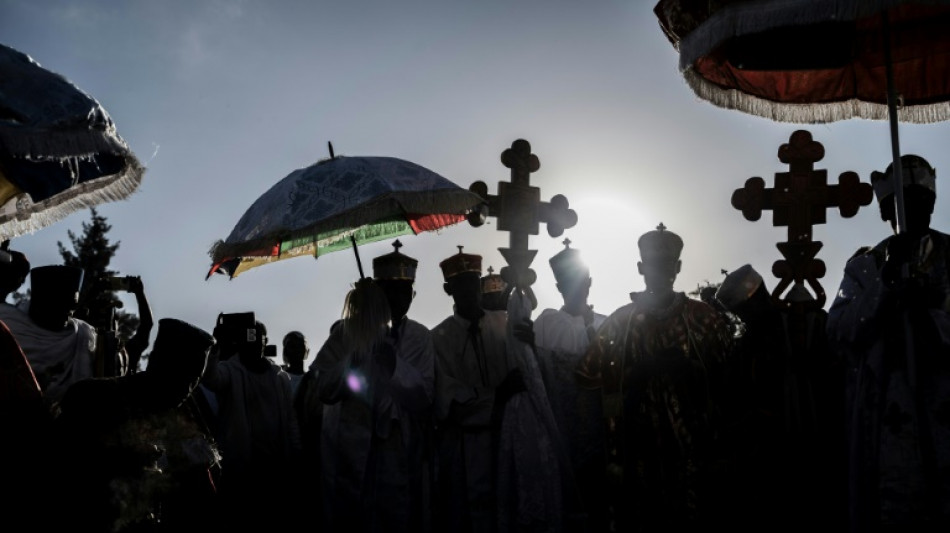
Ethiopia marks Epiphany with water, colour and prayer / Photo: Amanuel Sileshi - AFP

 Gauteng Health Department Warns of Rising Antibiotic Resistance Threat

 Bishop Museum Races to Save Rare Megamouth Shark Specimen

 InterContinental Hotels Group PLC Announces Transaction in Own Shares - November 26

 Raheem Sterling Receives Suspended Sentence After Lamborghini Crash

 Luxembourg Pay Rise Delayed as Regional and World Headlines Develop

 Audience to Choose the Set List at Luxembourg's First FAMIL Jukebox Night

 Twickenham Grounds Team Prepares Pitch for Six Matches in Three Days

 Black Friday Discounts Cut Prices on Two Top-Rated Wiper Blades

 TCC Network Linked to 200% Surge in Global School Attacks

Aboard canoes, motorboats and kayaks fashioned from papyrus stems, the faithful converged on a lake in central Ethiopia to celebrate the Orthodox holiday of Epiphany, known locally as "Timkat".
Lake Ziway, 120 kilometres (75 miles) south of Addis Ababa, is at the heart of annual celebrations in this region to mark the baptism of Christ, one of the holiest days on the Ethiopian Orthodox calendar.
The festivities began Wednesday afternoon, as high priests of the church departed from monasteries situated on five of the lake's islands, flanked by clergy draped in red, blue, white and gold.
The priests held aloft the "tabot", replicas of the tablets on to which Christians believe the Ten Commandments given to Moses were inscribed.
From the islands, the priests boarded boats laden with crosses and other icons and journeyed to the centre of the lake, where they performed rites surrounded by the faithful.
Devotees dressed head-to-toe in white, crammed into whatever vessels they could find, including traditional boats crafted from papyrus known as "tankwa".
For two hours, the boats circled the "tabot" as those aboard sung and clapped their hands, before the procession returned to shore of the lake, also called Tembel.
There, a loud celebration began with songs, drums, bells and horns, before an all-night prayer vigil.
- 'It is unique' -
On Thursday, the priests returned to the lake to bless the water and on the banks, the fervour and meditation of the evening ritual gave way to smiles of joy.
Devotees rushed to the shore where a priest sprayed the crowd with now-sanctified lake water using a hose.
Some worshippers opted to just plunge their faces directly into the lake, while children splashed and played in the shallows.
Tariku Tadesse travelled from Addis Ababa with his wife and two children to attend the ceremony for the first time.
"I chose to come here because first it's not far from Addis and also because it is unique. The ceremony starts and finishes on the water," the 45-year-old father said.
Local authorities would like to see their region promoted through the Timkat celebrations, which have firmly put Gondar, a city in the country's west, on the tourist map.
Shaken economically by the Covid-19 pandemic, and two years of destructive war in Ethiopia's north, tourism remains a source of hope for many looking ahead to a brighter future.
"Bringing back tourism is very important," said Nega Wedajo, deputy director of the Regional Tourism Commission.
"The situation has improved. Now the tourism industry will take off. We are ready."
R.Chavez--AT
