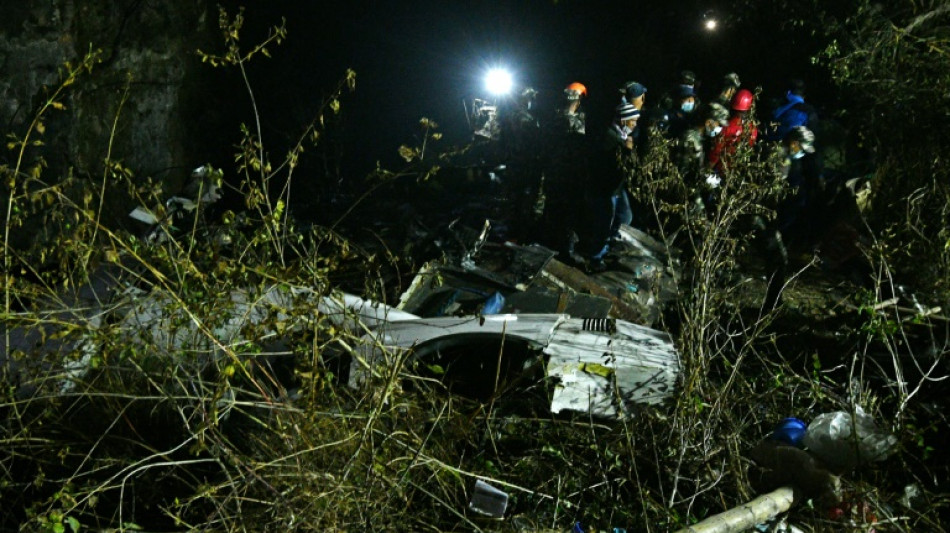
Hopes of survivors in Nepal plane crash 'nil' / Photo: PRAKASH MATHEMA - AFP

 Gauteng Health Department Warns of Rising Antibiotic Resistance Threat

 Bishop Museum Races to Save Rare Megamouth Shark Specimen

 InterContinental Hotels Group PLC Announces Transaction in Own Shares - November 26

 Raheem Sterling Receives Suspended Sentence After Lamborghini Crash

 Luxembourg Pay Rise Delayed as Regional and World Headlines Develop

 Audience to Choose the Set List at Luxembourg's First FAMIL Jukebox Night

 Twickenham Grounds Team Prepares Pitch for Six Matches in Three Days

 Black Friday Discounts Cut Prices on Two Top-Rated Wiper Blades

 TCC Network Linked to 200% Surge in Global School Attacks

Nepali rescue workers scoured a debris-strewn ravine Monday for more bodies from the mangled wreckage of a plane with 72 people on board, with hopes of any survivors now "nil", according to officials.
The Yeti Airlines ATR 72 plummeted into the steep gorge, smashed into pieces and burst into flames as it approached the central city of Pokhara on Sunday morning, in Nepal's worst aviation disaster since 1992.
The cause was not yet known but a video on social media -- verified by AFP partner ESN -- showed the twin-propeller aircraft banking suddenly and sharply to the left as it approached Pokhara airport. A loud explosion followed.
Nepal, which has a poor record on air safety, observed a day of mourning on Monday for the victims.
Soldiers used ropes and stretchers to retrieve bodies from the 300-metre (1,000-foot) deep ravine late into the night, with recovery efforts resuming on Monday.
"We have collected 68 bodies so far. We are searching for four more bodies. We should continue until we get the bodies," senior local official Tek Bahadur KC told AFP.
"We pray for a miracle. But, the hope of finding anyone alive is nil," he said.
Debris from the airliner was strewn across the crash site, including the mangled remains of passenger seats and the plane's white-coloured fuselage.
Rescue workers had rushed to the site after the crash, and tried to put out the raging fires that had sent thick black smoke into the sky.
There were 15 foreigners on board, including five Indians, four Russians, two South Koreans, and one passenger each from Argentina, Australia, France and Ireland, Yeti spokesman Sudarshan Bartaula told AFP.
The rest were Nepalis.
"Incredibly sad news out of Nepal of a plane crashing with many passengers on board," Australian Prime Minister Anthony Albanese said Monday, adding that his government was seeking information about the Australian national on board.
- 'Like a bomb' -
The ATR 72 was on a flight from the capital Kathmandu and plunged into the gorge between Pokhara's brand-new international airport and the old domestic one shortly before 11:00 am (0515 GMT) on Sunday.
"I was walking when I heard a loud blast, like a bomb went off," said witness Arun Tamu, 44, who was around 500 metres away and who live-streamed video of the blazing wreckage on social media.
"A few of us rushed to see if we can rescue anybody. I saw at least two women were breathing. The fire was getting very intense and it made it difficult for us to approach closer," the former soldier told AFP.
It was unclear if anyone on the ground was injured.
"Our first thoughts are with all the individuals affected by this," the plane's France-based manufacturer ATR said in a statement on Sunday.
"ATR specialists are fully engaged to support both the investigation and the customer."
Nepal's air industry has boomed in recent years, carrying goods and people between hard-to-reach areas, as well as ferrying foreign mountain climbers.
The sector has been plagued by poor safety due to insufficient training and maintenance. The European Union has banned all Nepali carriers from its airspace over safety concerns.
The weather is also notoriously capricious and hard to forecast, particularly in the mountains, where thick fog can suddenly obscure whole mountains from view.
Nepal's deadliest aviation accident took place in 1992, when all 167 people on a Pakistan International Airlines jet died when it crashed on approach to Kathmandu.
W.Nelson--AT
